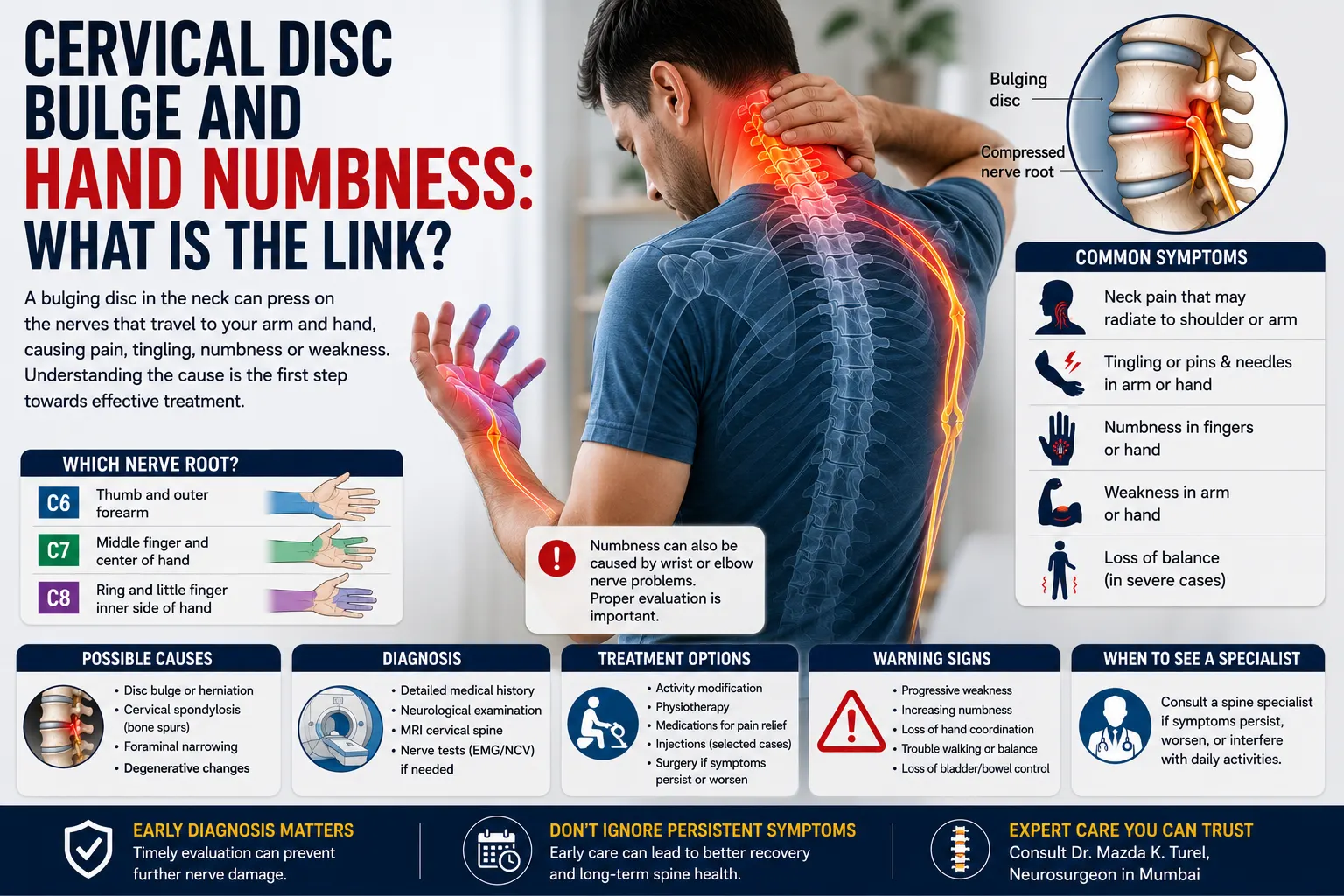
Finding a cervical disc bulge on an MRI can raise an obvious question: could it be responsible for tingling or numbness in the hand? The connection between a cervical disc bulge and hand numbness depends mainly on whether the disc is irritating or compressing a nerve that travels from the neck into the arm and hand.
A disc bulge by itself does not always cause symptoms. Some are found incidentally on scans. If a bulging or herniated cervical disc narrows the space around a nerve root, however, symptoms can include neck pain, arm pain, tingling, reduced sensation and sometimes muscle weakness.
Which fingers feel numb can offer useful clues, but examination is needed because wrist and elbow nerve problems can cause similar sensations.
Can a Cervical Disc Bulge Cause Hand Numbness?
Yes. A cervical disc bulge can cause hand numbness when it irritates or compresses a cervical nerve root that carries sensation between the neck, arm and hand. The exact location of numbness depends partly on which nerve is affected. However, a disc bulge seen on MRI does not automatically prove that it is the cause.
The cervical discs sit between the vertebrae in the neck. They help absorb forces and allow the neck to move.
When part of a disc extends beyond its usual boundary, it may reduce the space available for a nearby nerve. If that nerve becomes irritated, symptoms may be felt farther along its pathway rather than only in the neck.
This is why hand numbness from neck problems can occur even when neck pain itself is mild.
Why Does a Neck Disc Cause Tingling in the Hand?
Cervical nerves leave the spinal cord through small openings called neural foramina and then continue into the shoulder, arm and hand.
These nerves carry:
- Sensory information from the skin
- Signals controlling arm and hand muscles
- Reflex pathways
Cervical disc nerve compression can interfere with these signals. The result may be tingling, pins and needles, burning, reduced sensation or weakness.
AANS notes that cervical nerve compression can cause pain radiating from the neck into the arm as well as numbness or tingling in the shoulder, arm, hand or fingers.
The medical term for symptoms caused by an irritated cervical nerve root is cervical radiculopathy.
Which Fingers Can Become Numb From a Cervical Disc Problem?
The pattern of neck disc hand tingling can help doctors estimate which cervical nerve root may be affected.
A simplified guide is:
Nerve Root | Common Sensory Area | Other Possible Findings |
C6 | Thumb and outer forearm | Weakness with wrist extension or elbow bending |
C7 | Middle finger and part of the back of the forearm | Weakness with elbow straightening |
C8 | Ring/little-finger side of the hand and inner forearm | Grip or finger-flexion weakness |
For example, a C5-C6 disc problem may affect the C6 nerve root, while a C6-C7 problem may affect C7.
These patterns are useful but are not perfectly reliable. Real symptoms can overlap neighbouring nerve territories. Doctors therefore combine the distribution of numbness with muscle testing and reflex examination.
What Other Cervical Disc Symptoms Can Occur?
Hand numbness may occur on its own, but cervical nerve irritation commonly produces several symptoms together.
Possible cervical disc symptoms include:
- Neck pain
- Pain between the shoulder blades
- Pain travelling into the shoulder or arm
- Burning or electric-like arm pain
- Tingling in the hand or fingers
- Reduced sensation
- Grip weakness
- Weakness when lifting or pushing
- Symptoms that worsen with certain neck positions
Mayo Clinic notes that cervical disc herniation can cause pain, numbness or weakness in the neck, shoulders, arms or hands.
Some people experience significant arm or hand symptoms with very little neck pain.
Is Hand Numbness Always Coming From the Neck?
No. This is an important distinction.
Hand numbness can arise from several locations along the nerve pathway.
Carpal Tunnel Syndrome
Carpal tunnel syndrome involves compression of the median nerve at the wrist.
It commonly causes tingling or numbness affecting the:
- Thumb
- Index finger
- Middle finger
- Part of the ring finger
It may be particularly troublesome at night.
Cubital Tunnel Syndrome
The ulnar nerve can become compressed around the elbow. This often affects:
- Little finger
- Ulnar side of the ring finger
- Grip in more advanced cases
Other Possible Causes
Hand numbness can also occur with:
- Peripheral neuropathy
- Diabetes-related nerve problems
- Other peripheral nerve injuries
- Cervical spinal cord compression
- Less commonly, neurological conditions involving the brain or spinal cord
AAFP notes that electrodiagnostic testing can be useful when doctors need to distinguish cervical radiculopathy from peripheral nerve conditions such as carpal or cubital tunnel syndrome.
So, an MRI report showing a cervical disc bulge should not automatically be assumed to explain every episode of finger tingling.
How Do Doctors Find Out Whether the Numbness Is Coming From the Neck?
The diagnosis starts with the symptom pattern and neurological examination.
A doctor may ask:
- Which fingers are numb?
- Is only one hand affected?
- Does pain begin in the neck or shoulder?
- Does it travel down the arm?
- Do neck movements trigger the symptoms?
- Is the hand becoming weaker?
- Are you dropping objects?
- Does numbness mainly occur at night?
- Are there any balance or walking problems?
Strength Testing
Different cervical nerves control different muscles.
The doctor may test:
- Shoulder movement
- Elbow bending and straightening
- Wrist movement
- Grip
- Finger movement
Weakness in a particular group of muscles can help identify an affected nerve root.
Reflexes
Biceps, brachioradialis and triceps reflexes may be assessed.
A reduced reflex can provide another clue about which cervical nerve may be affected.
Sensation
The clinician may compare sensation across the thumb, fingers, hand and forearm to determine whether the pattern resembles a cervical nerve root or a peripheral nerve.
When Is a Cervical MRI Needed?
An MRI, or magnetic resonance imaging scan, produces detailed images of the cervical discs, nerve roots and spinal cord.
It can identify:
- Disc bulging or herniation
- Foraminal narrowing
- Nerve-root compression
- Cervical spinal stenosis
- Spinal cord compression
- Other structural abnormalities
Imaging is particularly useful when symptoms persist, significant weakness develops or examination raises concern about spinal cord involvement. AAFP notes that routine imaging is not necessary for every new episode of cervical radiculopathy, but it becomes more relevant when symptoms persist or red flags are present.
An MRI finding still needs clinical interpretation. A disc abnormality at one level may not be responsible if the patient’s numbness follows a completely different nerve pattern.
When Are EMG and Nerve-Conduction Tests Useful?
An EMG, or electromyography test, measures electrical activity in muscles. Nerve-conduction studies evaluate how signals travel through peripheral nerves.
These tests are not required for every person with cervical radiculopathy.
They may be particularly useful when doctors are trying to distinguish between:
- Cervical nerve-root compression
- Carpal tunnel syndrome
- Ulnar nerve compression
- Other peripheral nerve disorders
AAFP specifically notes that electrodiagnostic testing can help when peripheral neuropathy is a plausible alternative diagnosis.
How Is Cervical Disc-Related Hand Numbness Treated?
Treatment depends on whether the symptoms come from a compressed nerve, how much neurological function is affected and what the imaging shows.
Many cervical disc problems can initially be treated without surgery.
Activity Modification
Activities that repeatedly trigger radiating arm pain or increasing numbness may need temporary modification.
This may include:
- Heavy overhead lifting
- Repeated forceful neck movements
- Long periods in an uncomfortable computer posture
- Exercises that clearly worsen arm symptoms
Complete long-term neck immobilisation is usually not the goal.
Medication
Appropriate pain-relieving or anti-inflammatory medication may help manage symptoms in selected patients.
Medication choice depends on medical history, other medicines and the nature of the pain.
Physiotherapy
Physiotherapy may focus on:
- Neck mobility
- Posture
- Shoulder and upper-back strength
- Cervical muscle control
- Gradual return to normal activities
Patients wanting a broader overview can also review guidance on cervical pain care and treatment while seeking individual evaluation for neurological symptoms.
Cervical Injections
In selected cases of persistent nerve-related arm pain, a targeted injection may sometimes be considered.
An injection is intended to reduce inflammation around the affected nerve. It does not permanently correct disc degeneration.
Does Hand Numbness Mean Surgery Is Needed?
No. Hand numbness from a cervical disc problem does not automatically require surgery. Many patients can initially be managed conservatively. Surgery becomes more relevant when weakness progresses, neurological function deteriorates, disabling symptoms continue despite appropriate treatment, or the spinal cord is significantly compressed.
Possible reasons for surgical assessment include:
- Progressive arm or hand weakness
- Persistent disabling radiating pain
- Increasing sensory loss
- Significant nerve compression matching the symptoms
- Loss of hand function
- Evidence of cervical myelopathy
The exact surgical approach, if required, depends on the level and type of compression, spinal alignment, symptoms, age, overall health and other individual factors.
When Hand Numbness May Indicate Spinal Cord Compression
Most isolated cervical radiculopathy affects one nerve root. A different pattern can occur when the spinal cord is compressed.
This is called cervical myelopathy.
Warning features include:
- Increasing hand clumsiness
- Frequently dropping objects
- Difficulty buttoning clothes
- Changes in handwriting
- Numbness affecting both hands
- Balance problems
- Unsteady walking
- Leg stiffness or weakness
AANS lists loss of hand coordination, dropping objects and unsteady gait among symptoms that can occur with significant cervical spinal cord problems.
These findings deserve closer specialist assessment rather than being treated as routine hand tingling.
Which Symptoms Need Faster Medical Attention?
Arrange prompt medical evaluation if you develop:
- New or worsening hand weakness
- Increasing numbness
- Loss of grip strength
- Persistent radiating arm pain
- Repeated dropping of objects
- Difficulty using the fingers normally
More urgent assessment is appropriate for:
- Rapidly progressive weakness
- New balance or walking difficulty
- Weakness affecting the legs
- Significant symptoms involving both hands and legs
- New loss of bladder or bowel control
- Severe neurological symptoms after neck trauma
AANS advises specialist evaluation for progression of arm or leg weakness or numbness and for neck symptoms associated with coordination or walking problems.
When Should You Consult a Neurosurgeon?
A neurosurgical consultation may be useful when hand numbness is persistent, accompanied by measurable weakness, or linked to significant cervical nerve or spinal cord compression on MRI.
Seeing a neurosurgeon does not mean that surgery has already been decided.
A neurosurgeon such as Dr. Mazda K. Turel can compare the exact distribution of numbness with muscle strength, reflexes and cervical imaging. This helps determine whether symptoms are coming from a cervical nerve root, whether further testing such as EMG may help, and whether conservative or surgical treatment is appropriate.
Conclusion
The connection between a cervical disc bulge and hand numbness depends on whether the disc is actually compressing or irritating a nerve that supplies sensation to the arm and fingers. Thumb, middle-finger or little-finger numbness may provide useful clues about the affected cervical nerve, but these patterns are not enough to make a diagnosis.
Carpal tunnel syndrome, ulnar nerve compression and other neurological conditions can produce similar symptoms. A clinical examination, cervical MRI when appropriate, and occasionally EMG or nerve-conduction testing can help identify the source.
Persistent numbness or new weakness deserves medical evaluation. Increasing hand clumsiness, balance changes, leg symptoms or rapidly progressive weakness need closer specialist assessment because they may indicate spinal cord involvement rather than an isolated cervical nerve problem.
Frequently Asked Questions
1. Can a cervical disc bulge cause numb fingers without neck pain?
Yes. Cervical disc bulge hand numbness can occur even when neck pain is mild or absent. A cervical nerve root may be compressed enough to alter sensation in the arm or fingers without producing strong neck pain. The distribution of numbness, strength testing and imaging help determine whether the cervical spine is actually responsible.
2. Which cervical disc causes numbness in the thumb?
The C6 nerve root commonly supplies sensation toward the thumb and outer forearm. Compression around the C5-C6 level can therefore produce thumb-side tingling or numbness in some patients. Symptoms can overlap, so thumb numbness alone cannot confirm a C6 problem. Carpal tunnel syndrome can produce a similar complaint.
3. Which cervical nerve can cause middle-finger numbness?
The C7 nerve root is commonly associated with sensation involving the middle finger and part of the back of the forearm. A C6-C7 disc problem can sometimes compress this nerve. Doctors also look for related changes in triceps strength and reflexes when assessing a possible C7 radiculopathy.
4. Can a neck problem cause numbness in the little finger?
Yes. C8 nerve-root irritation can cause altered sensation toward the little-finger and ring-finger side of the hand. However, ulnar nerve compression around the elbow can cause a very similar pattern. Clinical examination and sometimes EMG or nerve-conduction testing can help distinguish between them.
5. How do I know if hand numbness is from my neck or carpal tunnel?
Cervical nerve compression may be associated with neck or shoulder pain, symptoms travelling down the arm, altered reflexes or weakness in muscles above the wrist. Carpal tunnel typically affects the median nerve distribution in the hand. Because symptoms can overlap, examination—and sometimes nerve testing—is more reliable than trying to diagnose the cause from finger location alone.
6. Can cervical disc-related hand numbness improve without surgery?
Yes. Many patients with cervical radiculopathy can initially be managed without an operation, particularly when strength remains stable and symptoms are improving. Treatment may include activity modification, appropriate medication and physiotherapy. Progressive weakness, persistent significant sensory loss or spinal cord compression makes specialist evaluation more important.
7. Is dropping objects a warning sign?
It can be. Dropping objects may result from weakness caused by a single compressed nerve root, but repeated loss of hand dexterity—especially when both hands are affected or balance and walking are changing—can indicate cervical myelopathy involving the spinal cord. These symptoms deserve medical assessment rather than being assumed to be ordinary hand numbness.