

If the brain is the big fat joint family and the lobes are the siblings arguing over property,
the medulla is the night-shift security guard protecting the territory. Unseen, underpaid, deeply unappreciated, but if it falls asleep, everyone dies. Unlike the cortex, which thinks, or the pons, which connects, the medulla governs survival in its purest form.
The medulla is small but savage. It does not care about your personality, your memories, or your Spotify playlists. It regulates breathing, heart rate, swallowing, blood pressure, coughing, gagging, and the rather important business of keeping you alive even when you are not paying attention. It is the part of the brain that works even when you do not – which is why operating here feels less like surgery and more like negotiating with fate.
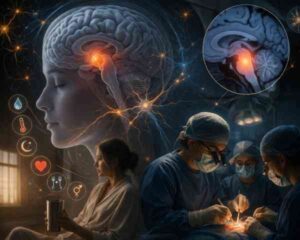
She was in her early forties – soft-spoken, sharp-eyed, and far braver than she looked. Her symptoms were subtle at first. Occasional imbalance. A strange heaviness in the limbs. Her voice occasionally softened as if she were tired of arguing with air. The scans revealed a hemangioblastoma (a tumour of entangled blood vessels) sitting inside the medulla, glowing like a forbidden ember. Benign, yes. But in this location, benign is a polite lie.
Hemangioblastomas are vascular tumours. Think of them as over-enthusiastic plumbing projects. They bleed easily, shimmer angrily on scans, and do not appreciate being disturbed. In the medulla, they are less like tumours and more like grenades ready to blow up.
The operation felt like standing at the edge of a cliff in strong wind. Every millimetre mattered. Every movement was deliberate. We had to go around the tumour, disconnecting every feeding vessel amidst a landmine. This is where intraoperative neuromonitoring becomes not just technology but reassurance. We monitored motor pathways, sensory pathways, cranial nerves, breathing-related signals, heart rate responses. Every wire attached to her body was connected to a computer.
The tumour came out after 8 hours. A glowing red ball of fire extracted from the brainstem, coaxed out rather than conquered. When it was finally out, there was relief, followed immediately by fear. The medulla does not like swelling. It responds to irritation by sulking. And when it sulks, breathing forgets how to breathe. Postoperatively, she did exactly what we feared and expected. She did not breathe on her own.
She stayed on the ventilator. One day became two. Two became twenty. Each morning, rounds felt like waiting for a verdict. Her scans showed swelling, not damage – which is medicine’s way of saying… maybe. She was awake and able to move her limbs; she just couldn’t breathe when she fell asleep.
This is where Ondine entered the room. Ondine’s curse comes from mythology. A nymph curses her unfaithful lover so that he must remember to breathe. If he falls asleep, he dies. In medicine, Ondine’s curse refers to central hypoventilation. The medulla forgets the automatic rhythm of breathing. Patients breathe when awake, but sleep becomes dangerous. She could breathe a little during the day but quickly fatigued as night arrived.
Every neurosurgeon fears it. Every intensivist watches for it. Every family lives through it in slow motion.
And then, one month later, the medulla remembered. She started with some breaths at night. Then a few more. Weak at first, uncertain, like someone relearning a forgotten language. The ventilator settings were reduced. Then reduced again. Six weeks later, she breathed entirely on her own. No drama. No announcement. Just quiet persistence. The medulla does not celebrate. It simply resumes duty.
Six months later, she had recovered entirely. Her voice strengthened. Her balance improved. Life crept back in small, unremarkable victories. Walking. Laughing. Breathing without thinking about it.
Surgeons love big moments: tumour out, bleeding controlled, wound closed. But the real triumph here was invisible. A structure smaller than a thumb deciding not to hold a grudge.
Because the truth is, the medulla never asks for applause. It works while you sleep, while you dream, while you forget yourself entirely. And when it falters, it reminds you just how fragile independence really is.
As for Ondine, she did not get her revenge this time. Which is fortunate, because remembering to breathe consciously is exhausting. I tried it for thirty seconds.
Then I went for an Art of Living course.

30 thoughts on “The brainstem part 3: The Medulla Oblongata”
I’m in awe of your writing skills. And obviously a very good neurosurgeon. I can make that out, without validation form my colleagues in Mumbai.
Please continue to enthrall us with more such articles!
Superb skills indeed Doctor! You are brilliant!!
Art of living!!!
Let the brain do our work constantly even while we are sleeping.
Dearest Dr Mazda sir 🌹
Absolute wonderful piece explaining the unsung hero Medulla…….
Although not talked about enough but extremely important and needed….
Your words and thoughts are so well written that very easy Apparently it is for common man, for neurosurgeon can feel the pain and suffering of each patient as if it is your own pain and until successfully out of ICU and hospital you can not breathe peacefully 🌹
Please continue your journey of enlightenment with your words and Hands and Brain in OT 🌹🌹
Brilliant as usual. It was like watching a tense movie…
I always wondered about the difference between voluntary, involuntary and semi voluntary muscles.
What an experience! Just reminded me life is so fragile yet strong. You are fantastic as a surgeon as well as a writer!
Thank you.
This is a nostalgic word since it is the first part of the brain we studied in the primary school science and used to say the other boys by keeping the hand behind their heads that- Hey, you will realise once you get a hit on your Medulla Oblongata. Thank you for another new piece of knowledge.
I wait eagerly for your articles doctor. I don’t know how else to put it, your writings are absolutely amazing. You make our brains and the condition of your patients come alive with your pen (err…keybaord!). I could almost feel your fear and her pain. Goosebumps.
Doc. i am sure you start n end your day with prayers.
Look forward to your articles.
What a wonderful writing Dr Mazda Sir,
So nicely explained about the Unsung Hero the Medulla Oblangota,
Keep doing the great work,
God bless you always
Brilliant as always. Thank you Dr Mazda.
It’s frightening to read and feel the tension of recovery time taken after the operation, you need a strong heart to go through it all for the surgeon and the patient.
Ahura Mazda bless you.
Doctor ,
a critical subject which is beyond our reach of understanding,
but your writing skill, your perception made us read the article like we are reading any thriller
Another masterclass, Mazda.
You’ve somehow made the medulla – a quiet, unsung night-shift guardian of life feel both awe inspiring and deeply human.
The way it slowly “remembered” to breathe was beautiful, and a gentle reminder that some of the most important things in life happen without noise or applause.
And of course, only you could end a story with an Art of Living punchline 🙃
Brilliant as ever….im falling short of words to explain how beautifully you have explained this part of the brain too.you are fabulous, Dr….how I wish to read similar on the other organs of our body too….:-)
Great Dr.. Experience while reading was like reading an horror story…
Wow!!! Another brilliant piece ♥️
The medulla sounds like a soft-by-nature-yet-strong-by-character mother fulfilling her housewifey roles silently without any appreciation and one day when the proverbial last straw falls, she makes you realise that you’ve taken her for granted all these years and it is impossible to survive without her 😌
You are an awesome human being and a brilliant doctor. Whenever I read your case study, I get goosebumps and I would pray for you and your patients. It makes me feel as if I can actually perceive the whole procedure. You are absolutely amazing doc!!
You write remarkably well!! Loved reading your blog.
‘The Ondine’s curse’ is a fascinating myth – which comes true!
Enjoyed my late read and your style of writing. The perfect Sunday dessert‼️
Thank you Doc
Amazing write up Dr.👏👏
Dear Dr Mazda,
Your writing cut like a scythe today!
Medulla’s graciousness overcame Ondine’s curse
Dear doctor, medulla’s importance all of us lay people know.But it’s behavior as u have described like the ondine. ‘s curse was surprisingly new.I am so happy that ur patient survived and recovered fully.U being her surgeon was not a surprise. Thank u .lots of love and blessings.
Waah!! Absolute mastery of the crafts..surgery and writing skills!
Every article you write so beautifully
Wow doc u r beyond words… A dr blessed with healing hands not only as a surgeon… But such vividly expressive writing skills..
Also a very humble orator… God bless you…
It is the part of the brain that works even when you do not – which is why operating here feels less like surgery and more like negotiating with fate.. The line speaks all. Appreciate the writing sir😍
I can’t express my gratitude enough to Dr Zuma for making me a living testimony. i have battled with HERPES SIMPLEX VIRUS 2 for about 6years now, and i have done all i can to make sure i am cured but nothing worked out, but miraculously my friend invited me to see a video on his Blog and as i visited i decided to see few of the comment below, and i found some people talking about Dr Zuma, and i decided to contact this great herbal healer to also help me, so i wrote to him, and he replied me back and assure me that i will get a cure for my HERPES SIMPLEX VIRUS 2. After preparing my medicine he sent it to me and when I started using it for 3weeks i was completely cured, I am a living testimony and assure anyone with the same illness that you can also be cured if you also contact this great man on his Email. spiritualherbalisthealing@gmail.com
HOW I RECOVERED MY LOST CRYPTOS FROM FAKE BROKER ONLINE.
I had lost over $152,000 by someone I met online on a fake investment project. After the loss, I had a long research on how to recover the lost funds. I came across a lot of Testimonies about, GEO COORDINATES HACKER. I contacted them providing the necessary information and it took the experts about 27hours to locate and help recover my stolen money. To anyone looking for a Recovery firm to Recover your lost Crypto. You can contact GEO COORDINATES HACKER. I hope this helps as many out there who are victims and have lost to these fake online investment scammers. You can contact GEO COORDINATES HACKER. By using
Email; (geovcoordinateshacker@gmail.com
Website; https://geovcoordinateshac.wixsite.com/geo-coordinates-hack