
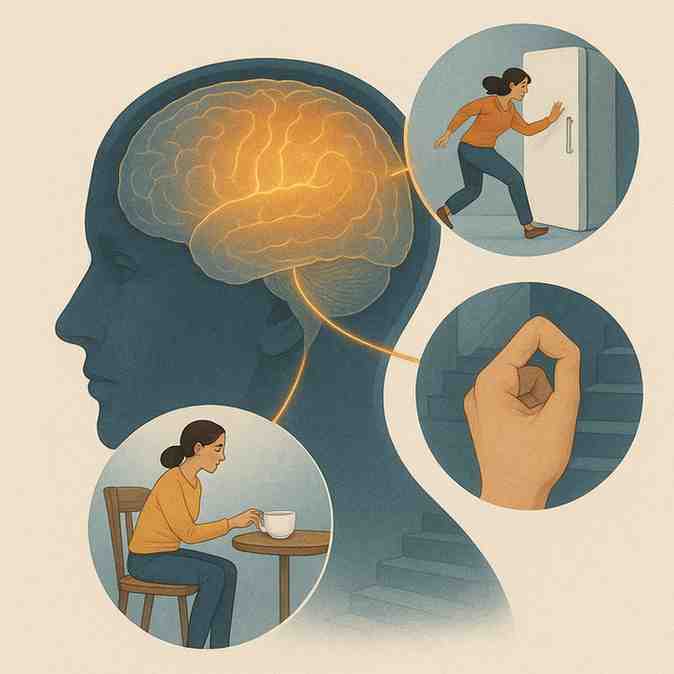
If the frontal lobe is where we decide what to do, the parietal lobe is where we understand where we are. It is the brain’s internal GPS, the quiet navigator that lets you put your hand exactly where your teacup is, find the edge of a staircase without staring at it, or scratch the correct side of your head when it itches. When it works well, we move through life gracefully. When it falters, life becomes slapstick comedy.
A few months ago, I saw a school teacher named Leena who walked into my clinic with a baffled expression and bandaged knee. Her husband followed behind her like a man who had witnessed something he could not unsee. “Doctor,” she announced, “I think something in my brain has gone on vacation.”
She had, quite literally, lost her sense of direction. She bumped into walls. She misjudged distances. She reached for her phone and grabbed the remote. At one point, she tried to place a glass of water on a table but set it gently onto thin air instead. It did not end well. Her husband added, “She walked into the fridge yesterday. Fully. Opened the door and walked straight in.” Leena glared at him. “It was white and rectangular and in the general direction of where I was going,” she retorted.
On examination, it was clear she had a deficit in spatial awareness. When I asked her to point to her left hand, she pointed to her right ear. When I asked her to place her finger on the tip of her nose, she almost poked her eye. She was cheerful about it and, in that way, uniquely Indian: she had already blamed her behaviour on stress, the weather, and her neighbour’s evil eye.
Her MRI revealed a small stroke in the right parietal lobe, the region responsible for constructing the map of our surroundings and the map of our own bodies. It is this area that tells you where your feet are in relation to the floor, where your torso ends and the sofa begins, and how far away your spouse’s elbow is during an argument.
In more severe injuries, the parietal lobe can produce something called Gerstmann syndrome, named after Josef Gerstmann – a Viennese neurologist who described it almost a century ago. Patients with this condition confuse right and left, struggle with calculations, mix up letters, and cannot recognise their own fingers. It is as if the brain suddenly forgets the body is attached to it. As one of my professors once said, the parietal lobe is the part of the brain that knows where all your furniture is, including the furniture you carry around.
Leena did not have the full syndrome, but she had a very entertaining partial version. During one test, I asked her to draw a simple clock. She placed all the numbers on one side, creating a timepiece that looked as if it had been emotionally traumatised by Salvador Dali. “This is abstract art,” she said proudly. “Do not judge.”
The parietal lobe is also deeply involved in proprioception, the silent sense that tells us where our limbs are without needing to look. When a surgeon operates on the brain, especially near this lobe, we navigate with extreme caution. A millimetre of insult can leave a person unable to find their own feet.
Fortunately, Leena’s stroke was small. With physiotherapy, occupational exercises, and a great deal of laughter, she began to regain her bearings. Six weeks later, she returned to the clinic. “Doctor,” she said triumphantly, “I have not walked into a single appliance this week.” Her husband nodded, relieved. “We are keeping count,” he whispered.
The parietal lobe reminds us that reality is not just what we see. It is what the brain constructs from millions of cues, distances, angles, and sensations. When the construction falters, life becomes tilted. When it recovers, everything snaps back into place. Before leaving, Leena told me, “I still mix up right and left sometimes.” I reassured her that so did half the people who drive in Mumbai.
The next time you effortlessly find your keys, locate your car, or sit successfully on a chair that is, in fact, actually placed behind you, pause for a moment and thank your parietal lobe. And if you walk straight into a fridge one day, do not panic. It may not be stupidity; it may just be geography.

44 thoughts on “The Parietal Lobe”
Superb explanation.as a layman I too can understand.thank you.
Very nice write up
I salute your knowledge & the ability to write in such a readable manner. Use of superb metaphors, examples, and humour! Wow, your brain is a bundle of talented neurons indeed! Such a pleasure to read & understand this fascinating organ!
Enjoyed.
Thank you for another wonderful Sunday read
As always very interesting. You are doing great job.
Wonderful write up.. 👍
Loved the reference to Salvador Dali…..realised just how much of a voracious reader you must be!
Brilliant as usual Dr! Loved it!
It’s amazing how blessed we are when we can go about our life without assistance… rest is just frills
Another beautiful piece of writing…simplified….Thank God to my Parietal lobe and the judgement I could make out with my spouses elbow…Hahaha
With every article I feel more connected to my brain, getting to know it inside out, understanding its strength and fragility, how it holds it all together and the mischief it can play when in the mood… I am literally head over heels falling in love with it. Thank you Doc for playing Cupid!
Such a complex part of our body and you understand every part of it, Doctor.
Wonderful writing and explaining ofparietal lobe.we generally think brain to b one organ taking care of everything together.Thank u for ur information of ur lay readers.God bless.
Happy Sunday Mazda.
If there’s one thing that brings smiles to my face and a sense of joy, not to mention enlightenment, it’s the articles you craft so beautifully!
This one about the parietal lobe is yet another unique mix of knowledge, wit, humour and entertainment!
Bless you for adding joy to my Sunday mornings Doctor!
Dearest Dr Mazda sir ……..
So so informative & useful explanation on function of the brain in lay man Language……
You dear Dr have superb writing skill & I salute you for the same ….
I can now correlate better bcos of mini stroke occurred to my 88 years old mom & you have hand the same professionally so well for which I am grateful to you from the bottom of my heart sir ……
GOD BLESS YOU WITH ALL YOUR DREAMS SIR 🌹
Wow! What an article. Thank you Doctor.
As always, wonderful article! What I find especially compelling is how you go beyond clinical facts to touch on the deeper human truths behind them.
Thanks for a great read.
Nicely explained Dr. 👌👍
It is with a humble heart that I would pay homage to my brain ,for letting me live such a wonderful healthy life.
Thank you,Doc ,for a very easy explanation!!
Thank you Dr Mazda for the GPS article to understand our own GPS in the body functioning.
Another beautiful piece, Mazda. What I’ve loved most over time is how you’ve quietly taken us on a journey through the brain, layer by layer, story by story.
Many of us began thinking of it as one mysterious organ, and now we feel familiar with its many parts: the cortex where identity forms, the pia and arachnoid that protect it, the white matter that connects it all, and now the parietal lobe that helps us find our place in the world.
Each essay feels less like a lesson and more like a conversation. One that leaves us a little wiser, a little humbler, and deeply grateful for the complex yet fragile miracle inside our heads.
You don’t just explain the brain, my friend; you make us feel more human for having read you 🙏🏻
All said and done one more fright you have given me Dr Mazda but please put the remedy or your perfect solution for it please.
It’s frightened me definitely.
Another Sunday and new story. I really wait for your posts and read it along with my morning newspaper to begin the day with. Keep amazing us ☺️
As usual Amazing Write up,
Your articles increases my knowledge about Brain and the Nervous system.
Amazing write up,
Your articles increases our knowledge about Brain and the Nervous system.
Brilliant as always Dr
Pl continue to enlighten your fans with simple articles that we can comprehend how our brains work
God bless you for what you so
Dr. Turel, another marvellous article on the organ we know the least about, the brain.
I practice in Cardiology and know a little about the preservation of circulation to the brain and it’s importance, but nothing really about it’s function.
Thank you for the article.
Dear Dr Mazda,
Well explained and I learnt something new. With your each write up i improve my knowledge.
Please continue your good work for our betterment.
Thankyou.
Thank you Dr for the amazing write up.
An eye opener for me.
I knew the ears affect balance – but this was news!
Thank you for it.
Thank you very much , Professor Mazda . A goof write up.
Thank you for unlocking yet another treasure room in our brain Dr Mazda!
I really enjoy reading ur articles and its more fun as it is in layman language with grt examples of pple suffering and being cured of it
Its always interesting to read ur articles Dr in layman language and tht with example of real people going thru it and being cured of it with humorous approach
Dr Turel, it’s pure joy to read your writing. You manage to convey complex neurological issues in such simple language with a dash of humour. Its hilarious yet so informative. Surely your frontal lobe seems to be an amazing piece of hardware. Hats off to you sir! And please keep writing.
Love your articles! Always filled with humour and deft navigation of metaphors!
The write up is really sensetizing, educational and humorous at the same time.
Very interesting knowledge. Thanks for sharing!
Once again another article so beautifully written….this reminds us how intricately our brains have been constructed and likewise every other organs….these things have become so easy to relate too only if its you explaining them…thanks Dr…👍👌👌
I can’t express my gratitude enough to Dr Zuma for making me a living testimony. i have battled with HERPES SIMPLEX VIRUS 2 for about 6years now, and i have done all i can to make sure i am cured but nothing worked out, but miraculously my friend invited me to see a video on his Blog and as i visited i decided to see few of the comment below, and i found some people talking about Dr Zuma, and i decided to contact this great herbal healer to also help me, so i wrote to him, and he replied me back and assure me that i will get a cure for my HERPES SIMPLEX VIRUS 2. After preparing my medicine he sent it to me and when I started using it for 3weeks i was completely cured, I am a living testimony and assure anyone with the same illness that you can also be cured if you also contact this great man on his Email. spiritualherbalisthealing@gmail.com
HIRE A HACKER YOUR STOLEN CRYPTO RECOVERY / BTC / USDT / ETH WITH THE HELP OF CAPITAL CRYPTO RECOVER.
I want to share my experience publicly regarding cryptocurrency wallet recovery, I highly recommend you to contact CAPITAL CRYPTO RECOVER, a professional private investigator in the Bitcoin world. They have a certified expert security team specializing in Bitcoin Recovery Services and have helped many people worldwide recover their lost funds. My wife and I were defrauded by an online manipulator posing as an experienced crypto investment professional. We lost $9.2 Million Stolen BTC in cryptocurrency and were left feeling homeless. After spending hours searching for a reliable crypto recovery service, I discovered CAPITAL CRYPTO RECOVER online. By patiently explaining my situation to their team, I was able to recover all my funds. Remarkably, my money was returned to my wallet in less than 24 hours. I am extremely grateful to CAPITAL CRYPTO RECOVER for their excellent assistance—they truly were a godsend in my difficult situation. If you have fallen victim to a cryptocurrency scam, you can reach CAPITAL CRYPTO RECOVER through the following channels Email: Recoverycapital @ fastservice. com OR Call/WhatsApp: +1 (336) 390-6684 Contact: Capitalcryptorecover @ zohomail. com
DR UYI has done it for me, His predictions are 100% correct, He is real and can perform miracles with his spell. I am overwhelmed because I just won 336,000, 000 million Euro from a lottery jackpot game with the lottery number DR UYI gave me. I contacted DR UYI for help to win a lottery via Facebook Page DR UYI, he told me that a spell was required to be casted so that he can predict my winning, I provided his requirements for casting the spell and after casting the spell he gave the lottery numbers, I played and won 336,000,00 euros. How can I thank this man enough? His spell is real and like a God on Earth. Thank you for changing my life with your lottery winning numbers. Do you need help to win a lottery too? contact Dr UYI via drzukalottospelltemple@gmail.com OR WhatsApp on +17174154115
Wow what a good God I am so excited to tell you all how I become a millionaire I’m a woman of faith I was reading a comment on google where I meet a man sharing how Dr UYI cast a spell for him and he get his wife back after the spell I was interested I have to do research when I was doing the research I got so many testimony about this same man call Dr UYI how he help people to win lottery how he help people to get there ex back how he help people to do so many things I was happy and I contact him to help me win the lottery when I contact him and he told me what to do and after I did what he ask me to do he den gave me a lottery number to play and told me to go and buy ticket after playing the game I was so surprise the game come out good and I won the sum of 90, 000,000 dollars i was amazed and promise to share it to the people around me if anyone is willing to play the mage lottery it should contact Dr UYI so he can give you the right number to play thanks to you Dr UYI I’m so so grateful contact Dr UYI via drzukalottospelltemple@gmail.com OR WhatsApp on +17174154115