
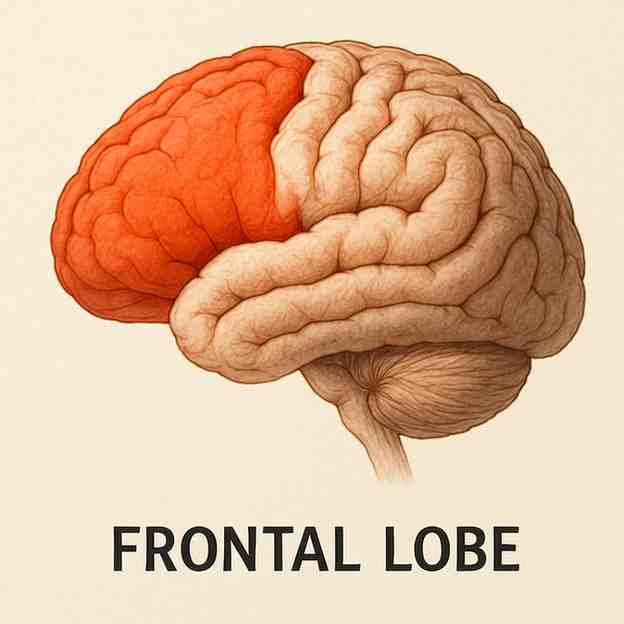
The frontal lobe is the part of the brain that makes us human. It is the seat of reason, planning, judgement, impulse control, and the quiet voice that stops us from doing the foolish things we very much want to do. It is, in essence, the brain’s civilising department – the one that tells you not to send that angry text, not to eat the fourth gulab jamun (or, in my case, the tenth), and not to tell your boss what you really think of him.
A few months ago, in walked Mr. Mehta, a 58-year-old Gujarati businessman with a paunch that entered the room one second before he did and a smile that tried to apologise for it. He arrived with his wife, Kusum, a tiny woman with sharp eyes and sharper commentary, the sort who noticed that the framed certificates on my wall were two millimetres off-centre.
“Doctor,” she said before he could sit down, “my husband has become… how to say… unfiltered.” Ashok nodded meekly. Lately, he had started saying things that should never be said out loud. At dinner parties, he announced who had gained weight. At family gatherings, he commented on who had lost hair. At a funeral, he once asked the wife of the deceased why she was dressed in a simple white saree.
“I don’t know why I say these things,” he told me. “They just escape my mouth!” Kusum folded her arms. “Doctor, he has become Google with no privacy settings.” The MRI showed a tumour sitting squarely on his left frontal lobe – the area responsible for tact, judgement, and inhibition. Medically, this explained everything. Socially, it had already caused three family WhatsApp groups to fall silent.
“So, he’s not rude?” she asked. “No,” I said, “his tumour is.” She nodded, as if finally understanding the laws of the universe. We decided to operate. The morning of surgery, Ashok said, “Doctor, please be careful; that’s the part of my brain that has kept me married for 32 years.” I was confused if he wanted out or wanted to stay.
The frontal lobe, when exposed during surgery, looks both powerful and fragile, a pale landscape of grooves and ridges that contains our best selves and our worst impulses. As I navigated my way to the tumour, I thought of how casually surgeons once approached this region.
This was the era captured in One Flew Over the Cuckoo’s Nest, when frontal lobotomies were advertised as cures for everything from depression to ‘difficult behaviour’. The tragedy was, that worked mostly by dimming people into obedience. The procedure made lives quieter, not better. This chapter in medical history also produced Egas Moniz, the Portuguese neurologist who won the 1949 Nobel Prize for pioneering the lobotomy – a fact that still makes neurologists and psychiatrists stare at the ceiling in disbelief. He genuinely believed he was saving people; what he didn’t realise was that he was also accidentally removing their personality settings. In hindsight, awarding a Nobel Prize for lobotomy feels a bit like applauding someone for fixing a leaky tap by shutting off the entire water supply. A creative solution, but one with catastrophic consequences. Thankfully, we’ve learned since then. Today, the frontal lobe is treated with reverence, not enthusiasm.
The tumour came out cleanly. The next morning, Ashok was noticeably calmer. Kusum tested him immediately. “Do you think my hair looks messy today?” she asked. He paused. He thought. “No. You look fine.” She burst into tears. “Doctor,” she whispered later, “he’s back!”
Frontal lobe patients often teach me more about the brain than textbooks. They remind me that personality isn’t a philosophical abstraction, it’s anatomy. It’s fibres and synapses and circuits firing in impossible harmony. One small lesion can turn a diplomat into a stand-up comedian; fixing it can return him to himself.
At his follow-up, Ashok told me proudly, “Doctor, I’m filtering my thoughts now.”
Kusum added, “Not all of them, but enough to keep our friends.”
The frontal lobe is the brain’s editor – the one that trims reckless sentences, reins in impulsive ideas, and stops us from hitting ‘send’ on all the things we’d regret. When it falters, life becomes unscripted. When it recovers, so do we.
So, the next time you stop yourself from saying something unfiltered or unwise, thank your frontal lobe. And if you don’t, get an MRI. Except if you’re a Parsi.
37 thoughts on “The frontal lobe”
Your article made understanding the brain delightful – thanks for the brainy insights!
And the last sentence….LOL
Your observations and co-relation between brain and routine life is so upto the mark. I don’t know how in that busy practice you put up medical cases practically so well..Each part of your writeup is perfectly put , awesome and admirable .SUPERB too falls short .
To think a Noble prize was given to a Dr who advised/performed lobotomy…that was news to me! Thanks Dr Mazda for a humorous, delightful blog on Sunday morning!
Look forward to your column.A refreshing look at the most complex part of the human body.
Hello Dr..yet another article that makes one understand anatomy so easily ….you are phenomenal…every line is so well aligned or put well…look forward to more….
A new morning and a new perspective. Keep it coming😁
Hilarious-specially the sentence “ I was confused, if he wanted out or he wanted to stay”
If ever my frontal lobe gets out of hand, I know where to go.
Thanks for the simplification of the subject.
Bless you!
Doctor, thank you for your article on the frontal lobe. You make neurosurgery sound like chicken feed!!!
Please keep writing.
THANK YOU!
As a Dr. It is remarkable how u bring about simplicity in your explanations. No complexity. Most importantly u always give a human angle to it.
Omg. Clarity with great depth about a very less understood but most vital area. Applied to reducing human suffering. In practise. Add to that an amazing sense of humor and the ability to express it so well. You are amazing
Thoroughly enjoyed the Anatomy of Personality, written with the delightful ,Parsi sense of humor
.. and it’s a double whammy if you are post-menopausal half parsi woman like me. Then, all bets are off!
Dear doctor ,the frontal lobe of our brain!! How easily u have explained it for common people like us.enjoyed every bit of this writing and ur art of laughing at urself. God bless.
Hi Mazda,
Your today’s piece was one of your best in a longtime. Ofcourse all your articles are super.
The lucidity with which you have explained the details of Frontal Lobotomy and the comparisons given deserve a standing ovation.
Excellent as usual. Plz keep them coming.
Doc. You are just amazing and you just never leave the reader fearsome and scared.You make us sail through so smoothly throughout just how we patient’s feel ,before and after the surgery.You are the Pillar behind the pain.Thankyou for being just you dear dr.mazfa.
Hilarious and very educative! You never cease to amaze me with your brilliantly written blogs.
Now that I have also stopped my favorite Gulab Jamuns completely, I know my Frontal Lobe is working fine.
Brilliant, as usual
And to think I was patting myself on the back for becoming wiser with age!!
Dann, Mazda you just shattered my growing ego in one fell sweep.
Come, dear Frontal Lobe! Take a bow instead!!
Wonderfully explained!
Enjoyed reading it !!
Dr Mazda you are Good !
I hope you can write on how to take good care of our brain & spine, ( to avoid meeting you professionally in person 😉)
Very nicely scripted sir
Dear Doc, another interesting read. Its amazing how you weave in a complex subject with such flair & make it so interesting blended with your humour.
Please keep writing. Look forward to your articles
Zenobia
EXCELLENT ENJOY READING IT, SCARY BUT DID NOT DISTURB MY HEART. YOUR KNOWLEDGE IS VERY USEFUL TO ALL OF US.
Hilarious and informative as usual!
Very knowledgeable information.
How simply explained by you indicate how depth of knowledge you have. Expected to learn lots of knowledge which we don’t know as common people.
So very well put!
And educative too! Especially the lobotomy part.
Thank you
Wonderful read, thank you Doctor for taking us through the Front Lobe domain with such erudition combining it with amazing wit and humour . Enjoyed .
What a beautiful piece of writing….I couldn’t resist myself reading it twice, thrice n even more…..love to feel the humour nd the case which u explained with ease and comfort.
Keep writing…..and spread the magic…
How nice it would have been if we had other Dr Mazda’s in medical fields like heart, kidney etc who could similarly explain about their field, like the original Dr Mazda Turel !!
Detailed and explanatory as always. Always a pleasure to read,keep going Doctor
Superb, sir! Lovely article.
Ur medical knowledge combined with wit & command in the language makes ur write up so interesting..
Ur a wonderful God’s gift to mankind… God bless u doc
I can’t express my gratitude enough to Dr Zuma for making me a living testimony. i have battled with HERPES SIMPLEX VIRUS 2 for about 6years now, and i have done all i can to make sure i am cured but nothing worked out, but miraculously my friend invited me to see a video on his Blog and as i visited i decided to see few of the comment below, and i found some people talking about Dr Zuma, and i decided to contact this great herbal healer to also help me, so i wrote to him, and he replied me back and assure me that i will get a cure for my HERPES SIMPLEX VIRUS 2. After preparing my medicine he sent it to me and when I started using it for 3weeks i was completely cured, I am a living testimony and assure anyone with the same illness that you can also be cured if you also contact this great man on his Email. spiritualherbalisthealing@gmail.com
DR UYI has done it for me, His predictions are 100% correct, He is real and can perform miracles with his spell. I am overwhelmed because I just won 336,000, 000 million Euro from a lottery jackpot game with the lottery number DR UYI gave me. I contacted DR UYI for help to win a lottery via Facebook Page DR UYI, he told me that a spell was required to be casted so that he can predict my winning, I provided his requirements for casting the spell and after casting the spell he gave the lottery numbers, I played and won 336,000,00 euros. How can I thank this man enough? His spell is real and like a God on Earth. Thank you for changing my life with your lottery winning numbers. Do you need help to win a lottery too? contact Dr UYI via drzukalottospelltemple@gmail.com OR WhatsApp on +17174154115
Wow what a good God I am so excited to tell you all how I become a millionaire I’m a woman of faith I was reading a comment on google where I meet a man sharing how Dr UYI cast a spell for him and he get his wife back after the spell I was interested I have to do research when I was doing the research I got so many testimony about this same man call Dr UYI how he help people to win lottery how he help people to get there ex back how he help people to do so many things I was happy and I contact him to help me win the lottery when I contact him and he told me what to do and after I did what he ask me to do he den gave me a lottery number to play and told me to go and buy ticket after playing the game I was so surprise the game come out good and I won the sum of 90, 000,000 dollars i was amazed and promise to share it to the people around me if anyone is willing to play the mage lottery it should contact Dr UYI so he can give you the right number to play thanks to you Dr UYI I’m so so grateful contact Dr UYI via drzukalottospelltemple@gmail.com OR WhatsApp on +17174154115