
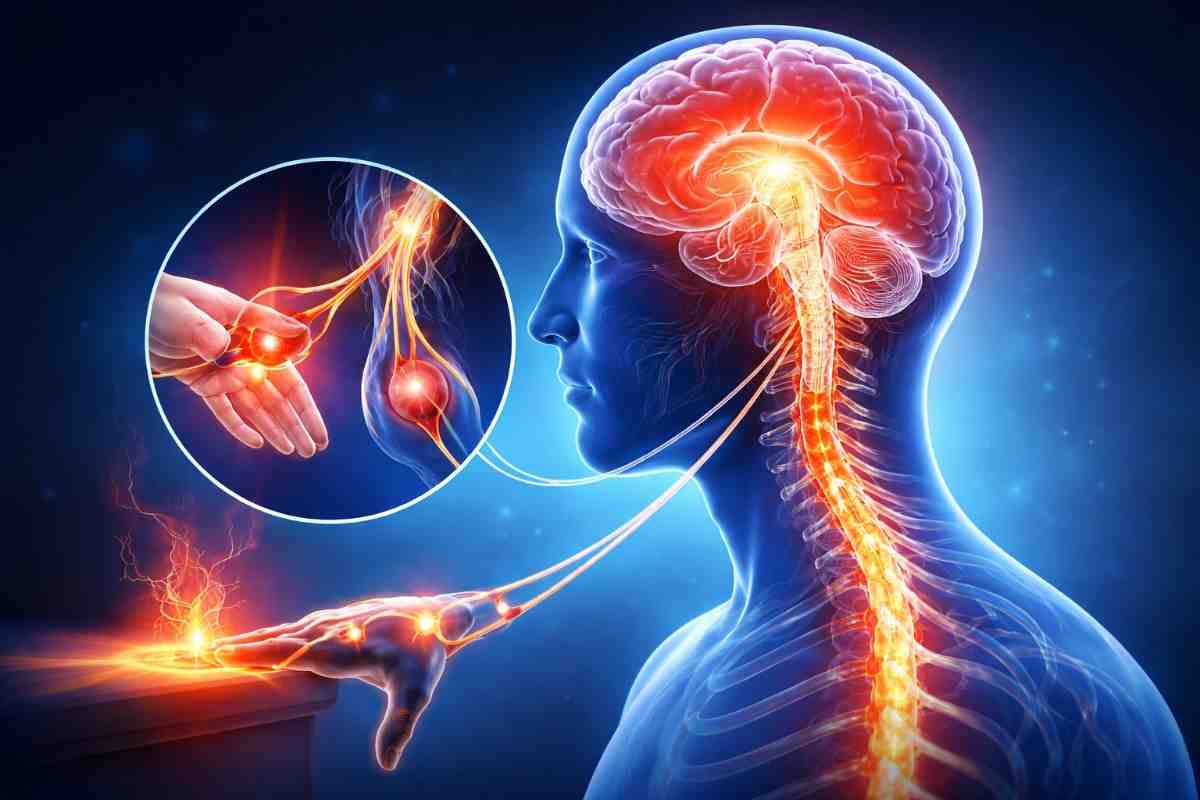
Examples of Reflex Actions and Brain Function in Everyday Life
- Driving: sudden braking uses spinal reflex + brain judgment
- Sports: catching a ball involves trained brain reflex loops
- Walking: posture reflexes constantly adjusted by the brain
- Chewing and swallowing: brainstem-controlled reflex actions
Everyday life would be unsafe without brain-guided reflex control.
Reflex Arc Explained: Where the Brain Fits In
The reflex arc is the basic unit of reflex action.
It includes:
- Receptor
- Sensory neuron
- Spinal cord
- Motor neuron
- Effector muscle
The brain:
- Receives parallel information
- Adjusts future reflex strength
- Suppresses harmful reflexes
Common Misconceptions About Brain and Reflex Action
Myth 1: Brain is not involved at all
 Reality: Brain always supervises
Myth 2: Faster reflex means no brain role
Reality: Brain training improves reflex speed
Myth 3: Reflexes don’t change
Reality: Brain adapts reflexes over time
Clinical Insight by Dr. Mazda K. Turel: Brain-Mediated Reflexes
In clinical practice, I often see patients where:
- Reflexes are exaggerated
- Reflexes are absent
- Reflexes are uneven
These patterns help locate where the problem lies – brain, spinal cord, or nerve.
Reflex testing is simple, but interpretation requires deep neurological understanding.
When Reflex Actions Go Wrong: Brain-Related Causes
Brain-related causes include:
- Stroke
- Head injury
- Brain tumors
- Infections
- Degenerative disorders
These conditions can cause:
- Slow reflexes
- Hyperactive reflexes
- Loss of protective reflexes
Early diagnosis makes a major difference.
How Neurologists Assess Brain Involvement in Reflexes
Doctors check:
- Speed of response
- Strength of movement
- Symmetry
- Associated muscle tone
These findings give clues about:
- Brain pathways
- Spinal cord health
- Nerve conduction
Brain Protection and Reflex Actions: What You Should Know
Protecting your brain helps maintain healthy reflexes.
Important steps:
- Use helmets
- Control blood pressure
- Manage diabetes
- Get timely treatment for head injuries
The brain needs constant care, even when you feel “normal.”
Key Differences Between Spinal and Brain Reflex Actions
Feature | Spinal Reflex | Brain Reflex |
Speed | Very fast | Fast but controlled |
Awareness | Unconscious | Partly integrated |
Control | Local | Central |
Damage impact | Localized | Widespread |
Reflex Action in Children vs Adults: Brain’s Changing Role
In children:
- Reflexes are stronger
- Brain control is still developing
In adults:
- Reflexes are refined
- Brain inhibition is stronger
In older age:
- Reflex speed may reduce
- Brain diseases may alter responses
Impact of Brain Injury on Reflex Action and Response Time
Brain injuries can cause:
- Delayed reflexes
- Loss of coordination
- Abnormal muscle tone
Rehabilitation focuses on retraining brain pathways to restore reflex balance.
Role of Brain in Reflex Action: What Research Shows
Modern studies show:
- Brain constantly modifies spinal reflexes
- Training improves reflex efficiency
- Brain plasticity helps recovery after injury
This proves reflexes are not “fixed” – they are brain-guided systems.
Tips to Improve Nervous System Health for Better Reflexes
- Regular physical activity
- Good sleep
- Balanced nutrition
- Mental stimulation
- Stress management
A healthy brain equals better reflex control.
Dr. Mazda K. Turel’s Professional Take on Brain-Driven Reflexes
Reflex actions are not just emergency responses.
They are windows into brain health.
If reflexes change suddenly, it should never be ignored. Early evaluation saves lives and function.
6 thoughts on “What Is the Role of Brain in Reflex Action?- Dr. Mazda Turel”
DR UYI has done it for me, His predictions are 100% correct, He is real and can perform miracles with his spell. I am overwhelmed because I just won 336,000, 000 million Euro from a lottery jackpot game with the lottery number DR UYI gave me. I contacted DR UYI for help to win a lottery via Facebook Page DR UYI, he told me that a spell was required to be casted so that he can predict my winning, I provided his requirements for casting the spell and after casting the spell he gave the lottery numbers, I played and won 336,000,00 euros. How can I thank this man enough? His spell is real and like a God on Earth. Thank you for changing my life with your lottery winning numbers. Do you need help to win a lottery too? contact Dr UYI via drzukalottospelltemple@gmail.com OR WhatsApp on +17174154115
It is a very hard situation when playing the lottery and never won, or keep winning low fund not up to 100 bucks, i have been a victim of such a tough life, the biggest fund i have ever won was 100 bucks, and i have been playing lottery for almost 11 years now, things suddenly change the moment i came across a secret online, a testimony of a spell caster called Dr.Isa who help people win in any type of lottery numbers, i was not easily convinced, but i decided to give a try, now i am a proud to be a lottery winner with the help of Dr.Isa spell, i won 2,000,000 Million dollars and i am making this known to everyone out there who have been trying all day to win the lottery, believe me this is the only way to win the lottery, this is the real secret we all have been searching for. His WhatsApp: +2347046030096 Email: drisaspellcaster@gmail.com
What a miracle to have my ex back and i need to share this great testimony… I just want to say thanks Dr ogbo for taking time to help me cast the spell {now my husband},who suddenly lost interest in me after six month of engagement, but today we are married and we are more happier than ever before, I am really short of words and joyful, and i don’t know how much to show my appreciation to you Dr ogbo you are a God sent to restore broken relationship. he deeply enjoy helping people achieve their desires, find true love, getting their ex lovers back, stop abusive relationships, find success, attract happiness, find soul mates and more, contact him today and let him show you the wonders and amazement of his Love Spell System. He deliver results at his best in real spell casting, email: Psychicogboreading@gmail.com OR what’sApp +2349057657558
Hi, wishing good fortune to everyone who comes across this comment! I went bankrupt last year due to failed business ideas. I used to enjoy playing the lottery for fun but as my situation worsened financially, I sought help to win big this time and found a man called MEDUZA, who has assisted numerous individuals worldwide with their financial issues. This man prepared a powerful spell for me that enabled him to get the secrete lucky numbers for me, I played the game with the numbers and to my astonishment, I discovered that I had won $259 million Jackpot after 2 weeks just has he said; Today, I’m now free of debt and I own different investments globally. Without Meduza, I wouldn’t have made it through the tough times I experienced last year. Truly, MEDUZA is a divine presence among us. If you are currently struggling in aspect of your life reach out to MEDUZA through the below information’s.
Whats-App +1 807 798 3042
Email: lordmeduzatemple@hotmail.com
Website: lordmeduzatemple.com
Today’s online world is flooded with scam advertisements, mostly lurking in comments across websites and blogs. Thousands of innocent people have fallen prey, losing vast sums of money to clever scammers. Common scams include:
Fake Bank Loan Offers
Cryptocurrency & Forex Trading Schemes
Fake Lotteries & Jackpots
Romance & Dating Frauds
…and many more.
But here’s the crucial question:
Can you recover the money stolen by these scammers?
The answer is YES, and here’s how you can do it.
The solution involves hiring a skilled hacker who can help retrieve your lost funds. Yes, that’s right we’re talking about professionals who specialize in tracking down scammers and recovering your money. Today might just be your lucky day!
Who Are We?
We are TREK Tech Corp, a team of expert hackers dedicated to helping victims reclaim their stolen funds. After extensive research, we found that over $3 billion USD is lost each year to online scams — and we’re here to turn the tide.
How Do We Work?
Our process begins by hacking into the scammer’s device — be it a phone or a computer — to uncover crucial details about their operations. Many scammers don’t keep money in banks; instead, they stash funds in Bitcoin wallets or other untraceable accounts. Once we gather enough intel, we craft a plan to recover your money and return it to you.
Reach Out to Us
Getting in touch is simple — just send us an email at: trektechcorp1@gmail.com
If you or someone you know has been scammed, don’t wait. Contact us now. Your safety and confidentiality are guaranteed.
We Also Offer Legitimate Hacking Services:
Phone & Device Hacking/Cloning
Email Hacking & Password Recovery
Social Media Account Hacking & Recovery
Deleted File Retrieval
Mobile Tracking
Virus Removal & System Security
And more.
Remember: If you’ve been scammed, help is just an email away. Reach out today!
For 43 years, I struggled with bad credit due to my own poor decisions, and my credit score was around 490. When my girlfriend and I decided to buy a house, a mortgage broker informed us that it would be impossible to secure a mortgage with my credit score. As a result, she referred me to a company called HACK MAVENS CREDIT SPECIALIST, assuring me of their professionalism and ability to assist with credit improvement. Upon contacting them, I was impressed by their professionalism and they assured me that they could help. In less than 6 days, my credit score skyrocketed to 785, and they also successfully resolved issues in my credit report, including the bankruptcy. I am incredibly satisfied with their service and would highly recommend HACK MAVENS CREDIT SPECIALIST for reliable credit repairs. You can reach them at H A C K M A V E N S 5 [AT] G M A I L [DOT] COM or at [+] [1] [2 0 9] [4 1 7] – [1 9 5 7]. Thanks to their help, my girlfriend and I are now proud homeowners.