
If the brain were a grand Indian household, the cortex would be the talkative uncle with opinions on everything, the lobes would be the siblings arguing over territory, and the brainstem would be the old, silent grandmother sitting in the corner – saying nothing, doing everything.
And if the brainstem is the old grandmother of the nervous system, then the midbrain is her sharp-eyed middle-aged son: quiet, alert, always watching, rarely speaking, but missing nothing.
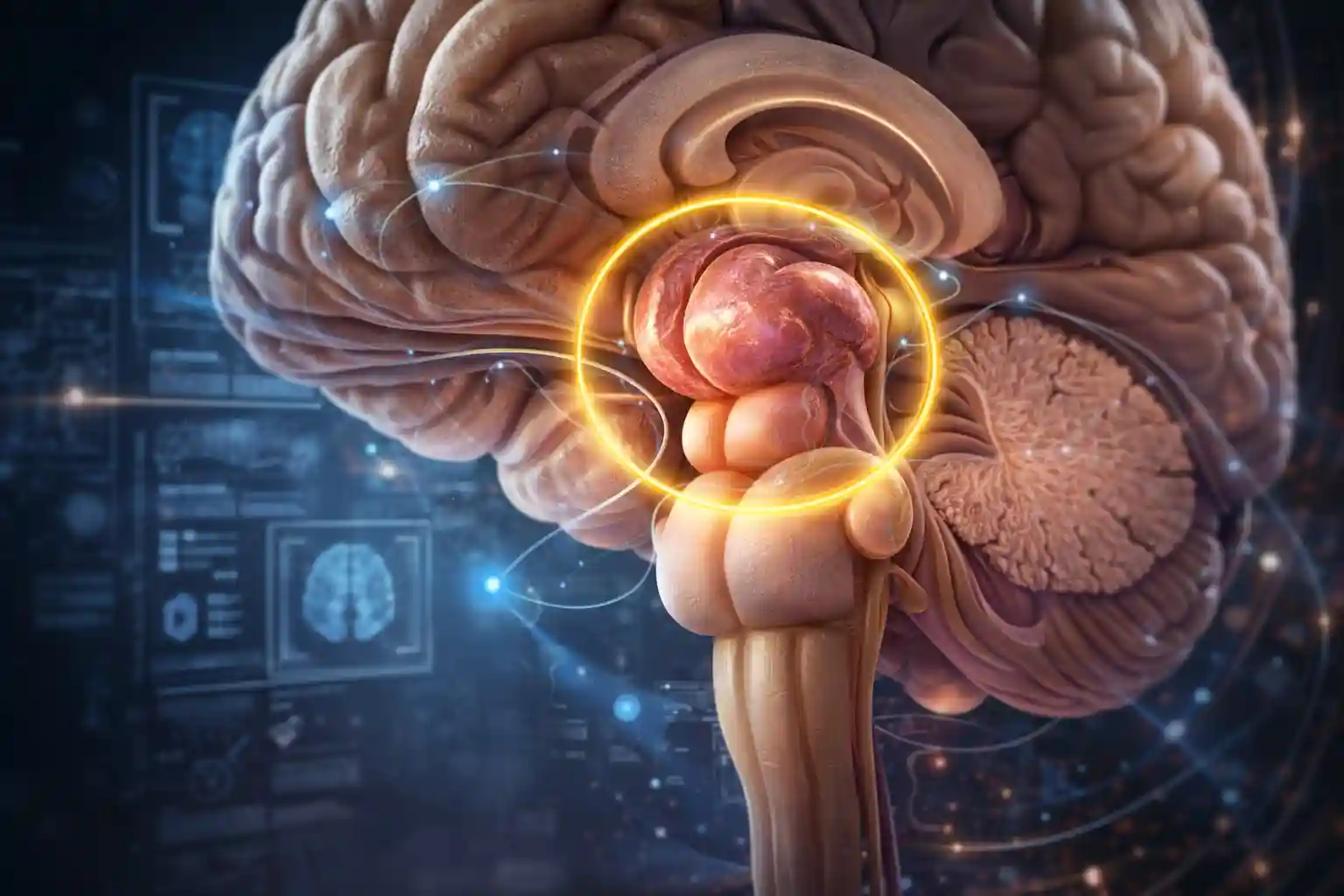
The midbrain occupies a precarious position as the top floor of the brainstem. It is small, central, and unforgiving. It sits between thought and survival, linking the higher brain above to the ancient machinery below. It governs eye movements, posture, reflexes, alertness. It decides where we look, what we notice, and how we orient ourselves in the world. It is not interested in drama, only efficiency.
Patients with midbrain problems rarely arrive with complaints that sound serious. They come with oddities. “Doctor, my eyes don’t move the way they used to.” “I feel awake but strangely detached.” “I keep bumping into things I can see.” The symptoms feel vague until anatomy gives them meaning.
A retired schoolteacher came to see me with his wife, both immaculately dressed, both slightly irritated with each other in that way only long marriages manage. His hair was neatly oiled, his spectacles spotless. He sat upright, composed, and mildly offended by his own body. “I can read perfectly,” he said, “but I cannot look up to meet my wife’s eyes when she scolds me.” His vertical gaze was restricted, his eyelids heavy, his reflexes subtly altered.
His MRI showed a small brain tumour nestled deep within the midbrain – a glioma. In neurosurgery, there are few words that instantly quiet a room like that one. Not because it is always aggressive, but because of where it lives. A midbrain glioma is not something you chase. It is something you respect.
This is not a place for heroic resections or dramatic gestures. The midbrain does not tolerate enthusiasm. The safest surgery here is often the smallest one – a navigation-guided biopsy, planned meticulously, executed gently, and stopped early.
On the day of surgery, the atmosphere in the operating room was noticeably different. No rush. No bravado. The navigation system became our compass, mapping a precise, minimally disruptive path through safe corridors. Each movement was deliberate, each decision weighed. We burred a small hole in the skull and cut the dura. The biopsy needle advanced millimetre by millimetre, guided by coordinates registered before we started. The tissue was sampled, haemostasis secured, and we withdrew. The surgery was brief; the responsibility wasn’t.
Postoperatively, the schoolteacher woke up unchanged – which, in this part of the brain, is the best possible outcome. His gaze limitation persisted. His dignity remained intact. His wife smiled with visible relief. “At least he can still hear me,” she said. He rolled his eyes sideways – a small victory for neurology and marriage.
The biopsy gave us clarity. Treatment followed. Life adjusted. He received radiation and then chemotherapy, which shrank the tumour substantially. His gaze improved over a few months. Now he could see right through her, and she wasn’t too happy with that either.
The midbrain teaches surgeons a lesson early in their careers: That doing less can sometimes mean doing it right. That intervention does not always mean removal. That courage occasionally lies in knowing when to stop.
Evolutionarily ancient, the midbrain predates language and logic. It reacts before thought. It turns the head before fear registers. It is the reason we flinch, orient, and attend. It reminds us that much of what keeps us functional operates beyond our awareness. And perhaps that is its quiet wisdom: That control is often subconscious. That survival does not require insight. That not all battles are meant to be fought head-on. The midbrain does not demand attention; it simply keeps you oriented, alert, and alive. And sometimes, the best thing a surgeon can do is listen to that silence – and leave it undisturbed.
6 thoughts on “The brainstem part 1: The midbrain”
HOW I RECOVERED MY LOST CRYPTOS FROM FAKE BROKER ONLINE.
I had lost over $152,000 by someone I met online on a fake investment project. After the loss, I had a long research on how to recover the lost funds. I came across a lot of Testimonies about, GEO COORDINATES HACKER. I contacted them providing the necessary information and it took the experts about 27hours to locate and help recover my stolen money. To anyone looking for a Recovery firm to Recover your lost Crypto. You can contact GEO COORDINATES HACKER. I hope this helps as many out there who are victims and have lost to these fake online investment scammers. You can contact GEO COORDINATES HACKER. By using
Email; (geovcoordinateshacker@gmail.com
Website; https://geovcoordinateshac.wixsite.com/geo-coordinates-hack
I can’t express my gratitude enough to Dr Zuma for making me a living testimony. i have battled with HERPES SIMPLEX VIRUS 2 for about 6years now, and i have done all i can to make sure i am cured but nothing worked out, but miraculously my friend invited me to see a video on his Blog and as i visited i decided to see few of the comment below, and i found some people talking about Dr Zuma, and i decided to contact this great herbal healer to also help me, so i wrote to him, and he replied me back and assure me that i will get a cure for my HERPES SIMPLEX VIRUS 2. After preparing my medicine he sent it to me and when I started using it for 3weeks i was completely cured, I am a living testimony and assure anyone with the same illness that you can also be cured if you also contact this great man on his Email. spiritualherbalisthealing@gmail.com
I thoughtI the physicians says there is no cure for HSV 2!!! I am telling you today that DR ITUA cure HSV 2 with his herbal medicine and once you get cured you are cured forever it is never reversible, I have been suffering for this deadly disease called HSV 2 for more than 2years and I lost all hope because my doctor says there is no cure for HSV 2. I saw a testimony on,the internet on how DR ITUA cure HSV, etc with his herbal medication and an email and whatsapp to contact him was also displayed, I thought this was a joke but I decided to contact him and he replied telling me not to worry that my problem is over . DR ITUA sent me a herbal medication to drink for three weeks but only 2weeks I feel strange and I went to my doctor and he confirmed me negative. He can help you too. Contact him via email…ituahealer@gmail.com WhatsApp +2348150223558 .website https://ituahealer.wixsite.com/my-site He is capable of curing AUTISM, HERPES, HPV, HSV1&2, HEPATITIS A B C, and DIABETES.
DR UYI has done it for me, His predictions are 100% correct, He is real and can perform miracles with his spell. I am overwhelmed because I just won 336,000, 000 million Euro from a lottery jackpot game with the lottery number DR UYI gave me. I contacted DR UYI for help to win a lottery via Facebook Page DR UYI, he told me that a spell was required to be casted so that he can predict my winning, I provided his requirements for casting the spell and after casting the spell he gave the lottery numbers, I played and won 336,000,00 euros. How can I thank this man enough? His spell is real and like a God on Earth. Thank you for changing my life with your lottery winning numbers. Do you need help to win a lottery too? contact Dr UYI via drzukalottospelltemple@gmail.com OR WhatsApp on +17174154115
Wow what a good God I am so excited to tell you all how I become a millionaire I’m a woman of faith I was reading a comment on google where I meet a man sharing how Dr UYI cast a spell for him and he get his wife back after the spell I was interested I have to do research when I was doing the research I got so many testimony about this same man call Dr UYI how he help people to win lottery how he help people to get there ex back how he help people to do so many things I was happy and I contact him to help me win the lottery when I contact him and he told me what to do and after I did what he ask me to do he den gave me a lottery number to play and told me to go and buy ticket after playing the game I was so surprise the game come out good and I won the sum of 90, 000,000 dollars i was amazed and promise to share it to the people around me if anyone is willing to play the mage lottery it should contact Dr UYI so he can give you the right number to play thanks to you Dr UYI I’m so so grateful contact Dr UYI via drzukalottospelltemple@gmail.com OR WhatsApp on +17174154115
I’m beyond grateful to Dr. Benjamin for changing my life completely! I had been playing the Mega Millions lottery for years without success, until I came across Dr. Benjamin and decided to give his spell casting services a try. After performing a powerful lottery spell for me, everything turned around in the most unbelievable way—I won the Mega Millions jackpot of $670,000,000,00! The experience still feels like a dream come true. Dr. Benjamin was professional, kind, and deeply spiritual throughout the entire process. He guided me with confidence and positive energy, and his work truly produced results beyond my imagination. I highly recommend Dr. Benjamin to anyone who believes in miracles and is ready for a life-changing breakthrough. reach him via drbenjaminlottospell711@gmail.com or WhatsApp: +18588585788.