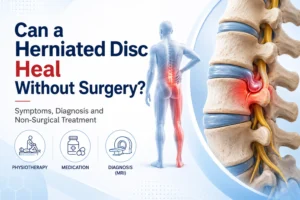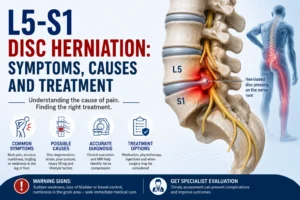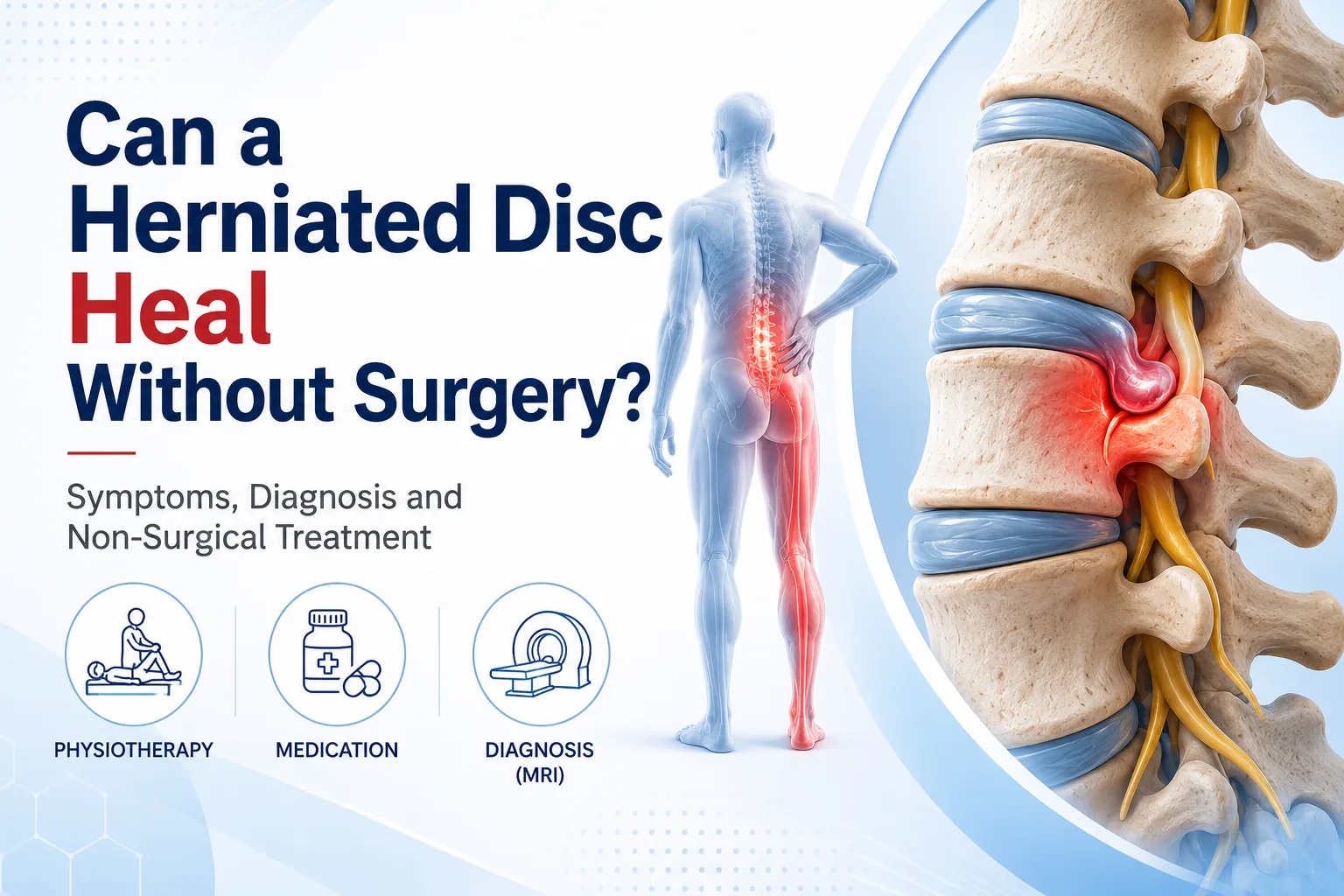
If an MRI shows a herniated disc, one of the first concerns is often whether an operation will be necessary. So, can a herniated disc heal without surgery? In many cases, yes. Symptoms caused by a herniated disc can improve with time and appropriate non-surgical care, particularly when there is no progressive muscle weakness or other serious neurological problem. Most people with a herniated disc do not require surgery.
“Healing,” however, needs some explanation. Pain can improve even when an MRI still shows a disc abnormality. In some lumbar disc herniations, the displaced disc material can also shrink or be gradually resorbed by the body.
Treatment therefore depends on symptoms, nerve function and examination findings rather than the MRI appearance alone.
Can a Herniated Disc Heal Without Surgery?
Yes, many herniated discs can improve without surgery. Pain and nerve irritation may settle with conservative treatment, while some herniated disc material can gradually shrink or be resorbed. Surgery is usually considered when significant symptoms persist despite appropriate treatment or when neurological problems such as progressive weakness develop.
A herniated disc occurs when part of the softer material inside an intervertebral disc extends through a weakened or torn area of its outer layer.
If this material irritates a nearby nerve, symptoms may include pain, tingling, numbness or weakness. In the lower back, nerve irritation may cause sciatica. In the neck, pain and sensory symptoms may travel into the shoulder, arm or hand.
The presence of a herniation does not mean that the disc must be surgically removed.
What Does “Healing” Actually Mean for a Herniated Disc?
Healing does not always mean that the disc returns perfectly to how it looked before the problem developed.
There are several ways a patient can improve.
Nerve inflammation can settle
A herniated disc can irritate a nerve both mechanically and through inflammation. As inflammation settles, radiating pain may decrease even if some disc material remains visible.
The herniated material may shrink
Some lumbar disc herniations undergo spontaneous resorption. This means the body gradually breaks down and removes some of the displaced disc material.
Research into this process suggests that immune cells, including macrophages, participate in breaking down herniated tissue. Blood vessel formation and changes within the disc fragment can also contribute to its reduction in size.
Function can improve
Pain control, appropriate movement and rehabilitation can improve strength and mobility. A patient may therefore return to normal activity even if a follow-up MRI does not look completely normal.
For disc herniation recovery, how a person feels and functions is generally more meaningful than whether every structural change has disappeared from a scan.
What Symptoms May Improve Without Surgery?
A herniated disc does not produce the same symptoms in every patient. Some people have mainly back or neck pain. Others develop symptoms because a nerve root is affected.
Depending on the location of the disc, symptoms may include:
- Lower back or neck pain
- Pain travelling into an arm or leg
- Sciatica
- Burning or shooting nerve pain
- Tingling or pins and needles
- Numbness
- Mild muscle weakness
- Pain made worse by particular movements, coughing or sneezing
Some herniated discs cause no symptoms at all and are found incidentally on imaging.
These symptoms can also have other causes. A clinical examination is needed before assuming that a disc seen on an MRI is responsible.
How Do Doctors Decide Whether Non-Surgical Treatment Is Suitable?
The decision is based on more than the size of the disc herniation.
A doctor may consider:
- Location of the pain
- Whether pain travels into an arm or leg
- Presence and distribution of numbness
- Muscle strength
- Reflexes
- Walking ability
- Duration and progression of symptoms
- MRI findings when imaging is indicated
- Previous treatment
- Overall health
A neurological examination is particularly useful because it can identify signs that a nerve is losing function rather than simply being painful.
An MRI, or magnetic resonance imaging scan, can show the disc, nerve roots and surrounding tissues in detail. Imaging can help identify a herniation and possible nerve compression, but it still needs to be matched with the patient’s symptoms.
What Does Herniated Disc Non Surgical Treatment Include?
Herniated disc non surgical treatment aims to reduce symptoms, maintain safe movement and allow irritated nerves time to recover. The exact plan varies according to the location of the disc problem, severity of symptoms and the patient’s overall health.
Appropriate activity
Long periods of complete bed rest are generally discouraged.
A short period of modifying movements that clearly aggravate severe pain may be reasonable, followed by gradual activity as tolerated. Walking is often encouraged when it does not significantly worsen nerve symptoms.
The goal is not to push through severe pain, but neither is it usually helpful to remain completely inactive for prolonged periods.
Pain-relieving medicines
A doctor may recommend suitable pain medicines or anti-inflammatory medication depending on the patient’s symptoms and medical history.
Some people with nerve-related pain may require prescription medicines. Medication decisions should account for other health conditions, current medicines and possible side effects.
Physiotherapy
Physiotherapy may form an important part of conservative care.
Depending on the condition, treatment can focus on:
- Restoring comfortable movement
- Improving core and spinal muscle support
- Building strength gradually
- Returning to normal activities
- Improving lifting and movement technique
- Reducing repeated aggravating movements
Exercises should be selected according to the patient’s symptoms. Someone with significant nerve weakness may need a different approach from someone who has back pain without neurological problems.
Epidural or nerve root injections
For selected patients with persistent radiating nerve pain, an injection around an affected nerve may be considered.
Steroid injections are intended to reduce inflammation and improve pain. They do not physically remove the herniated disc.
Patients requiring further assessment can learn more about available approaches to slip disc treatment and how treatment may be selected according to neurological findings and imaging.
How Long Does Disc Herniation Recovery Take?
There is no single recovery timeline that applies to everyone.
Some patients notice meaningful improvement over several weeks. For others, nerve-related symptoms may take longer to settle, particularly when there has been marked inflammation or compression.
Recovery can depend on:
- Location and type of herniation
- Nerve involvement
- Severity of symptoms
- Presence of muscle weakness
- Duration of nerve compression
- Physical demands of work
- General health
- Response to rehabilitation
Pain, numbness and weakness may also recover at different speeds.
A reduction in pain does not necessarily mean that the disc has completely disappeared, just as an abnormal-looking MRI does not necessarily mean that treatment has failed.
Does a Slip Disc Without Surgery Mean You Should Just Wait?
No. Managing a slip disc without surgery should not mean ignoring symptoms and hoping they disappear.
Conservative care works best when there is a proper diagnosis and a plan for monitoring neurological function.
Medical review becomes especially useful if:
- Pain remains difficult to control
- Symptoms repeatedly interfere with normal activities
- Numbness is persistent
- Leg or arm weakness appears
- Walking becomes difficult
- Symptoms continue despite appropriate treatment
If symptoms are improving and neurological function remains stable, continued non-surgical management may be appropriate.
When Might Surgery Become Necessary?
Surgery is generally considered when the expected benefits outweigh the risks and non-surgical treatment is no longer providing an acceptable result.
Possible reasons for surgical evaluation include:
- Persistent disabling nerve pain despite suitable treatment
- Progressive muscle weakness
- Increasing neurological loss
- Difficulty standing or walking because of weakness
- Significant nerve compression that matches the patient’s symptoms
- Loss of normal bladder or bowel function
A common operation for a lumbar herniated disc is a discectomy, in which the portion of disc material pressing on a nerve is removed.
Most people do not require disc surgery, but progressive neurological problems can change the treatment decision.
Which Symptoms Need Urgent Medical Attention?
Most herniated discs are not emergencies. Certain symptoms can indicate significant compression of the nerves at the bottom of the spinal canal and require urgent medical assessment.
Seek urgent care for:
- New difficulty passing urine
- Loss of bladder control
- Loss of bowel control
- Numbness around the genitals, buttocks or inner thighs
- Rapidly worsening weakness in one or both legs
- Significant new difficulty standing or walking because of weakness
Bladder or bowel dysfunction together with numbness in the saddle area can be associated with cauda equina syndrome, a serious condition caused by compression of multiple nerve roots.
These symptoms should not be managed by waiting to see whether the disc improves on its own.
When Should You Consult a Neurosurgeon?
A neurosurgical consultation may be appropriate when a herniated disc causes persistent radiating pain, significant numbness, progressive weakness or symptoms that continue despite appropriate conservative care.
Seeing a neurosurgeon does not mean that surgery has already been decided.
A neurosurgeon such as Dr. Mazda K. Turel can review the symptom pattern, neurological examination and imaging together. This can help determine whether continued non-surgical treatment is reasonable or whether nerve compression has reached a point where another approach should be considered.
Conclusion
So, can a herniated disc heal without surgery? For many patients, symptoms can improve with appropriate non-surgical care, and some lumbar herniations can gradually shrink through the body’s natural resorption process. Surgery is therefore not automatically required simply because an MRI shows a herniated disc.
The decision depends more on how the nerve is functioning than on the scan label alone. Persistent pain, numbness or difficulty with normal activities deserves medical review, while progressive weakness requires closer specialist assessment.
New bladder or bowel problems, saddle-area numbness or rapidly worsening leg weakness should be treated differently: these are warning signs that need urgent medical evaluation rather than waiting for natural recovery.
Frequently Asked Questions
1. Can a herniated disc heal without surgery completely?
Yes, some people experience substantial symptom recovery without surgery, and some lumbar herniations can shrink through spontaneous resorption. However, complete symptom relief does not require the MRI to return completely to normal. The more useful measure of recovery is usually improvement in pain, nerve function, strength and normal daily activities.
2. Can the body absorb a herniated disc?
The body can gradually resorb some herniated lumbar disc material. Immune cells can enter the area and contribute to breaking down displaced disc tissue, which may then decrease in size over time. This process does not occur identically in every herniation and should not be used as a reason to delay medical assessment when neurological weakness or other warning signs are present.
3. Is walking good during herniated disc recovery?
Gentle walking is often suitable when tolerated and is generally preferable to prolonged bed rest. However, activity should be adjusted to the individual. Walking that repeatedly produces severe radiating pain, increasing numbness or new weakness should not simply be pushed through. A doctor or physiotherapist can recommend an appropriate level of activity.
4. Does physiotherapy push a herniated disc back into place?
Physiotherapy does not simply push displaced disc material back inside the disc. Its role is to help manage symptoms, restore movement, improve strength and support a gradual return to activity. Exercise selection should be based on the patient’s symptoms, examination findings and stage of recovery.
5. Do epidural injections heal a herniated disc?
An epidural steroid injection is mainly used to reduce inflammation around an irritated nerve and control radiating pain in selected patients. It does not remove or directly repair the herniated disc. Symptom relief may allow a patient to participate more comfortably in rehabilitation while the underlying condition is managed.
6. How do I know if my herniated disc needs surgery?
The MRI alone cannot answer this. Surgery may become appropriate when there is persistent disabling nerve pain despite suitable non-surgical care, progressive weakness, difficulty walking because of neurological loss or certain serious bladder and bowel symptoms. The decision should combine symptoms, examination findings, imaging and the patient’s overall health.
7. Can pain return after a herniated disc improves?
Yes. Back, neck or nerve pain can recur even after a period of improvement. This does not automatically mean that the same disc has herniated again. Muscles, joints, another disc or renewed nerve irritation may produce similar symptoms. Recurrent pain accompanied by new numbness or weakness deserves medical reassessment.