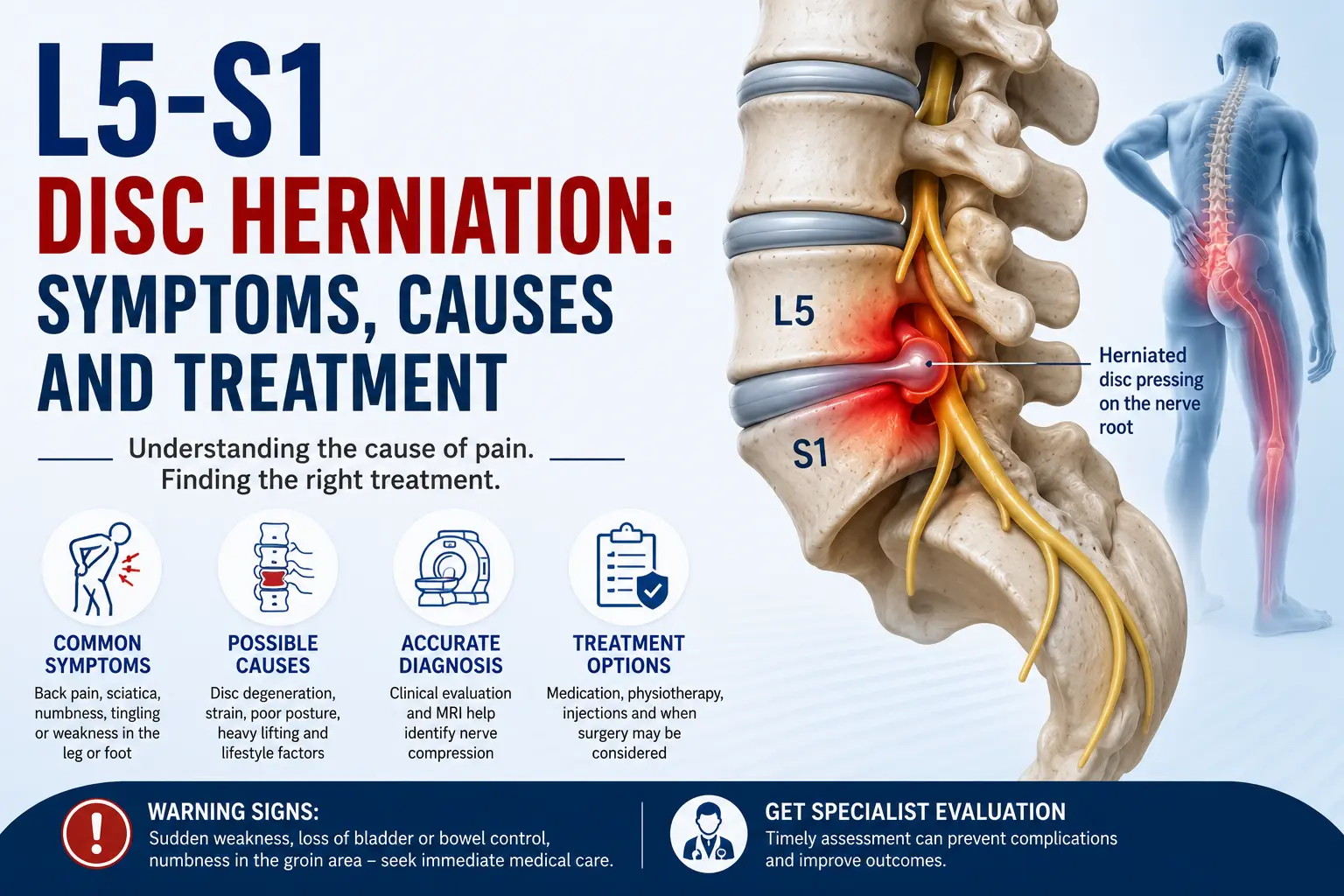
An L4-L5 disc bulge is a change in the disc located between the fourth and fifth lumbar vertebrae in the lower back. Some people discover it after an MRI for persistent back pain, while others may have leg pain, tingling, numbness or weakness if the disc affects a nearby nerve.
Seeing “L4-L5 disc bulge” on a scan does not automatically mean the condition is severe or that surgery is required. Disc changes can sometimes appear on imaging without being the actual source of pain. What matters is whether the MRI finding matches your symptoms and neurological examination.
This article explains what an L4-L5 bulge means, the symptoms it may produce, how nerve compression is assessed and the treatment options that may be considered.
What Does an L4-L5 Disc Bulge Mean?
An L4-L5 disc bulge means that part of the intervertebral disc between the L4 and L5 vertebrae extends beyond its usual boundary. If the bulging disc narrows the space available for a nearby nerve root, it can cause pain, numbness, tingling or weakness. A bulge seen on MRI does not always cause symptoms.
The discs between the vertebrae act as cushions and allow movement of the spine. Each disc has a softer centre surrounded by a stronger outer layer.
Over time, a disc may lose some of its water content and flexibility. Its outer border can then extend outward. This is commonly described as a disc bulge.
The direction and size of the bulge matter. A bulge extending toward the spinal canal or the opening through which a nerve exits may have greater clinical significance than one that does not contact a nerve.
Imaging abnormalities should therefore be interpreted together with symptoms rather than treated simply because they appear on an MRI.
What Are the Common L4 L5 Disc Bulge Symptoms?
Some L4-L5 disc bulges cause only lower back discomfort. Others can irritate or compress a nerve and produce symptoms that travel into the leg.
Possible L4 L5 disc bulge symptoms include:
- Pain across the lower back
- Pain spreading into the buttock
- Shooting or burning pain down one leg
- Tingling or pins and needles
- Numbness in part of the leg or foot
- Weakness while lifting the foot or big toe
- Difficulty walking on the heel
- Increased pain with certain bending or lifting movements
Pain caused by an irritated lumbar nerve is often called radicular pain or sciatica.
If the L5 nerve root is involved, symptoms may extend through the buttock and outer part of the leg toward the top of the foot. Weakness can sometimes affect ankle or big-toe dorsiflexion, which means lifting the foot or big toe upward.
Symptoms vary from one person to another. Lower back and leg pain can have several causes, so these features alone cannot confirm that an L4-L5 disc is responsible.
Does an L4-L5 Disc Bulge Always Compress the L5 Nerve?
No. An L4-L5 disc abnormality often affects the L5 nerve root when it is located centrally or just to the side of the spinal canal, but the exact nerve involved depends on the direction of the disc change. A more lateral abnormality at L4-L5 can potentially affect the exiting L4 nerve root instead.
This distinction matters because L4 L5 nerve compression cannot be determined from the disc level alone.
Doctors look at:
- Where the disc is bulging
- Whether a nerve is contacted or compressed
- Which leg is affected
- The pattern of numbness
- Muscle strength
- Reflexes
- MRI findings
For example, weakness in lifting the big toe and altered sensation over the top of the foot can suggest L5 nerve involvement.
What Causes an L4-L5 Disc Bulge?
There is not always one specific event responsible for a disc bulge.
Disc changes commonly develop gradually as the spinal discs age and lose some of their flexibility. Repeated mechanical loading can also contribute.
Factors that may play a role include:
- Age-related disc degeneration
- Repeated heavy lifting
- Frequent bending or twisting
- Poor lifting technique
- Physically demanding work
- Previous injury to the lower back
- Excess body weight placing additional load on the spine
- Long periods of inactivity followed by sudden heavy activity
A disc problem can also develop without a memorable injury.
This is why a patient may develop L4 L5 back pain even though there was no single moment when the problem appeared to begin.
How Is an L4-L5 Disc Bulge Diagnosed?
Diagnosis requires more than reading an MRI report.
A doctor will usually begin by asking about the location and nature of the pain. They may ask whether pain travels below the knee, whether numbness is present and whether there has been any change in leg or foot strength.
Neurological Examination
The examination may include checking:
- Leg muscle strength
- Ability to walk normally
- Ability to walk on the heels or toes
- Sensation in different parts of the leg
- Knee and ankle reflexes
- Straight-leg raising
Testing these functions can help determine whether a particular lumbar nerve root may be affected.
MRI Scan
An MRI, or magnetic resonance imaging scan, provides detailed images of the spinal discs, nerves and other soft tissues.
It can show:
- The level of the disc abnormality
- The direction of the bulge
- Whether there is a protrusion or herniation
- Narrowing around a nerve
- Other degenerative changes
- Possible nerve root compression
An MRI can identify structural abnormalities, but the scan still needs to be compared with symptoms and examination findings. Mayo Clinic notes that disc abnormalities found on imaging do not always cause symptoms or require treatment.
What Are the L4 L5 Disc Treatment Options?
L4 L5 disc treatment depends on symptoms, neurological findings and the degree of nerve compression. Many patients can initially be managed without surgery, particularly when there is no progressive weakness, bladder or bowel dysfunction or another serious neurological finding.
Treatment is individual rather than determined by the MRI wording alone.
Activity Modification
During a painful episode, temporarily reducing activities that clearly worsen the pain may help. Prolonged complete bed rest is generally not recommended.
Gentle movement and gradual return to normal activities are commonly encouraged as symptoms permit.
Medicines
Depending on the individual, a doctor may recommend medicines for pain or inflammation. Some patients with significant nerve-related pain may need different prescription medicines.
Medication choice should consider medical history, other medicines being taken and possible side effects.
Physiotherapy
Physiotherapy may be useful once appropriate for the patient’s symptoms.
A rehabilitation plan may focus on:
- Improving movement
- Building core and spinal support
- Gradually restoring activity
- Correcting movement patterns
- Learning safer techniques for bending and lifting
Exercises should be selected according to the diagnosis rather than copied from a general online routine, particularly when significant nerve symptoms are present.
Spinal Injections
For selected patients with persistent nerve-related leg pain, an injection around the affected nerve may sometimes be considered.
The aim is usually to reduce inflammation and pain enough to allow rehabilitation. An injection does not necessarily correct the structural disc change itself.
When Might Surgery Be Considered for an L4-L5 Disc Problem?
Surgery is not recommended simply because an MRI shows an L4-L5 bulge.
Specialist surgical evaluation may be considered when there is:
- Progressive muscle weakness
- Significant difficulty standing or walking because of weakness
- Persistent disabling leg pain despite suitable non-surgical treatment
- Numbness or neurological symptoms that remain significant
- Clear nerve compression matching the patient’s symptoms
- Loss of bladder or bowel control requiring urgent assessment
For a disc compressing a nerve, procedures such as a discectomy may be considered in appropriate cases. A discectomy removes the portion of disc material responsible for pressure on the nerve.
Every operation has potential risks, which can vary according to the procedure and individual circumstances. Before recommending surgery, the surgeon considers factors such as the patient’s symptoms, neurological examination, age, overall health, imaging and response to previous treatment.
What Can Recovery Look Like?
Recovery is different for each patient.
Someone being treated conservatively may gradually return to normal activities as pain and nerve irritation settle. Physiotherapy can then focus on restoring movement and strength.
Recovery after surgery depends on the procedure performed, the severity and duration of nerve compression, general health and the physical demands of work or daily activities.
Nerve symptoms do not always disappear at the same speed as pain. If a nerve has been compressed for some time, numbness or weakness may take longer to improve. A treating doctor can give more realistic expectations after examining the patient and reviewing the MRI.
Which Symptoms Need Urgent Medical Attention?
Most L4-L5 disc problems are not medical emergencies. Certain neurological changes need prompt assessment.
Seek urgent medical attention for:
- New loss of bladder control
- New loss of bowel control
- Difficulty starting or controlling urination
- Numbness around the genitals, buttocks or inner thighs
- Rapidly worsening weakness in one or both legs
- Severe difficulty walking because of new weakness
A combination of bladder or bowel dysfunction, saddle-area numbness and lower-limb neurological symptoms can occur with cauda equina syndrome, which requires urgent evaluation.
When Should You Consult a Neurosurgeon?
A neurosurgeon may be consulted when an L4-L5 disc problem causes persistent leg pain, repeated episodes that significantly affect daily activities, progressive weakness or significant nerve compression on imaging.
Consultation does not automatically mean that surgery will be recommended.
Patients requiring specialist assessment can learn more about evaluation and slip disc treatment when symptoms suggest that a lumbar disc problem may be affecting a nerve.
A neurosurgeon such as Dr. Mazda K. Turel can review the symptoms, neurological examination and MRI together before discussing whether continued conservative management, further investigation or surgery is appropriate.
What Should You Ask During Your Consultation?
Useful questions include:
- Is the L4-L5 finding actually causing my symptoms?
- Which nerve, if any, is being compressed?
- Do I have muscle weakness?
- Can I continue with non-surgical treatment?
- Which activities should I temporarily avoid?
- Is physiotherapy appropriate at this stage?
- What changes would make surgery necessary?
- What recovery should I realistically expect?
- Which symptoms should make me seek urgent medical care?
These questions can help patients understand the diagnosis rather than focusing only on terms written in the MRI report.
Conclusion
An L4-L5 disc bulge is an MRI finding whose importance depends on how it affects the individual patient. Some people experience only local back discomfort, while nerve involvement can cause pain, tingling, numbness or weakness extending into the leg or foot.
The size of the bulge on an MRI is only part of the assessment. Symptoms, muscle strength, sensation, neurological examination and the exact location of nerve compression all help determine whether treatment is needed.
Many patients can begin with non-surgical care. Persistent nerve pain, progressive weakness or significant neurological changes deserve specialist review, while new bladder or bowel dysfunction or saddle-area numbness requires urgent medical assessment.
Frequently Asked Questions
1. Is an L4-L5 disc bulge serious?
An L4-L5 disc bulge is not automatically serious. Some bulges produce no symptoms, while others cause back pain or affect a nearby nerve. Its significance depends on the location of the bulge, the amount of nerve compression and whether there is numbness, weakness or another neurological change. An MRI should therefore be interpreted alongside a clinical examination.
2. Can an L4-L5 disc bulge cause leg pain?
Yes. If an L4-L5 disc abnormality irritates or compresses a nerve root, pain may travel from the lower back or buttock into the leg. Tingling or numbness can occur as well. The exact pattern depends on which nerve is affected, so leg pain by itself cannot confirm that L4-L5 is responsible.
3. Can an L4-L5 disc bulge cause foot weakness?
It can. A typical L4-L5 disc abnormality affecting the L5 nerve root may cause weakness when lifting the ankle or big toe. In more noticeable cases, heel walking may become difficult. New or worsening weakness deserves medical assessment because it gives doctors useful information about how strongly a nerve may be affected.
4. Can an L4-L5 disc bulge improve without surgery?
Many L4-L5 disc problems can be treated initially without surgery when there is no significant or progressive neurological deficit. Treatment may involve activity modification, appropriate medicines and physiotherapy. Surgery becomes more relevant when severe symptoms persist despite treatment or significant neurological problems develop.
5. Is walking good for an L4-L5 disc bulge?
Gentle walking is often encouraged as tolerated rather than prolonged bed rest. However, the appropriate amount of activity depends on the patient’s symptoms. Walking that produces rapidly increasing leg pain, numbness or weakness should not simply be pushed through. A doctor or physiotherapist can advise on suitable activity based on the individual condition.
6. What should I avoid with L4 L5 back pain?
During a painful episode, activities that repeatedly reproduce or significantly worsen symptoms may need temporary modification. These can include heavy lifting, repeated bending or twisting for some patients. Complete long-term avoidance of movement is generally not the goal. A gradual return to normal activity is usually planned according to symptoms and clinical advice.
7. Does L4 L5 nerve compression always need surgery?
No. L4 L5 nerve compression does not automatically mean surgery is necessary. The decision depends on the severity of pain, degree of weakness or numbness, imaging findings, duration of symptoms and response to non-surgical care. Progressive weakness, serious neurological deficits or bladder and bowel symptoms can make surgical assessment more urgent.