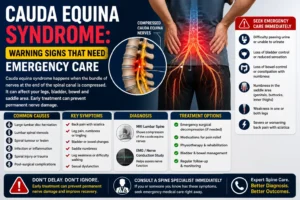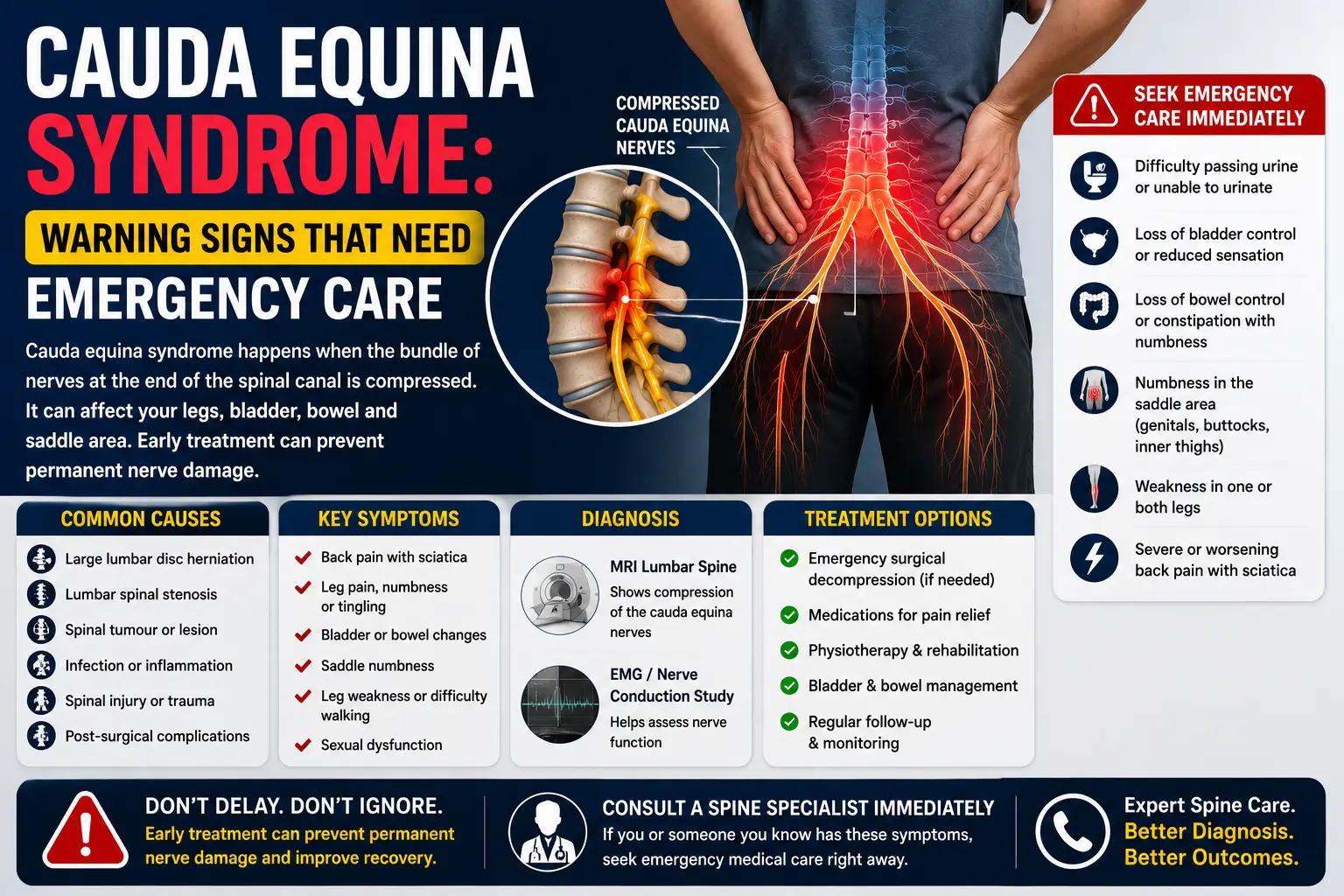
Severe lower back pain or sciatica is common and usually does not represent an emergency. Certain symptoms are different. Cauda equina syndrome symptoms can include new difficulty passing urine, loss of bladder or bowel control, numbness around the genitals or inner thighs, and new or worsening weakness in the legs. These warning signs require urgent medical assessment.
Cauda equina syndrome develops when several nerve roots at the lower end of the spinal canal become significantly compressed. These nerves help control sensation and movement in the legs as well as bladder, bowel and sexual function. NICE recommends immediate assessment for suspected cauda equina syndrome when severe lower back pain radiating into the leg occurs with new bladder, bowel or sexual dysfunction or new perineal numbness.
What Is Cauda Equina Syndrome?
Cauda equina syndrome, or CES, is a serious neurological condition caused by compression of the bundle of nerves at the bottom of the spinal canal. These nerves control parts of the legs, bladder, bowel and genital region. New bladder problems, saddle numbness or significant leg weakness may indicate CES and require emergency assessment.
The spinal cord itself ends higher in the lumbar spine. Below it continues a bundle of nerve roots called the cauda equina, a Latin term meaning “horse’s tail” because of its appearance.
These nerves carry signals responsible for:
- Leg sensation
- Lower-limb muscle function
- Bladder control
- Bowel control
- Sensation around the perineum
- Sexual function
Compression of several of these nerve roots at once can disrupt these functions.
What Are the Main Cauda Equina Syndrome Symptoms?
The presentation can vary between patients. A person does not necessarily have every symptom.
Important cauda equina syndrome symptoms include:
- New difficulty starting urination
- Difficulty sensing when the bladder is full
- Inability to pass urine normally
- New urinary incontinence
- New bowel-control problems
- Numbness around the genitals, anus or inner thighs
- Severe or worsening weakness in one or both legs
- Back pain with sciatica
- Changes in sexual sensation or function
The most concerning pattern is a new change in bladder or bowel function together with altered sensation around the saddle region or significant lower-limb neurological symptoms.
These symptoms should not be monitored at home to see whether they disappear.
What Does Saddle Numbness Mean?
Saddle numbness means reduced or altered sensation in the parts of the body that would contact a saddle: the inner thighs, buttocks, genital area and region around the anus. New saddle-area sensory loss together with severe back or leg symptoms is an important warning sign of possible cauda equina compression.
Patients may describe saddle numbness in different ways:
- Pins and needles around the groin
- Reduced sensation while wiping after using the toilet
- Numbness around the genitals
- Reduced sensation between the legs
- An unusual “dead” feeling around the buttocks or anus
A subtle change can still matter. NICE specifically includes new-onset perineal numbness among symptoms requiring immediate referral for assessment of cauda equina syndrome.
Why Are Bladder Problems So Important?
Bladder changes are among the most important cauda equina warning signs because the sacral nerve roots help control both bladder sensation and emptying.
A patient may notice that:
- They cannot feel the usual urge to urinate
- Starting urine becomes difficult
- The bladder feels full but will not empty
- Urine begins leaking unexpectedly
- They cannot tell whether the bladder is full or empty
Urinary retention—where the bladder fills but cannot empty normally—is a recognised presentation of cauda equina syndrome. Overflow leakage can then occur if the bladder becomes excessively full.
Ordinary urinary frequency or a long-standing bladder condition does not automatically mean CES. The concern is a new neurological change, particularly alongside back pain, sciatica, saddle numbness or weakness.
Can Bowel Changes Occur With Back Pain?
Yes. New loss of bowel control can occur when severe compression interferes with the nerves controlling the anal sphincter and pelvic organs.
The combination of bladder bowel back pain symptoms deserves particular attention when changes are new.
Examples include:
- Loss of bowel control
- Reduced awareness of passing stool
- New numbness around the anus
- New bladder dysfunction occurring at the same time
Back pain with constipation alone does not prove cauda equina syndrome. Constipation has many common causes. What matters is whether there is new loss of neurological control or sensation.
What Causes Cauda Equina Syndrome?
A large lumbar disc herniation is a major cause of CES. Disc material can enter the spinal canal and compress multiple nerve roots at once.
Other possible causes include:
- Severe lumbar spinal stenosis
- Spinal tumours or other lesions
- Infection or inflammation around the spine
- Significant spinal trauma
- Bleeding around the spinal nerves
- Certain postoperative complications
- Less commonly, vascular or congenital spinal abnormalities
AANS lists large lumbar disc herniation as a common cause while also recognising stenosis, tumours, infections, trauma and spinal haemorrhage among possible causes.
Finding the cause matters because treatment is directed at whatever is compressing the nerves.
Is Severe Sciatica the Same as Cauda Equina Syndrome?
No.
Sciatica usually affects one or occasionally more spinal nerve roots and commonly causes:
- Shooting leg pain
- Tingling
- Numbness
- Burning pain
- Sometimes muscle weakness
Most people with sciatica do not have cauda equina syndrome.
The situation becomes much more concerning when back or leg pain occurs with:
- New bladder dysfunction
- New bowel dysfunction
- Saddle-area numbness
- Significant or rapidly worsening leg weakness
- Symptoms affecting both legs
These emergency spine symptoms require a different level of assessment from routine sciatica.
How Do Doctors Diagnose Cauda Equina Syndrome?
Suspected CES requires urgent clinical assessment.
A doctor may ask detailed questions about:
- Ability to pass urine
- Bladder sensation
- Bowel function
- Saddle-area sensation
- Leg weakness
- Walking
- Sexual sensory changes
- Back and leg pain
A neurological examination may assess leg strength, sensation, reflexes and areas around the saddle region where clinically appropriate.
MRI of the Lumbar Spine
MRI, or magnetic resonance imaging, provides detailed images of the spinal canal, nerve roots, discs and surrounding soft tissues.
It can help identify:
- A large disc herniation
- Severe spinal narrowing
- A mass or lesion
- Infection
- Other causes of nerve compression
MRI is an important imaging test in suspected cauda equina syndrome because doctors need to know whether the cauda equina is actually compressed and what is causing it.
If MRI cannot be performed in a particular situation, alternative imaging may sometimes be considered by the treating team.
What Happens if Cauda Equina Syndrome Is Confirmed?
Confirmed cauda equina syndrome caused by mechanical nerve compression usually requires urgent surgical treatment to relieve pressure on the affected nerve roots. The exact operation depends on the cause. Emergency assessment should not be delayed while waiting to see whether symptoms improve naturally.
For a large herniated disc, surgery may involve removing the disc material compressing the nerves.
For spinal stenosis or another structural cause, a decompression procedure may be needed to create more space for the nerve roots.
The surgical plan varies according to:
- Cause of compression
- Location
- Neurological findings
- MRI appearance
- Overall health
- Other spinal abnormalities
CES is different from uncomplicated slipped-disc pain, where conservative treatment may often be appropriate.
Why Does Early Assessment Matter?
The purpose of urgent assessment is to identify significant nerve compression before neurological dysfunction becomes more established.
Untreated cauda equina compression can potentially result in continuing problems with:
- Bladder function
- Bowel function
- Sexual function
- Leg strength
- Sensation
- Walking
AANS describes CES as requiring immediate medical attention and states that surgical decompression is generally performed urgently once significant compression is identified.
This does not mean that every person with back pain should worry about CES. It means that specific new neurological warning signs should not be ignored.
When Should You Go to the Emergency Department?
Seek emergency medical assessment if severe back pain or sciatica is accompanied by any new combination of:
- Difficulty passing urine
- Inability to feel normal bladder fullness
- Loss of bladder control
- Loss of bowel control
- Numbness around the genitals or anus
- New saddle numbness
- Rapidly worsening leg weakness
- Major new walking difficulty
- Significant neurological symptoms affecting both legs
NICE advises immediate referral when severe lower back pain radiating into the leg occurs together with new bladder, bowel or sexual dysfunction or new perineal numbness.
Do not wait for a routine outpatient appointment if these symptoms are present.
When Should You Consult a Neurosurgeon?
For suspected cauda equina syndrome, the appropriate first step is emergency medical assessment rather than arranging a routine neurosurgical consultation.
If urgent imaging confirms spinal nerve compression, a neurosurgeon or spine surgeon can determine whether emergency decompression is required.
For non-emergency spinal symptoms—such as persistent back pain, recurrent sciatica or neurological symptoms without CES red flags—evaluation by a spine specialist in Mumbai may help determine the underlying cause and appropriate treatment.
A neurosurgeon such as Dr. Mazda K. Turel can correlate neurological findings with spinal imaging when specialist assessment is appropriate. Suspected cauda equina syndrome, however, should always follow an emergency pathway.
Conclusion
Recognising cauda equina syndrome symptoms means paying attention to neurological changes rather than back pain alone. New difficulty passing urine, loss of bladder or bowel control, saddle numbness, sexual sensory changes or rapidly worsening leg weakness can indicate significant compression of the lower spinal nerves.
Most back pain and sciatica does not represent cauda equina syndrome. The distinction is the appearance of these new red-flag symptoms.
Suspected CES is not a condition to monitor at home or wait for a routine specialist appointment. Emergency clinical assessment and appropriate spinal imaging are needed to determine whether nerve compression is present. If significant compression is confirmed, urgent specialist treatment can then be planned according to its cause and the patient’s neurological findings.
Frequently Asked Questions
1. What are the earliest cauda equina syndrome symptoms?
Early cauda equina syndrome symptoms can vary. New difficulty passing urine, altered bladder sensation, numbness around the saddle area, new bowel or sexual dysfunction and increasing leg weakness are concerning signs. A patient does not need to develop complete bladder incontinence before seeking help. New neurological changes alongside severe back or leg pain deserve urgent assessment.
2. Can cauda equina syndrome start with saddle numbness?
Yes. New saddle numbness or altered sensation around the genitals, anus, buttocks or inner thighs is an important warning sign. NICE recommends immediate assessment when severe lower back pain radiating into a leg occurs with new perineal numbness.
3. Does cauda equina syndrome always cause severe pain?
Not necessarily. Back pain and sciatica are common, but the severity and combination of symptoms can vary. Neurological changes such as bladder dysfunction, saddle numbness or significant leg weakness may be more clinically important than the pain score. A person should not dismiss new neurological symptoms simply because the pain is tolerable.
4. Does difficulty urinating with back pain mean cauda equina syndrome?
Not always. Urinary problems have many causes. However, new difficulty passing urine, reduced bladder sensation or loss of bladder control occurring with severe back pain, sciatica, saddle numbness or leg weakness requires immediate medical assessment to exclude CES.
5. Can a slipped disc cause cauda equina syndrome?
Yes. A large lumbar disc herniation can compress several nerve roots within the spinal canal and cause CES. Most disc herniations do not cause cauda equina syndrome, but new bladder or bowel dysfunction, saddle numbness or severe neurological weakness changes the situation and requires urgent evaluation.
6. Can an MRI confirm cauda equina syndrome?
MRI can show whether the cauda equina nerve roots are being compressed and can identify causes such as a large disc herniation, spinal narrowing or another lesion. Diagnosis also requires clinical assessment because doctors need to interpret the scan alongside bladder, bowel, sensory and neurological symptoms.
7. Can cauda equina syndrome be treated without surgery?
When CES is caused by significant mechanical compression of the nerve roots, urgent surgical decompression is generally required. Treatment can differ if symptoms are found to have another cause. Because the consequences of untreated compression can be serious, suspected CES should be evaluated urgently rather than managed at home with physiotherapy, medication or observation alone.