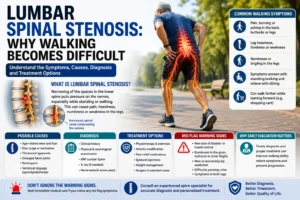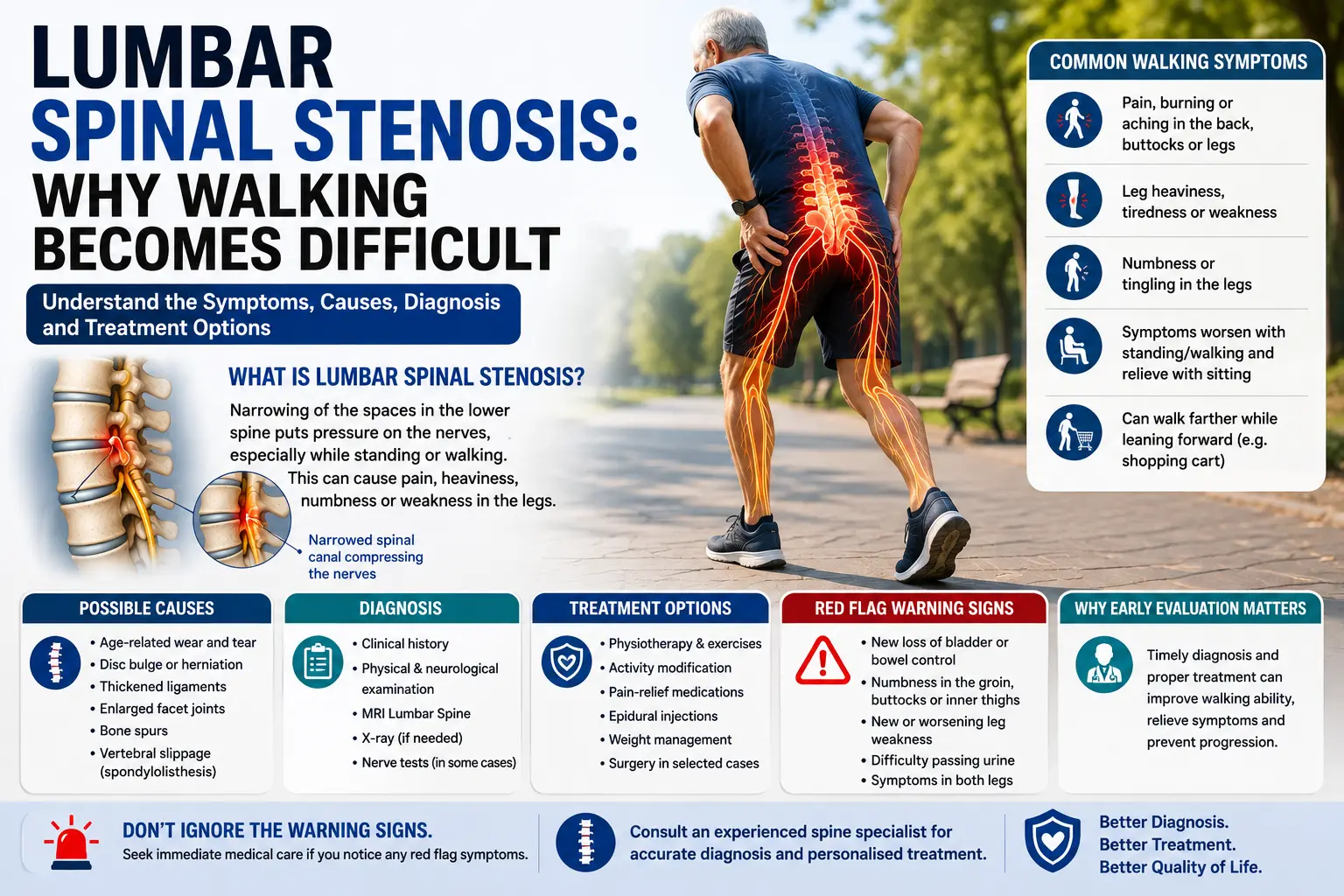
People with lumbar spinal stenosis often notice an unusual pattern: they may feel reasonably comfortable while sitting, yet pain, heaviness, tingling or weakness begins after standing or walking for some time. These lumbar spinal stenosis walking symptoms occur because narrowing in the lower spinal canal reduces the space available for nerves travelling into the legs.
Walking difficulty does not affect everyone in the same way. Some people develop aching calves, while others describe heavy legs, burning pain, numbness or a need to sit after a certain distance. Symptoms may improve when bending forward or leaning over a shopping trolley. This pattern is known as neurogenic claudication.
Understanding this pattern can help distinguish spinal stenosis from other causes of leg discomfort and guide appropriate treatment.
What Is Lumbar Spinal Stenosis?
Lumbar spinal stenosis means narrowing of the spaces within the lower part of the spine where the nerve roots travel.
The lumbar spine contains five vertebrae. Between them are discs, joints and ligaments that help support movement. Over time, several age-related changes may reduce the available space for the nerves.
These may include:
- Loss of disc height
- Bulging or degenerative discs
- Enlargement of the facet joints
- Bone spur formation
- Thickening of spinal ligaments
- Degenerative spondylolisthesis, where one vertebra shifts relative to another
These changes can gradually narrow the central spinal canal or the openings through which individual nerves leave the spine.
An MRI showing narrowing does not automatically mean that a person has symptomatic lumbar stenosis. Doctors match the imaging with the patient’s walking pattern, leg symptoms and neurological examination.
What Are Lumbar Spinal Stenosis Walking Symptoms?
Lumbar spinal stenosis walking symptoms commonly include pain, heaviness, tingling, numbness, cramping or weakness in the buttocks and legs that develops during prolonged standing or walking. Symptoms often improve after sitting or bending forward. This activity-related pattern is called neurogenic claudication.
Typical symptoms include:
- Aching or burning in the buttocks
- Pain travelling into one or both thighs or calves
- Spinal stenosis leg heaviness
- Tingling or numbness
- Calf cramping
- Weakness after walking
- Reduced walking distance
- Feeling unsteady after standing for a while
- Needing frequent sitting breaks
Some patients can walk farther while leaning forward over a trolley than they can while walking upright. AAOS explains that bending forward may increase the space available for the spinal nerves, which can reduce symptoms.
What Is Neurogenic Claudication?
Neurogenic claudication is a pattern of leg symptoms caused by narrowing around the spinal nerves. Pain, burning, heaviness, tingling or weakness is usually brought on by standing or walking and relieved by sitting, squatting or leaning forward. It is one of the characteristic symptom patterns of symptomatic lumbar spinal stenosis.
The word “claudication” simply describes symptoms that occur with activity.
With lumbar spinal stenosis, standing upright and walking can reduce the available room around already crowded nerves. Bending forward changes the position of the lumbar spine and may temporarily create more space.
This explains why someone may say:
“I cannot walk far on an open road, but I can walk much longer while leaning on a shopping cart.”
That pattern is clinically useful, although it does not confirm the diagnosis by itself.
Why Do the Legs Feel Heavy During Walking?
Spinal stenosis leg heaviness is often part of neurogenic claudication.
Patients may not always describe their symptoms as pain. They may instead say that their legs:
- Feel unusually tired
- Become heavy after walking
- Feel as though they may give way
- Become numb or weak
- Need a few minutes of sitting before they can continue
Narrowing around the nerve roots can interfere with normal nerve function during standing and walking. Symptoms may become increasingly noticeable the longer the person remains upright.
In more advanced cases, sitting or lying down may not provide the same degree of relief.
How Is Spinal Stenosis Walking Difficulty Different From Poor Circulation?
Leg pain while walking can also occur because of reduced blood flow to the legs, known as vascular claudication.
This can sometimes resemble lumbar spinal stenosis.
Feature | Neurogenic Claudication | Vascular Claudication |
Main cause | Compression of spinal nerves | Reduced arterial blood flow |
Trigger | Standing or walking upright | Physical exercise |
Relief | Sitting or bending forward often helps | Rest usually helps regardless of posture |
Leg pulses | Usually preserved | May be reduced |
Other clues | Back pain, tingling, numbness or weakness may occur | Cool skin or colour changes may occur |
Doctors may therefore examine pulses in the feet and consider circulation tests when the symptom pattern is unclear.
Hip problems and peripheral nerve disorders can also mimic some lumbar stenosis symptoms, which is another reason a physical examination remains important.
How Is Lumbar Spinal Stenosis Diagnosed?
Diagnosis begins with understanding exactly what happens when the patient walks.
A doctor may ask:
- How far can you walk before symptoms begin?
- Do symptoms affect one leg or both?
- Does sitting relieve the discomfort?
- Does leaning forward help?
- Is there numbness or tingling?
- Have you noticed leg weakness?
- Can you climb stairs normally?
- Have you experienced falls or balance problems?
Neurological Examination
The examination may include checking:
- Leg strength
- Sensation
- Knee and ankle reflexes
- Walking pattern
- Balance
- Heel and toe walking
- Pulses in the legs and feet
Progressive weakness or foot drop deserves closer attention because it indicates that nerve function may be affected rather than pain alone.
MRI Scan
An MRI, or magnetic resonance imaging scan, provides detailed images of the spinal canal, discs and nerve roots.
It can demonstrate:
- Central canal stenosis
- Foraminal narrowing
- Disc degeneration or herniation
- Facet-joint enlargement
- Compression of individual nerve roots
MRI is generally the preferred imaging investigation when lumbar stenosis needs to be confirmed. Diagnosis still requires both compatible symptoms and corresponding imaging findings.
X-rays may also help show spinal alignment, arthritis, loss of disc height or vertebral slippage.
Can You Keep Walking With Lumbar Spinal Stenosis?
Many people with lumbar spinal stenosis can continue walking within a comfortable range. The aim is usually not complete rest, but sensible activity pacing. Shorter walks with breaks, walking in a slightly comfortable forward-leaning posture when appropriate, and an individual physiotherapy programme may help maintain mobility and endurance.
Activity should be adjusted if walking repeatedly produces severe pain or increasing neurological symptoms.
Practical strategies can include:
- Taking shorter walks more frequently
- Resting before symptoms become overwhelming
- Using a walking aid if advised
- Cycling on a stationary bicycle when more comfortable than upright walking
- Gradually building endurance
- Following prescribed strengthening and flexibility exercises
Exercise and physical therapy may help improve pain and walking distance in some patients, although the best rehabilitation approach varies between individuals.
How Is Lumbar Spinal Stenosis Treated?
Treatment is based on the severity of symptoms and how much walking and normal activity have been affected.
Non-Surgical Treatment
When there is no urgent neurological problem, treatment often begins conservatively.
Options may include:
- Physiotherapy
- Core and lower-limb strengthening
- Posture and activity modification
- Appropriate pain-relieving medication
- Weight management where relevant
- Selected spinal injections
Medication choice should be individualised according to age, medical history and other medicines being taken.
Epidural injections may be considered for selected patients for short-term symptom relief. They do not physically widen the spinal canal or correct established muscle weakness.
When Might Surgery Be Considered?
Surgery may become relevant when symptoms significantly restrict normal life despite appropriate non-surgical care.
Reasons for surgical assessment can include:
- Marked walking difficulty from spinal stenosis
- Persistent disabling leg pain
- Progressive leg weakness
- Foot drop
- Increasing numbness
- Poor response to appropriate conservative treatment
- Loss of bladder or bowel control
The most common principle of surgery is decompression, meaning removal of structures that are crowding the nerves to create more space. Fusion may be considered in selected cases when instability is also present.
Surgery is not automatically required simply because an MRI shows severe narrowing.
What Recovery Milestones Should Patients Watch?
Recovery should not be judged only by whether an MRI still shows stenosis.
Functional changes are often more meaningful.
Useful milestones to discuss with your doctor include:
- Walking farther before symptoms begin
- Needing fewer sitting breaks
- Recovering more quickly after a walk
- Reduced leg heaviness
- Less numbness or burning
- Better balance
- Improved leg strength
- Greater independence with daily activities
Keeping a simple record of how many minutes or how far you can comfortably walk can help show whether function is improving, stable or worsening.
After surgery, walking is commonly introduced early as appropriate, followed by gradual rehabilitation. The pace of recovery varies according to the operation, age, overall health, neurological symptoms and whether spinal fusion was required.
What Warning Signs Need Faster Medical Assessment?
Walking limitation caused by lumbar stenosis is usually not an emergency. Certain neurological changes should not be ignored.
Arrange prompt specialist assessment if you develop:
- Increasing leg weakness
- New foot drop
- Repeated falls because the leg gives way
- Rapidly decreasing walking ability
- Progressive numbness
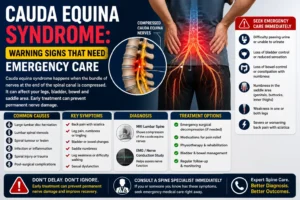
Seek urgent medical care if back or leg symptoms are accompanied by:
- New loss of bladder control
- New bowel-control problems
- Difficulty passing urine
- Numbness around the genitals, buttocks or inner thighs
- Rapidly worsening weakness in both legs
These can indicate severe compression of the lower spinal nerves, including possible cauda equina syndrome.
When Should You Consult a Neurosurgeon?
A neurosurgical review may be useful when lumbar spinal stenosis is progressively limiting walking, causing significant leg symptoms or producing measurable weakness.
The aim of the consultation is not automatically to plan surgery. The specialist needs to determine whether the degree and location of narrowing on imaging actually explain the patient’s functional problems.
Patients experiencing persistent walking limitation can seek evaluation from a spine specialist in Mumbai to review neurological findings, imaging and available treatment options.
A neurosurgeon such as Dr. Mazda K. Turel can assess walking ability, muscle strength, sensation and MRI findings before discussing whether continued conservative management or surgical decompression may be appropriate.
Conclusion
Lumbar spinal stenosis walking symptoms often have a recognisable pattern: the legs become painful, heavy, numb or weak during standing and walking, while sitting or leaning forward provides relief. This pattern, known as neurogenic claudication, develops when narrowed spaces in the lumbar spine affect the nerves travelling into the legs.
The MRI alone does not determine treatment. Walking distance, leg strength, sensation, balance and the effect on everyday life are equally important.
Many patients can begin with activity modification, physiotherapy and other non-surgical measures. Increasing weakness, foot drop or steadily declining walking ability deserves specialist assessment, while new bladder or bowel problems or saddle numbness requires urgent medical care.
Frequently Asked Questions
1. What are the most common lumbar spinal stenosis walking symptoms?
Common lumbar spinal stenosis walking symptoms include aching, burning, heaviness, cramping, numbness or weakness in the buttocks and legs after standing or walking. Many patients feel better after sitting or leaning forward. Symptoms may affect one or both legs and often limit how far a person can walk comfortably.
2. Why can I walk farther when leaning over a shopping trolley?
Leaning forward changes the position of the lumbar spine and can increase the available space around narrowed spinal nerves. This may temporarily reduce neurogenic claudication symptoms. The pattern is sometimes called the “shopping cart sign” and is commonly associated with lumbar spinal stenosis.
3. Can lumbar spinal stenosis make the legs feel weak without much back pain?
Yes. Some patients have relatively little lower back pain but experience leg heaviness, numbness or weakness while standing and walking. The main problem may be pressure on the nerves travelling into the legs rather than pain from the spinal joints themselves.
4. Does lumbar spinal stenosis always get progressively worse?
Not necessarily. Symptoms may remain relatively stable, fluctuate or gradually worsen over time. Treatment decisions are therefore based on functional changes, neurological examination and the patient’s quality of life rather than assuming that every MRI finding will inevitably progress.
5. Should I stop walking if I have neurogenic claudication?
Usually not. Complete inactivity can reduce strength and endurance. Many patients benefit from appropriately paced walking and physiotherapy. However, activity should be modified if it causes severe symptoms, progressive numbness or weakness. A clinician or physiotherapist can help establish an appropriate walking and exercise programme.
6. When is surgery considered for walking difficulty from spinal stenosis?
Surgery may be discussed when walking and normal activities remain significantly restricted despite appropriate non-surgical treatment, or when progressive neurological deficits such as weakness or foot drop develop. The decision also depends on MRI findings, general health and whether spinal instability is present.
7. What symptoms mean lumbar stenosis has become urgent?
New bladder or bowel dysfunction, difficulty passing urine, saddle-area numbness or rapidly worsening leg weakness requires urgent medical assessment. Progressive foot drop or a rapidly declining ability to walk also deserves prompt specialist review.