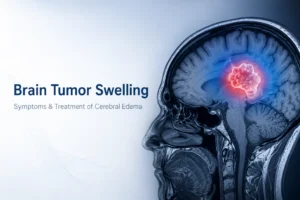
Sometimes the symptoms caused by a brain tumor come not only from the tumor itself but also from swelling in the brain tissue around it. This brain tumor swelling, medically called cerebral or peritumoral edema, can increase pressure inside the skull and temporarily worsen neurological function.
A person may develop headaches, nausea, weakness, speech or vision problems, confusion, seizures, or increasing drowsiness depending on the location and severity of the swelling. Cerebral edema can occur with both primary brain tumors and cancers that have spread to the brain.
Treatment focuses on controlling the swelling while also addressing its underlying cause. Steroid medicines such as dexamethasone are commonly used for symptomatic tumor-related edema, but dosing and tapering need medical supervision.
What Is Brain Tumor Swelling?
Brain tumor swelling occurs when excess fluid builds up in or around brain tissue surrounding a tumor. This is commonly a form of vasogenic cerebral edema, in which disruption of the blood-brain barrier allows fluid to leak from blood vessels into nearby tissue. The swelling can add to the pressure and neurological effects caused by the tumor itself.
The brain sits inside a rigid skull, so there is limited space available when extra fluid accumulates.
A tumor may therefore cause symptoms in two related ways:
- The tumor physically occupies space.
- Swelling around it increases the overall mass effect.
In some patients, the area of edema visible on MRI can extend well beyond the main tumor.
This is why a patient with a relatively modest-sized lesion may still experience significant symptoms if substantial swelling develops around it.
Why Do Brain Tumors Cause Cerebral Edema?
Normal brain blood vessels are protected by the blood-brain barrier, which carefully controls what can move from the bloodstream into brain tissue.
Many tumors disrupt this barrier and alter blood-vessel permeability. Fluid and proteins can then leak into the space between brain cells, producing vasogenic edema. This mechanism is recognised around primary brain tumors as well as brain metastases.
Several factors may influence the amount of edema, including:
- Tumor type
- Tumor location
- Abnormal tumor blood vessels
- Inflammatory signals produced around the tumor
- Previous surgery
- Radiation-related changes
- Individual tissue response
Swelling is therefore not a direct measurement of how large or aggressive a tumor is.
What Brain Swelling Symptoms Can Occur?
Brain swelling symptoms depend on the amount of edema, the speed at which it develops, and which brain structures are affected. Headache, nausea, vomiting, confusion, weakness, speech difficulty, vision changes, seizures, and reduced alertness can occur when cerebral edema increases pressure or disrupts nearby neurological pathways.
Possible symptoms include:
- New or worsening headaches
- Nausea or repeated vomiting
- Weakness in an arm or leg
- Numbness or altered sensation
- Difficulty speaking or finding words
- Blurred or reduced vision
- Problems with balance
- Difficulty concentrating
- Increasing confusion
- Personality or behavioural changes
- Seizures
- Unusual sleepiness
Symptoms can overlap with those caused directly by the tumor.
For example, a tumor near an area controlling movement may cause weakness itself, while edema extending into the same region may make that weakness more noticeable.
Can Swelling Make Brain Tumor Symptoms Suddenly Worse?
Yes.
A change in edema can sometimes produce noticeable neurological deterioration even if the underlying tumor has not dramatically changed in size.
Mayo Clinic notes that peritumoral edema can worsen headaches, weakness, speech problems, and visual symptoms because swelling increases pressure and irritates or stretches nearby brain pathways.
A new neurological deterioration still needs assessment rather than being automatically blamed on known edema. Bleeding, seizures, stroke, hydrocephalus, infection, and tumor progression can produce similar changes.
How Do Doctors See Cerebral Edema on Brain Imaging?
MRI is particularly useful for evaluating brain tumors and the surrounding tissue.
On certain MRI sequences, especially T2-weighted and FLAIR images, areas containing increased fluid may appear brighter than normal brain tissue.
Doctors look at:
- The main tumor
- Amount and distribution of surrounding edema
- Pressure on nearby brain structures
- Compression of the brain’s fluid spaces
- Midline shift
- Changes from previous scans
- Contrast enhancement
- Signs of bleeding or treatment-related change
Edema around a tumor is not necessarily identical to tumor tissue. In infiltrative tumors such as glioma, however, abnormal tumor cells can sometimes extend into areas that also appear swollen on imaging, making interpretation more complex.
CT scanning can also detect significant swelling and mass effect, particularly when rapid imaging is needed.
What Does “Mass Effect” Mean on an MRI Report?
Mass effect means that a tumor, swelling, or both are pushing nearby structures away from their normal position.
The report may describe:
- Compression of nearby brain tissue
- Compression of the ventricles
- Narrowing of normal fluid spaces
- Midline shift
A small amount of mass effect does not have the same meaning in every patient. Doctors interpret it alongside the person’s symptoms, neurological examination, tumor location, and changes from earlier scans.
Significant mass effect associated with neurological deterioration may require urgent treatment.
Brain Tumor Edema Treatment: How Is the Swelling Reduced?
Treatment depends on how severe the swelling is and what is causing it.
Steroids for Brain Swelling
Steroids for brain swelling, particularly dexamethasone, are commonly used when tumor-related cerebral edema is causing symptoms.
Dexamethasone is a corticosteroid that can reduce inflammation and vascular leakage around the tumor. The NCI specifically lists dexamethasone as a treatment for cerebral edema associated with brain tumors.
Patients may notice improvement in pressure-related symptoms as swelling comes under better control, but steroids are not a treatment for every brain tumor and should not be taken without medical supervision.
Doctors generally try to use an appropriate dose for the shortest period needed because corticosteroids can cause side effects.
Possible problems can include:
- Elevated blood sugar
- Increased blood pressure
- Sleep or mood changes
- Muscle weakness with prolonged use
- Increased infection risk
- Impaired wound healing
Steroid treatment may also need to be gradually reduced rather than suddenly stopped depending on the dose and treatment duration. An active NCI study of postoperative dexamethasone specifically highlights the balance between edema control and steroid-related side effects.
Do not change or stop prescribed dexamethasone without advice from the treating team.
Emergency Treatment for Severe Brain Swelling
Severe cerebral edema with rapidly increasing intracranial pressure is a medical emergency.
Hospital treatment may include intensive neurological monitoring and medicines designed to reduce brain swelling and pressure. NCI guidance lists osmotic treatment such as mannitol among supportive therapies used for peritumoral edema.
These treatments require medical supervision and are not home treatments.
Treating the Tumor Itself
Controlling swelling is only part of management.
Depending on the diagnosis, the underlying tumor may require:
- Surgery
- Radiation therapy
- Chemotherapy
- Targeted or other systemic therapy
- A combination of treatments
Treating the tumor can reduce the cause of the edema over time.
When Can Surgery Help With Brain Tumor Swelling?
Surgery may be considered when the tumor is producing significant mass effect and can be removed safely.
Removing tumor tissue may create more space inside the skull and reduce pressure on nearby structures.
The decision depends on:
- Tumor diagnosis
- Location
- Size
- Amount of edema
- Neurological symptoms
- Relationship with important functional areas
- Overall health
- Likely surgical risks
Not every patient with edema needs surgery. Some swelling responds well to medication while the underlying tumor is treated through other approaches.
For patients with substantial mass effect or an identified lesion that may require surgical treatment, assessment by a brain tumor surgeon in Mumbai can help determine whether decompression, tumor removal, biopsy, or another strategy is appropriate.
Why Can Swelling Occur After Brain Tumor Treatment?
Cerebral edema can also appear or increase after treatment.
Possible causes include:
- Normal postoperative tissue response
- Radiation-related inflammation
- Radiation necrosis
- Tumor progression or recurrence
- Other treatment effects
This can make follow-up imaging difficult to interpret.
An enlarging enhancing area with surrounding edema after radiation does not automatically mean that the tumor has returned. Doctors may compare serial scans and use specialised imaging or, in selected cases, tissue diagnosis to clarify the cause.
When Is Brain Tumor Swelling an Emergency?
Seek urgent medical care for neurological deterioration such as:
- A new seizure
- Loss of consciousness
- Rapidly increasing drowsiness
- Severe or rapidly worsening confusion
- New weakness on one side
- New difficulty speaking
- Sudden major vision changes
- Repeated vomiting with worsening headache
- Rapid loss of balance or neurological function
Severe pressure in the brain can become life-threatening if swelling progresses substantially.
Do not increase steroid doses or take someone else’s medication in response to worsening neurological symptoms. Acute deterioration needs medical assessment because the cause may not be edema alone.
When Should You Consult a Neurosurgeon?
A neurosurgical review may be useful when imaging shows a tumor with significant swelling or mass effect, particularly if neurological symptoms are progressing.
A neurosurgeon may review:
- The actual MRI or CT images
- Tumor location
- Amount of edema
- Degree of mass effect
- Neurological examination findings
- Response to steroids
- Whether biopsy is needed
- Whether surgical decompression or tumor removal is appropriate
- Whether another treatment is preferable
Dr. Mazda K. Turel can review the imaging together with symptoms and neurological findings before discussing whether surgery has a useful role.
A consultation does not automatically mean that an operation is required. Sometimes medical treatment and close monitoring remain the most appropriate approach.
Conclusion
Brain tumor swelling can contribute substantially to headache, weakness, speech or vision changes, confusion, seizures, and other neurological symptoms. The swelling is often vasogenic cerebral edema caused by leakage of fluid into brain tissue around a tumor.
MRI helps doctors determine how much edema is present and whether it is creating significant mass effect. Brain tumor edema treatment may involve dexamethasone, other hospital-based measures in severe cases, and treatment directed at the underlying tumor.
Steroids can be very useful but require careful dosing and monitoring rather than self-treatment. New seizures, loss of consciousness, rapidly worsening confusion, repeated vomiting, or sudden neurological deficits need urgent medical assessment.
The key question is not only how much swelling appears on the scan, but how it is affecting the patient and what is causing it.
Frequently Asked Questions
Is brain tumor swelling the same as tumor growth?
No. Brain tumor swelling refers to excess fluid in brain tissue, while tumor growth refers to an increase in tumor tissue. The two can occur together, but swelling can change without a comparable change in tumor size. MRI helps doctors assess the tumor and surrounding edema separately, although they can overlap in some infiltrative tumors.
What does cerebral edema around a brain tumor mean?
Cerebral edema brain tumor findings usually mean excess fluid has accumulated in brain tissue around the lesion. With many tumors, this is vasogenic edema caused by disruption of the blood-brain barrier. The swelling can increase pressure and worsen neurological symptoms even though it is not necessarily all tumor tissue.
How quickly do steroids reduce brain tumor swelling?
The response varies between patients and depends on the amount of edema, underlying tumor, steroid dose, and severity of symptoms. Dexamethasone is commonly used for symptomatic tumor-related cerebral edema, but treatment needs to be monitored because steroids can produce significant side effects. Patients should not adjust the dose themselves.
Does every patient with a brain tumor need steroids?
No. Steroids are generally used when edema is producing symptoms or when the clinical situation makes treatment appropriate. Giving corticosteroids unnecessarily can expose patients to side effects without useful benefit. Whether dexamethasone is needed, at what dose, and for how long should be determined by the treating medical team.
Can cerebral edema cause seizures?
Yes. A brain tumor and changes in nearby swollen brain tissue can disturb normal electrical activity and contribute to seizures. A first seizure requires medical evaluation because tumors are only one possible cause. Patients with a known tumor who develop a new or changing seizure pattern should inform their treating team promptly.
Will cerebral edema disappear after brain tumor surgery?
Swelling may decrease after successful tumor treatment, but it does not necessarily disappear immediately. Surgery itself can temporarily cause additional local swelling as tissues heal. Postoperative imaging and neurological monitoring help doctors determine whether the edema is following an expected course or requires further treatment.
Can brain swelling return after steroids are stopped?
It can if the underlying cause remains active or if steroids are reduced faster than is appropriate for the individual situation. Steroid dosing is therefore often adjusted according to symptoms, imaging, and treatment response. Patients should follow the prescribed taper and contact the treating team if neurological symptoms worsen.