
Best Herniated Disc Specialist in Mumbai
Best Herniated Disc Specialist in Mumbai | Spine Expert
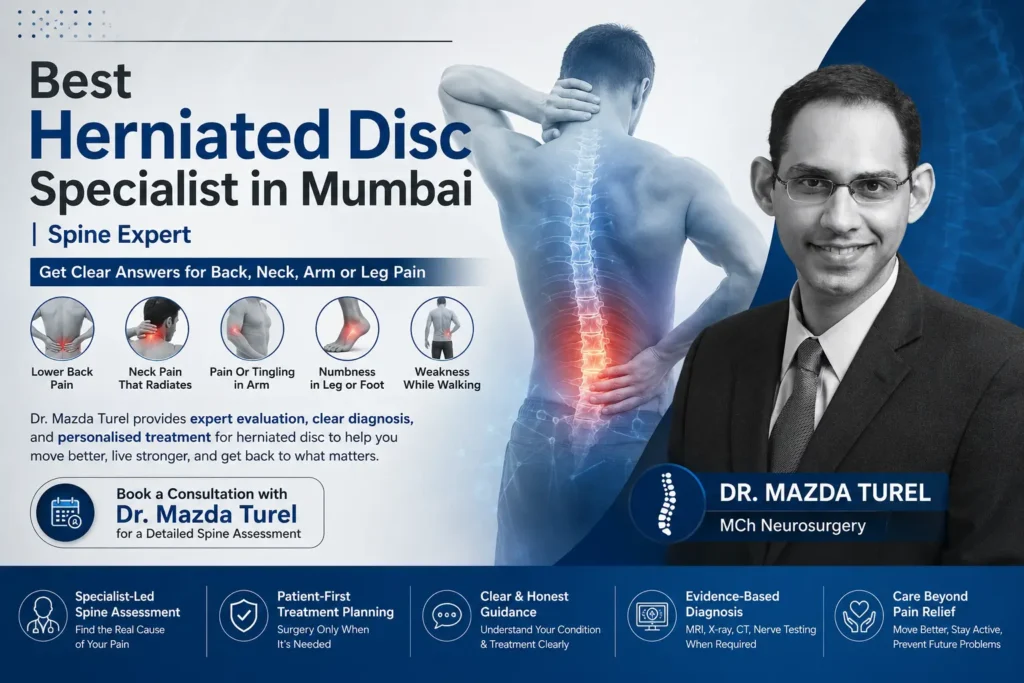
Get Clear Answers for Back, Neck, Arm or Leg Pain
A herniated disc can make simple movements painful. You may feel lower-back pain that travels into the leg, neck pain that shoots into the arm, tingling in the fingers, numbness in the foot, or weakness while walking. These symptoms can affect work, sleep, travel, exercise, and daily confidence.
Dr. Mazda Turel provides specialist evaluation for patients looking for a trusted herniated disc specialist in Mumbai. The focus is on finding the real cause of nerve pain, explaining the condition in simple terms, and choosing the safest treatment path for your symptoms and lifestyle.
Many people with a herniated disc improve with non-surgical care. However, persistent pain, progressive weakness, or nerve-related symptoms may need timely specialist attention.
Why Choose Dr. Mazda Turel for Herniated Disc Treatment?
- Specialist-led spine assessment
Back pain is not always caused by a disc problem. A detailed review helps distinguish disc herniation from spinal stenosis, muscle strain, arthritis, nerve compression, fracture, infection, or other spine conditions.
- Patient-first treatment planning
Treatment is based on your pain pattern, neurological examination, scan findings, activity level, medical history, and recovery goals. Surgery is not recommended unless it is genuinely needed.
- Clear, honest guidance
You should understand what is causing your symptoms, what treatment can help, what recovery may involve, and when urgent care is required.
- Evidence-based diagnosis
MRI, X-ray, CT scan, nerve testing, and blood tests may be used when clinically required. Imaging is selected according to symptoms and red-flag signs rather than ordered routinely.
- Focus on safety
Progressive weakness, loss of bladder or bowel control, severe numbness, or spinal cord compression need urgent assessment. Early recognition can help prevent long-term nerve damage.
- Care beyond pain relief
The aim is not only to reduce pain. It is to help you move better, protect nerve function, return to daily activity safely, and reduce the chance of repeat injury.
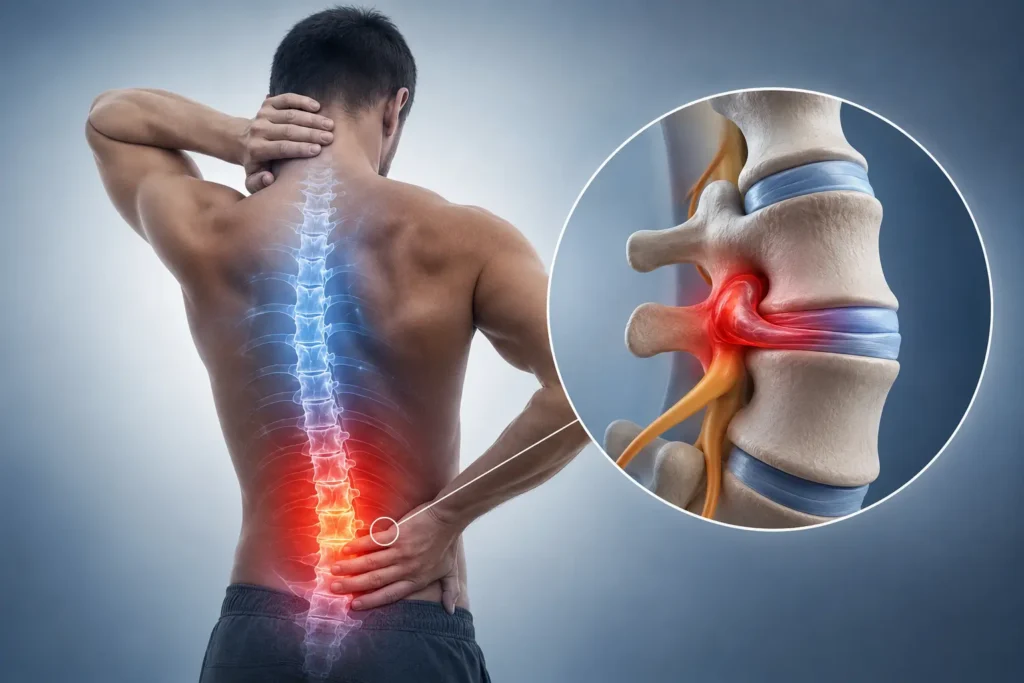
What Is Herniated Disc Treatment?
A spinal disc is a soft cushion between the bones of the spine, called vertebrae. Each disc has a soft inner centre called the nucleus and a tougher outer layer called the annulus.
A herniated disc, also called a slipped disc, prolapsed disc, ruptured disc, or disc prolapse, happens when the soft inner material pushes through a weak or torn part of the outer layer. If this material presses on a nearby nerve root or the spinal cord, it can cause pain, tingling, numbness, weakness, or loss of coordination.
A herniated disc can occur in the:
- Lumbar spine: Lower back, often causing sciatica or leg pain
- Cervical spine: Neck, often causing arm pain, hand numbness, or weakness
- Thoracic spine: Mid-back, less common but sometimes linked with chest-wall pain or spinal cord symptoms
Treatment may include medicines, activity changes, physiotherapy, injections, or surgery depending on nerve pressure and symptom severity.
Conditions Treated
- Lumbar Disc Herniation and Sciatica
A lumbar disc herniation occurs in the lower back. It commonly affects the L4-L5 or L5-S1 levels and may irritate the sciatic nerve.
Common symptoms:
- Low-back pain
- Pain moving from the buttock into the thigh, calf, or foot
- Burning, electric-shock, or shooting leg pain
- Numbness in the foot or toes
- Weakness while lifting the foot or standing on the toes
- Pain that worsens while coughing, sneezing, bending, or sitting
When treatment is needed:
A specialist review is important when pain does not improve, sleep and walking are affected, weakness develops, or symptoms keep returning.
2. Cervical Disc Herniation
A cervical disc herniation affects the neck. It may press on a nerve root or, in some cases, the spinal cord.
Common symptoms:
- Neck pain and stiffness
- Pain spreading into the shoulder, arm, or hand
- Tingling in the fingers
- Numbness in the arm or hand
- Weak grip or difficulty holding objects
- Headache linked with neck movement
When treatment is needed:
Seek specialist care when arm pain is severe, weakness is increasing, balance is affected, or hand coordination becomes difficult. Cervical disc problems can sometimes cause spinal cord compression, known as myelopathy.
3. Disc Bulge and Disc Prolapse
A disc bulge means the disc extends beyond its normal boundary. A disc prolapse or herniation means the inner material pushes through the outer layer more clearly.
Common symptoms:
- Localised neck or back pain
- Pain during sitting, bending, lifting, or twisting
- Leg pain or arm pain
- Tingling or numbness
- Muscle weakness in severe nerve compression
When treatment is needed:
A scan finding alone does not always need treatment. Care is considered when symptoms, clinical examination, and imaging findings match.
4. Recurrent Disc Herniation
Some patients develop pain again after previous disc surgery. This may happen due to repeat herniation, scar tissue, instability, spinal degeneration, or a different level of nerve compression.
Common symptoms:
- Return of leg pain or arm pain
- New numbness or weakness
- Pain after a period of improvement
- Difficulty returning to normal work or exercise
When treatment is needed:
New or worsening symptoms after spine surgery should be assessed carefully. MRI and clinical examination may help identify the cause.
5. Disc Herniation with Nerve Weakness
A compressed nerve can affect muscle strength. Examples include foot drop, reduced hand grip, difficulty climbing stairs, or trouble standing on the heels or toes.
Common symptoms:
- Foot dragging while walking
- Weak ankle movement
- Difficulty lifting the arm
- Dropping objects
- Loss of balance
- Reduced muscle strength on one side
When treatment is needed:
Progressive weakness should not be ignored. It needs prompt specialist assessment to reduce the risk of long-term nerve damage.
6. Cauda Equina Syndrome
Cauda equina syndrome is a rare but serious condition where nerves at the base of the spine are compressed.
Common symptoms:
- Loss of bladder control
- Difficulty passing urine
- Loss of bowel control
- Numbness around the groin, buttocks, or inner thighs
- Severe weakness in one or both legs
When treatment is needed:
This is a medical emergency. Go to the nearest emergency department immediately. Delaying treatment may lead to permanent weakness, numbness, or bladder and bowel problems.
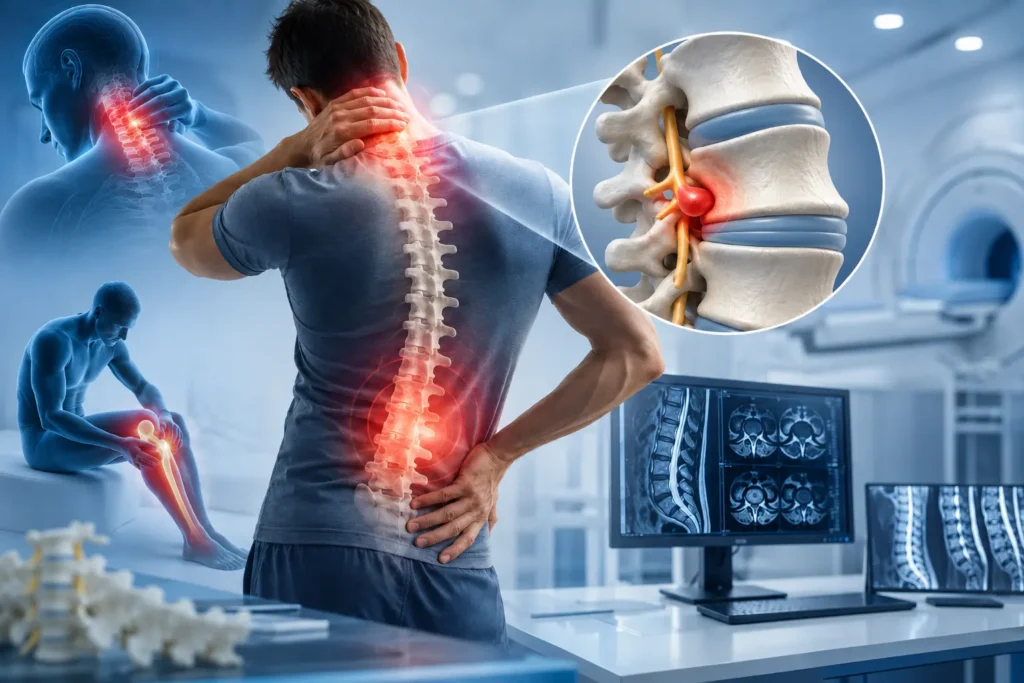
Signs You Should See a Herniated Disc Specialist
Consult a spine specialist if you have:
- Back pain travelling into the leg
- Neck pain travelling into the arm
- Persistent numbness or tingling
- Weakness in the hand, arm, foot, or leg
- Pain that is not improving with rest and basic care
- Difficulty walking, sitting, driving, or sleeping
- Recurrent pain after previous spine surgery
- Pain after a fall, accident, or heavy lifting injury
- Severe pain with fever, unexplained weight loss, or a history of cancer
- Loss of bladder or bowel control
- Numbness around the groin or inner thighs
Causes and Risk Factors for Herniated Disc
A herniated disc can develop suddenly after strain, but it often develops gradually as the disc loses water content and flexibility over time.
Common causes and risk factors include:
- Age-related disc wear
As discs age, they can become less flexible and more likely to tear or bulge.
- Heavy lifting with poor technique
Lifting with the back instead of the legs can increase stress on the lumbar spine.
- Repeated bending and twisting
Jobs or activities that involve frequent bending, twisting, lifting, pulling, or pushing may increase disc strain.
- Long hours of sitting
Extended sitting, especially with poor posture, can increase pressure on the lower-back discs.
- Smoking
Smoking may reduce blood supply to spinal discs and contribute to disc degeneration.
- Excess body weight
Extra weight can increase the load carried by the lower-back discs.
- Low physical activity
Weak core and back muscles may reduce spinal support.
- Family tendency
Some people may have an inherited tendency toward disc degeneration or disc herniation.
Diagnosis of Herniated Disc
A correct diagnosis starts with listening to your symptoms, not only reading an MRI report.
- Medical History
Your doctor may ask about:
- Where the pain starts and where it travels
- Tingling, numbness, weakness, or balance changes
- Recent lifting, injury, fall, or accident
- Pain during coughing, sneezing, sitting, bending, or walking
- Previous treatment, injections, surgery, or physiotherapy
- Medical conditions such as diabetes, osteoporosis, cancer, or infection
- Physical and Neurological Examination
The examination may include checking:
- Muscle power
- Reflexes
- Sensation in the arm or leg
- Walking pattern
- Spine movement
- Straight-leg raise test for sciatica
- Hand coordination and balance for cervical spine symptoms
1. MRI Scan
MRI is commonly used to view discs, nerves, spinal cord, and soft tissues. It can help identify disc herniation, nerve compression, spinal stenosis, infection, or tumour-related changes when clinically suspected.
2. X-Ray
An X-ray does not show the disc clearly, but it may help assess spinal alignment, instability, arthritis, fractures, or bone changes.
3. CT Scan
CT may be useful when detailed bone assessment is required or when MRI is not suitable.
- Nerve Conduction Study or EMG
In selected cases, nerve testing may help confirm whether weakness or numbness is linked to nerve compression or another nerve condition.
Imaging is most useful when symptoms persist, neurological signs are present, red flags exist, or an injection or surgery is being considered.
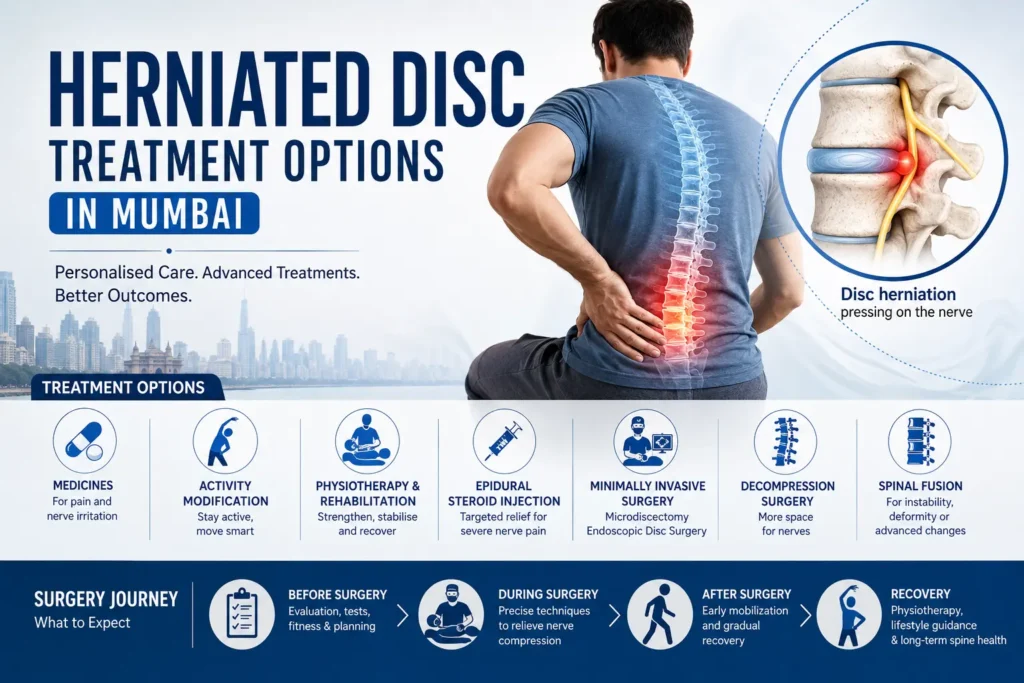
Herniated Disc Treatment Options in Mumbai
The right treatment depends on the location of the disc problem, nerve involvement, symptom duration, weakness, scan findings, and your daily needs.
- Medicines for Pain and Nerve Irritation
Your doctor may prescribe medicines for short-term pain relief, inflammation, muscle spasm, or nerve-related pain where appropriate.
Medicines should only be taken under medical guidance, especially if you have kidney disease, stomach ulcers, heart disease, diabetes, are pregnant, or take blood thinners.
- Activity Modification
Complete bed rest is usually not advised for long periods. Controlled movement, avoiding painful lifting, and gradual return to daily activity can support recovery.
- Physiotherapy and Rehabilitation
Physiotherapy may include:
- Gentle mobility exercises
- Core strengthening
- Posture correction
- Nerve glide exercises
- Walking progression
- Safe lifting education
- Return-to-work guidance
The exercise plan should be tailored to your symptoms. A movement that helps one patient may worsen symptoms in another.
- Epidural Steroid Injection
For selected patients with severe radicular pain, an epidural steroid injection may help reduce inflammation around the irritated nerve and provide short-term pain relief.
It is not a permanent solution for every patient, and the decision should be based on symptoms, imaging, medical history, and clinical examination.
- Microdiscectomy
Microdiscectomy is a surgical procedure used to remove the part of the disc pressing on the nerve. It is commonly considered when severe leg pain, nerve weakness, or persistent symptoms do not improve with appropriate non-surgical treatment.
- Endoscopic Disc Surgery
Endoscopic disc surgery uses a small camera and specialised instruments through a small incision to access selected disc problems. It may be suitable for some lumbar disc herniations, depending on disc location, anatomy, and nerve compression.
Not every patient is a candidate for endoscopic treatment. The safest technique is chosen after reviewing your clinical condition and imaging.
- Laminectomy or Decompression Surgery
If there is spinal canal narrowing, bone spur pressure, or ligament thickening along with disc compression, decompression surgery may be considered to create more space for the nerves.
- Spinal Fusion
Fusion is not required for every disc herniation. It may be considered in selected cases involving instability, deformity, repeated disc surgery, or significant degenerative changes.
Herniated Disc Surgery: What Happens Before, During and After?
- Before Surgery
Before surgery, your doctor may review:
- MRI or CT scan findings
- Your symptoms and neurological examination
- Medical fitness for anaesthesia
- Blood tests and medications
- Diabetes, blood pressure, heart health, and blood thinner use
- Expected benefits, limitations, and possible risks
You will also receive instructions about fasting, medicines, hospital admission, and recovery planning.
- During Surgery
The exact technique depends on the spine level and problem being treated. In a discectomy or microdiscectomy, the surgeon removes the portion of the disc causing pressure on the nerve while preserving as much normal tissue as possible.
- After Surgery
After surgery, you may be encouraged to stand and walk based on your condition and the procedure performed. Pain relief can be quick for some patients, while numbness or weakness may take longer to improve because nerves recover gradually.
- Recovery
Recovery time differs from person to person. It depends on the procedure, duration of nerve compression, overall health, type of work, and rehabilitation progress.
Your doctor will guide you on:
- Sitting and sleeping positions
- Walking schedule
- Wound care
- Bathing instructions
- Driving
- Return to work
- Physiotherapy
- Lifting restrictions
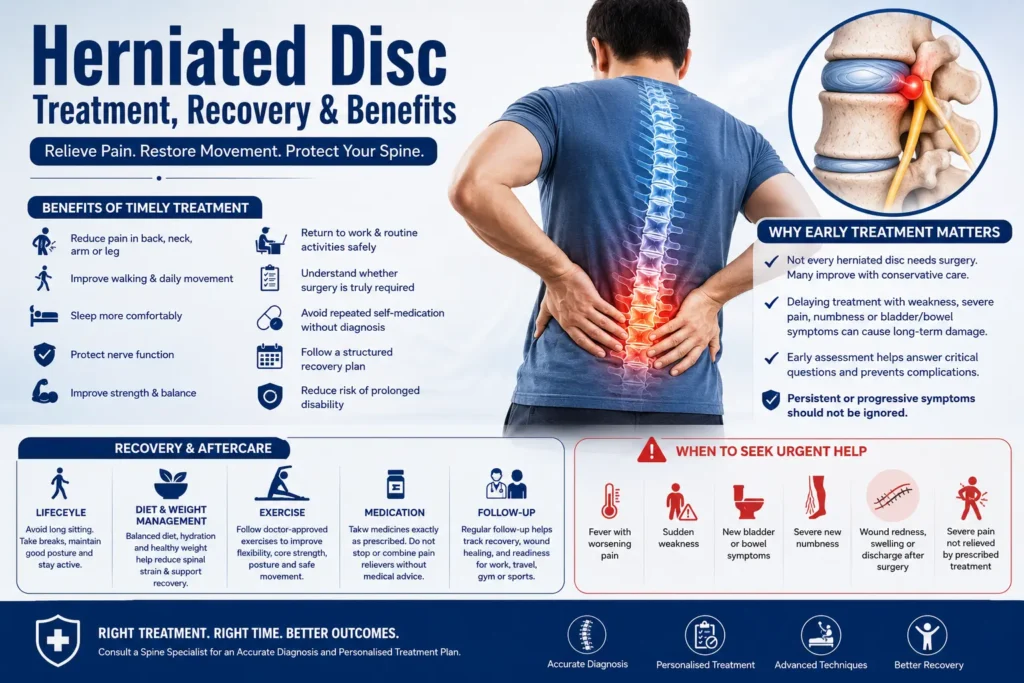
Benefits of Timely Herniated Disc Treatment
Appropriate treatment may help you:
- Reduce back, neck, arm, or leg pain
- Improve walking and daily movement
- Sleep more comfortably
- Protect nerve function
- Improve strength and balance
- Return to work and routine activities safely
- Understand whether surgery is truly required
- Avoid repeated self-medication without diagnosis
- Follow a structured recovery plan
- Reduce the risk of prolonged disability caused by untreated nerve compression
Results vary from person to person. The goal is to choose the most suitable treatment at the right time.
Why Early Treatment Matters
Not every herniated disc needs surgery. Many patients improve with guided conservative treatment.
However, waiting too long when there is progressive weakness, severe nerve pain, worsening numbness, balance changes, or bladder and bowel symptoms can increase the risk of long-term nerve problems.
Early specialist assessment can help answer important questions:
- Is the pain truly from a disc?
- Is a nerve under pressure?
- Is weakness getting worse?
- Is physiotherapy safe at this stage?
- Is an injection likely to help?
- Is surgery necessary now, later, or not at all?
Persistent or progressive neurological symptoms should be reviewed without delay.
Recovery and Aftercare for Herniated Disc
- Lifestyle
Avoid prolonged sitting in one position. Take short walking breaks, use good posture, and return to activity gradually.
- Diet and Weight Management
A balanced diet with adequate protein, fibre, hydration, and healthy body weight can support overall recovery. If weight is contributing to lower-back strain, gradual weight management may help reduce spinal load.
- Exercise
Only follow exercises approved by your treating doctor or physiotherapist. Common rehabilitation goals include improving flexibility, core strength, hip mobility, posture, and safe movement patterns.
- Medication
Take prescribed medicines exactly as advised. Do not stop, increase, or combine pain medicines without medical guidance.
- Follow-Up
Follow-up visits help track pain levels, nerve recovery, wound healing after surgery, and readiness to return to work, travel, gym activity, or sports.
- When to Seek Urgent Help During Recovery
Contact your doctor or seek urgent care if you develop:
- Fever with worsening back or neck pain
- Sudden weakness
- New bladder or bowel symptoms
- Severe new numbness
- Increasing wound redness, swelling, or discharge after surgery
- Severe pain that does not improve with prescribed treatment

Emergency Cases
Please feel welcome to contact our friendly reception staff with any general or medical equiry call us.
Frequently Asked Questions
1. What is the difference between a slipped disc and a herniated disc?
They are commonly used to describe the same condition. A herniated disc occurs when the soft inner part of a spinal disc pushes through a tear or weak area in the outer layer.
2. Can a herniated disc heal without surgery?
Yes. Many people improve with medicines, activity changes, physiotherapy, and time. Surgery may be considered when pain remains severe, weakness progresses, or nerve compression affects daily life.
3. What are the first symptoms of a herniated disc?
Symptoms may include back or neck pain, pain travelling into the leg or arm, tingling, numbness, burning pain, or weakness. Symptoms vary depending on the disc level and the nerve affected.
4. Does a herniated disc always show on MRI?
MRI can often identify disc bulges and herniations. However, scan findings must be matched with your symptoms and examination because some people have disc changes on MRI without pain.
5. How do I know if my leg pain is sciatica?
Sciatica often feels like sharp, burning, electric, or shooting pain that travels from the lower back or buttock into the thigh, calf, or foot. It may also cause numbness or weakness.
6. Can a herniated disc cause foot drop?
Yes. A lumbar disc herniation can compress nerves that help lift the foot. Foot drop or new weakness requires prompt specialist assessment.
7. Is neck disc pain dangerous?
Neck disc pain can range from mild to serious. Arm pain and tingling may occur due to nerve irritation. However, weakness, poor hand coordination, gait imbalance, or signs of spinal cord compression need urgent evaluation.
8. When is surgery required for a herniated disc?
Surgery may be considered for severe persistent pain that does not improve with suitable non-surgical treatment, progressive weakness, cauda equina syndrome, or significant nerve compression affecting daily function.
9. Is endoscopic disc surgery better than open surgery?
Endoscopic surgery may be helpful for selected patients because it uses smaller access points. However, it is not automatically better for every disc problem. The best procedure depends on disc location, anatomy, nerve pressure, previous surgery, and overall health.
10. How long does recovery take after microdiscectomy?
Recovery varies. Many patients begin walking soon after surgery, but return to work, exercise, driving, and lifting depends on the procedure, type of work, healing progress, and doctor’s advice.
11. Can physiotherapy make a herniated disc worse?
The wrong exercise at the wrong stage can increase pain. Physiotherapy should be guided by your symptoms, scan findings, and specialist advice. Stop and seek medical guidance if pain sharply worsens or weakness develops.
12. Can I go to the gym with a slipped disc?
You may need to pause heavy lifting, twisting, deep bending, or high-impact activity during the painful stage. A gradual return should be planned with your doctor or physiotherapist.
13. Can sitting worsen a herniated disc?
Long periods of sitting may increase lower-back discomfort for some people. Taking regular breaks, changing position, using lumbar support, and improving posture may help.
14. What should I avoid with a herniated disc?
Avoid heavy lifting with poor form, repeated twisting, sudden bending, long periods of inactivity, self-prescribed pain medicines, and exercises that clearly worsen pain or numbness.
15. When should I go to the emergency room for back pain?
Go to emergency care immediately if you have loss of bladder or bowel control, numbness around the groin, severe weakness in the legs, inability to walk properly, or severe back pain with fever and illness.