
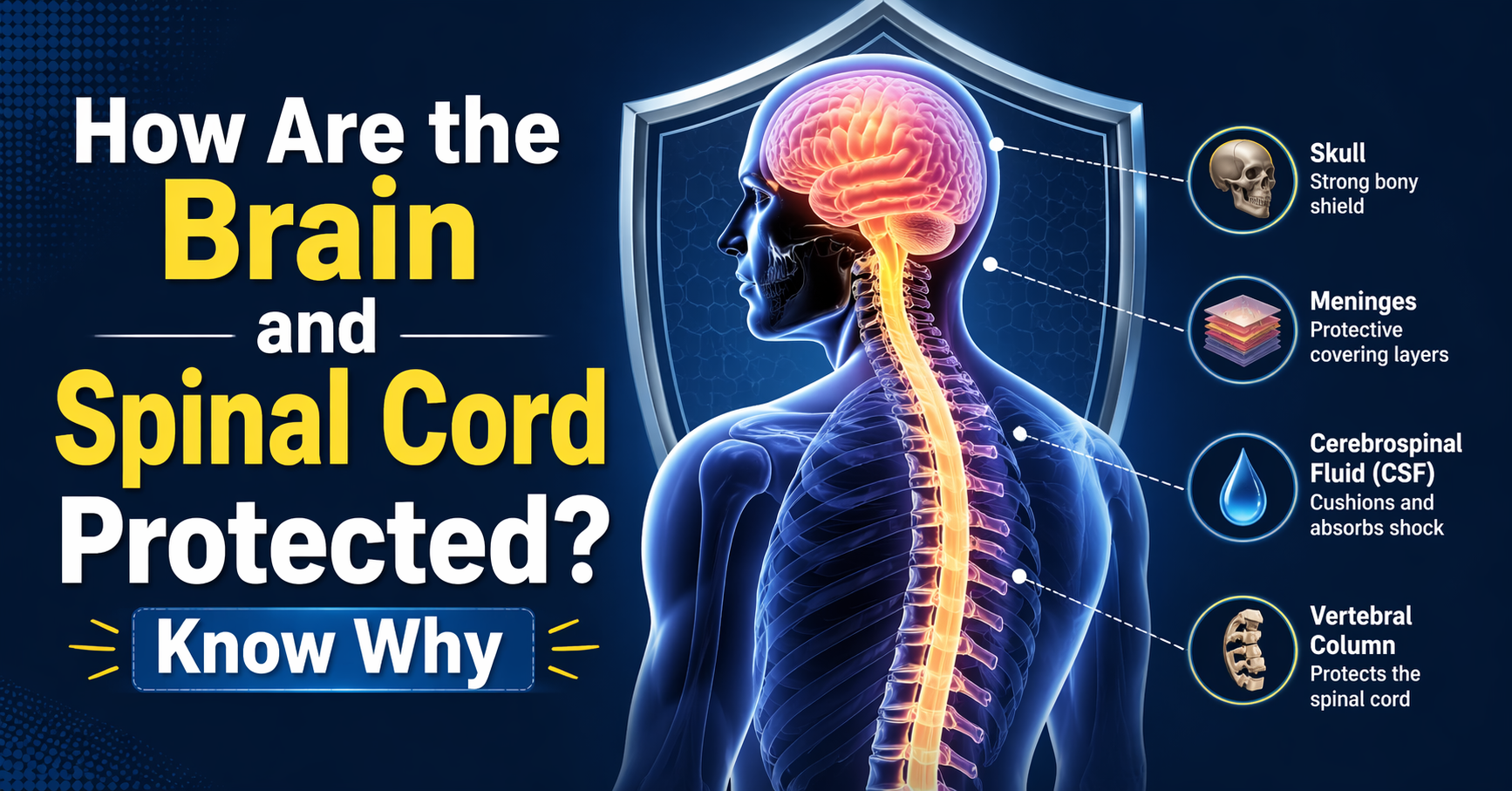
Understanding how are the brain and spinal cord protected isn’t just a biology topic-it’s the foundation of how your body survives everyday life. These two organs make up the central nervous system, which controls everything from breathing and movement to memory and emotions.
Because they are so vital, the body doesn’t rely on just one layer of protection-it uses a multi-layered defense system that works together like a shield.
Let’s break this down in a way that’s easy to understand.
Why Protection of the Brain and Spinal Cord Matters
Your brain is like a control center, and your spinal cord is the communication highway connecting it to the rest of your body. Even a small injury can disrupt signals, leading to serious complications.
That’s why the body has developed three major protection systems:
- Strong bones
- Protective membranes
- Fluid cushioning
Each of these plays a different role, but together, they form a highly reliable defense system.
1. Skull – The Hard Outer Shield of the Brain
The first and most visible protection for the brain is the skull, also called the cranium.
What makes the skull effective?
- It is made of thick, strong bones
- Designed to absorb impact
- Covers the brain completely
Think of it like a helmet that you’re born with.
But here’s the catch:
While the skull is strong, it’s not indestructible. Severe trauma (like accidents) can still affect the brain, which is why internal protection layers are equally important.
2. Vertebral Column – Protection for the Spinal Cord
The spinal cord runs through a long structure called the vertebral column (or spine).
Key features:
- Made up of 33 vertebrae
- Each bone has a hollow center
- These openings form a canal where the spinal cord sits
Additional protection:
- Intervertebral discs act like shock absorbers
- Flexible structure allows movement while protecting nerves
This design ensures that even when you bend, twist, or move, your spinal cord remains safe.
3. Meninges – The Protective Covering Layers
Inside the bones, there’s another layer of protection called the meninges.
These are three thin layers of tissue that wrap around both the brain and spinal cord.
The three layers:
- Dura Mater – Tough outer layer
- Arachnoid Mater – Middle web-like layer
- Pia Mater – Soft inner layer directly covering the brain
What do they do?
- Protect against infections
- Provide structural support
- Hold fluid (CSF) in place
These layers act like a soft yet secure wrapping system.
4. Cerebrospinal Fluid (CSF) – The Cushioning System
One of the most fascinating answers to how are the brain and spinal cord protected is the role of cerebrospinal fluid (CSF).
What is CSF?
A clear fluid that surrounds both the brain and spinal cord.
Its functions:
- Acts as a shock absorber
- Reduces pressure on the brain
- Supplies nutrients
- Removes waste
Interesting fact:
Your brain actually “floats” in this fluid, which reduces its effective weight and prevents damage from sudden movements.
5. Blood-Brain Barrier – The Chemical Protection
Beyond physical protection, the brain also has a filter system called the blood-brain barrier.
What does it do?
- Blocks harmful substances from entering the brain
- Allows essential nutrients to pass through
This ensures that toxins, infections, or harmful chemicals don’t easily reach sensitive brain tissue.
How All These Layers Work Together
The protection system is not just about individual parts it’s about how they function together:
- Skull & vertebrae → protect from physical impact
- Meninges → provide layered security
- CSF → absorbs shock and maintains balance
- Blood-brain barrier → protects chemically
Together, they form a complete defense mechanism.
What Happens When Protection Fails?
Even with strong protection, certain conditions can affect the brain and spinal cord:
- Head injuries
- Spinal cord injuries
- Infections like meningitis
- Tumors
When these occur, expert medical care becomes essential. If you’re looking for specialized guidance or advanced treatment options, you can explore expert neurosurgical care here:
https://mazdaturel.com/
Simple Analogy to Understand Better
Imagine protecting something extremely valuable:
- Box (Skull & Spine) → Hard outer protection
- Bubble wrap (Meninges) → Soft cushioning layers
- Water cushion (CSF) → Shock absorption
- Security filter (Blood-brain barrier) → Blocks harmful elements
That’s exactly how your body protects your central nervous system.
Key Takeaways
- The brain and spinal cord are protected by multiple layers, not just one
- Bones provide the first line of defense
- Meninges and fluid add internal protection
- Chemical barriers prevent harmful substances from entering
- All systems work together to ensure safety
When Should You Be Concerned?
You should seek medical attention if you notice:
- Persistent headaches
- Neck or back pain
- Weakness or numbness
- Loss of coordination
Early diagnosis can prevent serious complications. For expert consultation and guidance, you can also visit:
https://mazdaturel.com/
Final Thought
The human body has designed one of the most advanced protection systems for the brain and spinal cord. From hard bones to fluid cushioning and microscopic filters, every layer plays a role in keeping you functioning normally every second.
Understanding how are the brain and spinal cord protected helps you appreciate why even minor symptoms should never be ignored and why proper care matters.
1. How are the brain and spinal cord protected in simple terms?
They are protected by bones (skull and spine), membranes (meninges), fluid (CSF), and a chemical filter (blood-brain barrier).
2. What is the main function of cerebrospinal fluid?
It cushions the brain and spinal cord, absorbs shocks, and helps transport nutrients and waste.
3. Can the skull fully protect the brain?
The skull provides strong protection, but severe injuries can still affect the brain, which is why internal layers are also important.
4. What happens if the spinal cord is damaged?
Damage to the spinal cord can disrupt communication between the brain and body, leading to loss of movement or sensation.
5. What are meninges and why are they important?
Meninges are three protective layers that surround the brain and spinal cord, providing structure and protection.
6. Is the brain directly attached to the skull?
No, the brain is surrounded by fluid and membranes, which prevent direct contact with the skull.
7. What is the blood-brain barrier?
It’s a protective system that filters harmful substances from entering the brain while allowing essential nutrients.
6 thoughts on “How Are the Brain and Spinal Cord Protected? Know Why”
winx96 casino, https://play-winx96.com/ заинтересовывает
многих азартных любителей игр.
Юридические услуги в Алматы, https://femida-justice.com/ предоставляют качественную помощь в разрешении правовых
вопросов.
I’m not that much of a online reader to be honest but your sites really
nice, keep it up! I’ll go ahead and bookmark your
site to come back later. Cheers
мостбет официальный сайт, мостбет официальный
сайт зеркало предлагает широкий выбор азартных игр и ставок.
Also visit my site :: https://mostbet-cwn49.top/
леонбетс зеркало, leon зеркало
— это важный инструмент для игроков, который обеспечивает доступ к платформе в условиях
блокировок.
My web-site: https://leon-nqz29.cfd/
интернет-магазин одежды ,
https://vgarderobe.ru/предлагает широкий выбор стильной и современной одежды.