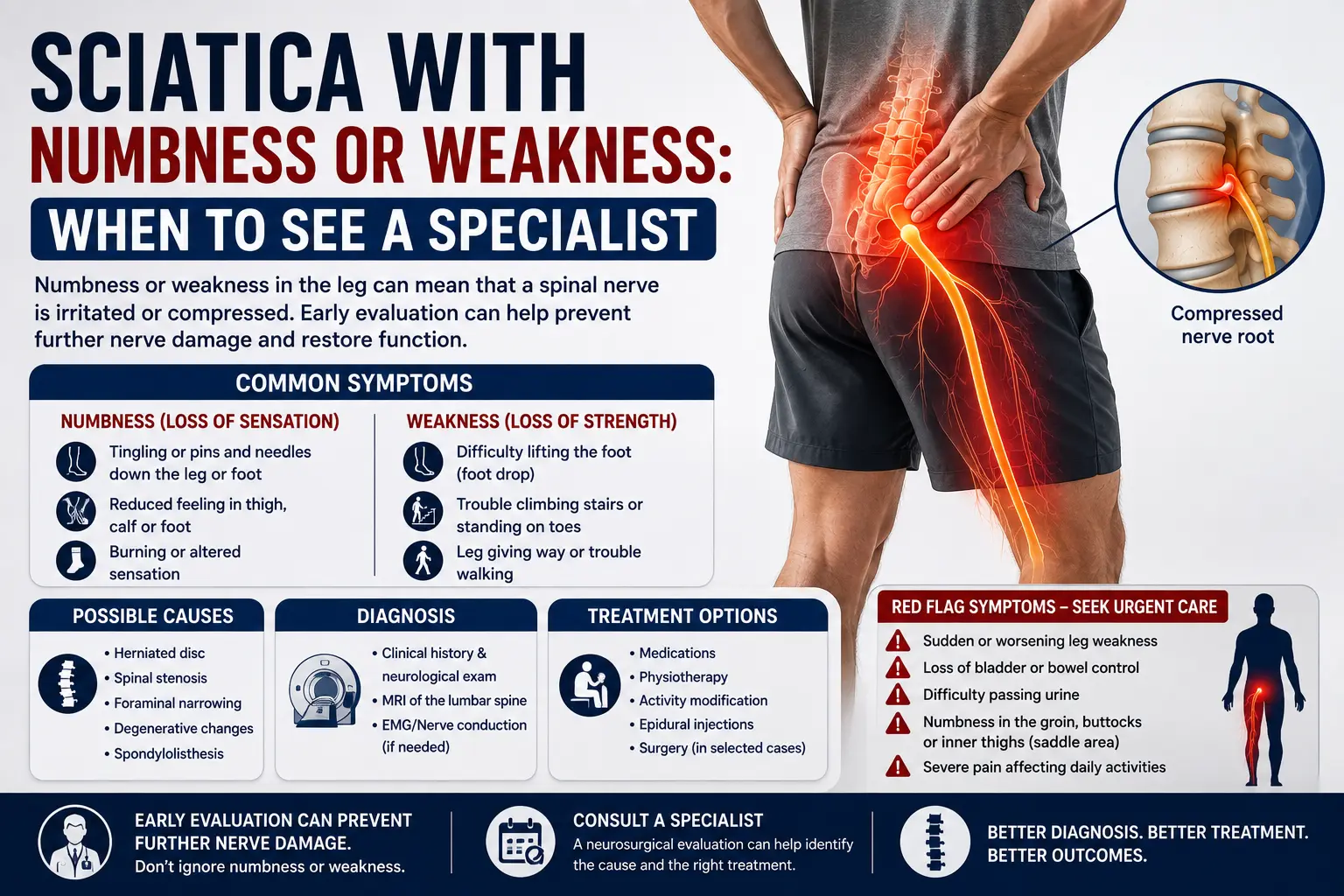
Sciatica is often associated with shooting or burning leg pain, but pain is not the only symptom a compressed nerve can produce. Sciatica numbness and weakness can occur when a nerve root in the lower spine is irritated or compressed strongly enough to affect sensation or muscle function.
Occasional tingling or a small numb area may occur with sciatica, but new or increasing muscle weakness deserves closer attention. Difficulty lifting the foot, walking normally, standing on the toes or controlling the leg may indicate that the nerve is not functioning normally.
This does not automatically mean surgery is required. The next step depends on how severe the neurological changes are, whether they are progressing, and what the examination and imaging show.
What Do Sciatica Numbness and Weakness Mean?
Sciatica numbness and weakness suggest that the affected spinal nerve may be influencing sensory or motor function, not only causing pain. Numbness reflects altered sensation, while weakness means the muscles supplied by the nerve are not working at their usual strength. Progressive or significant weakness generally deserves prompt medical assessment.
Sciatica occurs when one or more nerve roots contributing to the sciatic nerve become irritated or compressed.
A compressed nerve can produce several types of symptoms:
- Pain
- Burning
- Tingling or pins and needles
- Reduced sensation
- Muscle weakness
- Changes in reflexes
Mayo Clinic notes that sciatica may cause numbness, tingling and muscle weakness in the affected leg or foot in addition to pain.
The exact combination varies. One person may have severe pain but normal strength, while another may notice less pain but more obvious numbness or weakness.
Is Sciatica Leg Numbness Normal?
Sciatica leg numbness can occur when an irritated nerve root affects the sensory signals travelling between the leg and the spinal cord. It may affect a small area of the thigh, calf or foot, depending on which nerve root is involved. Persistent, spreading or worsening numbness should be medically assessed.
Patients may describe numbness as:
- Reduced feeling when touching the skin
- A “dead” or heavy sensation
- Pins and needles
- Burning
- Altered temperature sensation
- Feeling as though part of the foot is covered by a thick sock
Pain and numbness do not always appear in exactly the same location. A person may experience pain in one part of the leg and numbness in another.
Merck Manual notes that lumbar nerve-root compression can produce sensory loss, weakness and changes in reflexes as well as radiating pain.
What Does Sciatica Weakness Feel Like?
Sciatica weakness is different from avoiding movement because it hurts. True neurological weakness means a muscle cannot produce its normal strength because the affected nerve is not supplying it properly. It may show up as difficulty controlling the ankle, foot or leg during ordinary activities.
Examples can include:
- The foot repeatedly catching on the floor
- Difficulty lifting the front of the foot
- Trouble walking on the heels
- Difficulty standing or walking on the toes
- The leg giving way unexpectedly
- Reduced ability to climb stairs
- Difficulty maintaining normal walking because one leg feels weak
Pain can also make a person hesitant to use the leg fully. A neurological examination helps distinguish pain-limited movement from actual loss of muscle power.
New weakness should not simply be treated by doing more strengthening exercises at home without understanding why it has developed.
Why Can Sciatica Cause Weakness or Numbness?
The sciatic nerve is formed from nerve roots emerging from the lower spine. These nerve roots carry both sensory information and signals that control muscles.
If a nerve root is compressed, its function can become disturbed.
Common causes of nerve compression sciatica include:
Herniated Disc
A lumbar disc can herniate and press against a nearby nerve root.
This can cause radiating pain, numbness and sometimes muscle weakness in the areas supplied by that nerve.
Lumbar Spinal Stenosis
Spinal stenosis means that the space available for nerves becomes narrowed. It may develop because of age-related changes involving discs, joints and ligaments.
Some patients experience leg pain, numbness or weakness that becomes more noticeable while standing or walking.
Foraminal Narrowing
Nerves leave the spine through small openings called foramina. Degenerative changes can narrow these openings and place pressure on an exiting nerve.
Spondylolisthesis and Degenerative Changes
A vertebra that shifts relative to the one below it, along with arthritic or bony changes around the spine, can also reduce the space available for nerves.
Less commonly, other conditions can produce similar neurological symptoms. This is why numbness or weakness should not be self-diagnosed as a disc problem solely from symptoms.
When Does Numbness or Weakness Need Specialist Review?
Not every tingling sensation requires an emergency visit. However, neurological changes deserve more attention than uncomplicated pain.
Arrange medical or specialist evaluation if:
- Numbness persists rather than gradually improving
- The area of numbness is increasing
- You notice measurable weakness in the leg or foot
- Walking has changed
- The foot repeatedly catches while walking
- Heel or toe walking becomes difficult
- Symptoms are continuing despite appropriate treatment
- Pain, numbness or weakness significantly interferes with daily activity
AANS advises earlier imaging and specialist assessment when progressive neurological deficits, including increasing weakness, are present.
The trend matters. Stable mild symptoms are different from weakness that is noticeably worsening over hours or days.
Which Severe Sciatica Symptoms Require Urgent Medical Attention?
New marked or rapidly worsening weakness, loss of bladder or bowel control, difficulty passing urine, or numbness around the genitals and inner thighs requires urgent medical assessment. These symptoms can indicate severe compression of the lower spinal nerves and should not be managed by waiting for a routine appointment.
Seek urgent care for:
- Sudden significant leg weakness
- Rapid progression of existing weakness
- New inability to control urine
- Difficulty starting or passing urine
- New loss of bowel control
- Numbness around the genitals, anus, buttocks or inner thighs
- Severe neurological symptoms affecting both legs
- Major new difficulty standing or walking because of weakness
A combination of bladder, bowel or sexual dysfunction with new perineal numbness can suggest cauda equina syndrome, which requires immediate assessment. NICE recommends immediate referral when severe low back pain radiating into the leg occurs with new bladder, bowel or sexual dysfunction or new perineal numbness.
These are different from ordinary severe sciatica symptoms caused by pain alone.
How Does a Doctor Check Whether the Nerve Is Losing Function?
Evaluation begins with a history and neurological examination.
The doctor may ask:
- When did the numbness begin?
- Is it becoming more noticeable?
- Which part of the leg or foot is affected?
- Has walking changed?
- Can you climb stairs normally?
- Does the foot drag?
- Is pain travelling below the knee?
- Are bladder or bowel functions normal?
Muscle Strength Testing
The clinician may ask you to move the hip, knee, ankle and toes against resistance.
Walking on the heels or toes can also provide useful information about specific muscle groups.
Sensation
Different areas of the leg and foot may be tested for altered or reduced sensation.
Reflexes
Knee and ankle reflexes can change when certain nerve roots are affected.
Straight-Leg Raise
During this test, the leg is gradually raised while the knee remains straight. Reproduction of characteristic radiating pain may support a diagnosis of lumbar radiculopathy in the appropriate clinical setting.
No individual test should be interpreted in isolation.
When Is an MRI Needed for Sciatica With Weakness?
MRI becomes more relevant when there is a neurological deficit, symptoms are significant or persistent, or the doctor needs to identify the exact site of nerve compression.
An MRI, or magnetic resonance imaging scan, provides detailed images of:
- Spinal discs
- Nerve roots
- Spinal canal
- Areas of narrowing
- Herniated discs
- Other surrounding structures
The scan can help identify whether a disc or another structural problem is compressing a nerve.
However, an MRI abnormality does not automatically prove that it is responsible for the symptoms. The level and side of nerve compression should correspond with the examination findings.
Can an EMG Help?
In selected patients, electromyography or EMG may be useful.
EMG and nerve-conduction testing assess electrical activity in nerves and muscles. They can help evaluate the severity or location of nerve dysfunction when the diagnosis remains uncertain.
How Is Sciatica With Numbness or Weakness Treated?
Treatment depends on how much nerve function is affected.
A person with pain and mild stable sensory symptoms may have a different treatment plan from someone developing progressive muscle weakness.
Non-Surgical Treatment
Where clinically appropriate, treatment may include:
- Staying active within a tolerable range
- Appropriate pain or anti-inflammatory medicines
- Physiotherapy
- Gradual strengthening
- Modification of activities that repeatedly worsen symptoms
- Selected steroid injections around an irritated nerve root
Physical therapy can help improve movement, posture, strength and function. However, exercise should be individualised when weakness is present rather than based only on a generic online sciatica routine.
Patients with persistent neurological symptoms can seek assessment from a sciatica specialist in Mumbai to determine which nerve may be affected and whether further treatment is needed.
Does Sciatica Weakness Always Mean Surgery?
No. Weakness does not automatically mean that surgery is necessary. Treatment depends on its severity, whether it is improving or progressing, how much normal function has been affected and what the MRI shows. Progressive or substantial weakness, however, can make surgical assessment more important.
Surgery may be considered when:
- Weakness is significant
- Neurological function continues to worsen
- Walking or standing becomes difficult
- Persistent nerve pain remains disabling despite appropriate treatment
- Imaging demonstrates nerve compression that matches the symptoms
- Bladder or bowel dysfunction develops
If a herniated disc is responsible, surgery may involve removing the portion of disc that is pressing on the nerve.
Mayo Clinic states that surgery may be recommended when sciatica causes severe weakness, loss of bladder or bowel control, or pain that does not improve with other treatment.
When Should You Consult a Neurosurgeon?
A neurosurgical evaluation is particularly relevant when sciatica includes persistent numbness, measurable weakness or difficulty walking.
The purpose of consultation is not simply to decide whether surgery is needed.
A neurosurgeon such as Dr. Mazda K. Turel can review the history, test muscle strength and reflexes, assess areas of sensory loss and compare these findings with MRI imaging. This helps determine whether the affected nerve can continue to be monitored with conservative care or whether decompression should be considered.
Progressive weakness usually deserves earlier assessment than pain alone because it may indicate ongoing neurological dysfunction.
Conclusion
Sciatica numbness and weakness can provide important information about how an irritated spinal nerve is functioning. Pain and tingling are common, but loss of sensation or muscle strength deserves closer attention, especially when symptoms are progressing.
Mild, stable symptoms may sometimes improve with appropriate non-surgical care. New foot weakness, altered walking or increasing numbness should be assessed so that the cause and degree of nerve compression can be identified.
The most urgent warning signs are rapidly worsening weakness, new bladder or bowel dysfunction, difficulty passing urine and numbness around the saddle area. In these situations, medical evaluation should not be delayed. For persistent but non-emergency symptoms, neurological examination and appropriate imaging can help determine the safest next step.
Frequently Asked Questions
1. Is numbness from sciatica dangerous?
Sciatica numbness is not always dangerous, but persistent or increasing sensory loss deserves medical assessment. Numbness means the affected nerve is influencing sensation rather than producing pain alone. The level of concern depends on how extensive it is, whether weakness is also present and whether symptoms are improving or worsening.
2. Can sciatica cause permanent numbness?
Nerve-related numbness can sometimes persist, particularly when a nerve has been significantly or repeatedly compressed. Recovery varies according to the cause, severity and duration of nerve involvement. Persistent numbness should therefore be assessed rather than assuming that sensation will return within a particular number of days or weeks.
3. How do I know if leg weakness is from sciatica?
True neurological weakness may make it difficult to lift the foot, walk on the heel or toes, climb stairs or control the leg normally. Pain itself can also limit effort, so a clinical strength examination is useful. Doctors compare muscle function with sensation, reflexes and imaging to identify whether a spinal nerve is responsible.
4. Is foot drop a severe sciatica symptom?
Foot drop means difficulty lifting the front of the foot and can occur when nerves controlling those muscles are affected. It deserves prompt medical assessment, particularly if it is new or worsening. Foot drop has several possible causes, so examination is needed to determine whether lumbar nerve compression is responsible and what treatment is appropriate.
5. Can sciatica numbness improve without surgery?
Yes, sensory symptoms can improve with non-surgical treatment in some patients as nerve irritation settles. Whether conservative management is suitable depends on the cause, severity and neurological examination. Increasing numbness accompanied by progressive weakness requires closer assessment and should not simply be monitored indefinitely at home.
6. Should I exercise if sciatica is causing weakness?
Exercise can be useful during sciatica recovery, but new neurological weakness should first be evaluated. A physiotherapy programme can then be tailored to the diagnosis and stage of recovery. Repeatedly forcing exercises that increase numbness, radiating pain or weakness is not advisable.
7. When should I go to the hospital for sciatica numbness and weakness?
Seek urgent medical care if numbness or weakness develops suddenly or progresses rapidly, particularly with bladder or bowel changes, difficulty passing urine, saddle-area numbness or severe symptoms affecting both legs. These findings can indicate significant nerve compression and require urgent assessment rather than routine home treatment.