
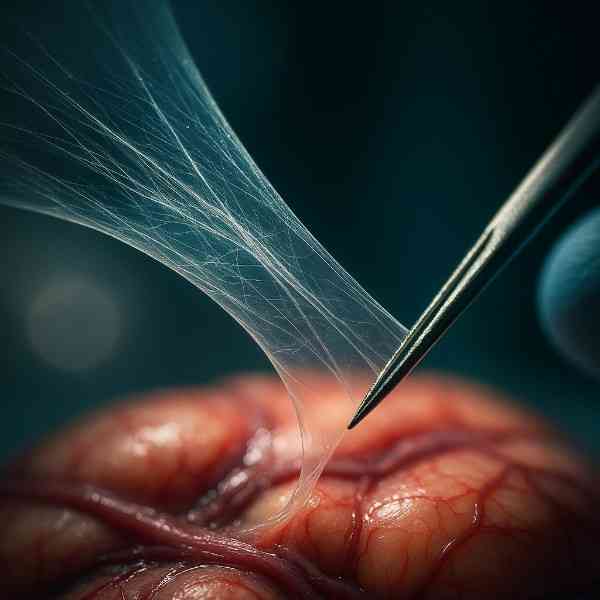
Beneath the toughness of the dura lies a layer called the arachnoid mater. Transparent and delicate, it drapes the brain like the finest of veils. One of my favourite writers, Maria Popova, once wrote that the brain “is a cathedral built of gossamer threads,” and nowhere is that truer than in the arachnoid. Under the microscope, it looks less like a membrane and more like spun sugar, or a spider’s web catching morning dew. It is beautiful, but it is also treacherous. When blood seeps into it, the cathedral darkens.
One evening, a woman in her fifties was rushed in with the sudden, thunderclap headache that makes every doctor move faster. “It felt like something exploded in my head,” she whispered on meeting me. She wasn’t exaggerating. A CT scan confirmed a subarachnoid haemorrhage – blood flooding into the delicate space beneath the arachnoid membrane. The culprit was a ruptured aneurysm at the junction of the anterior communicating artery, a tiny outpouching of vessel wall that had finally given way.
The thing about a subarachnoid haemorrhage is its drama. Patients go from reading the newspaper to collapsing on the bathroom floor in minutes. Families describe it as “she was fine, and then she wasn’t.” The arachnoid space, meant to cradle cerebrospinal fluid in quiet suspension, suddenly becomes a pool of blood – irritating, inflaming, threatening. It is one of the few neurosurgical emergencies that unites every department – the ER, radiology, the ICU, and the operating theatre – in a single collective gasp.
Surgery in these cases is not for the faint-hearted. Under the microscope, I opened the dura and began to peel back the arachnoid. It shimmered under the light, so fine you feared a breath could tear it. As the microscope magnified, you could see its filaments stretch across the sulci like tiny suspension bridges. To cut them is both delicate and dramatic, each incision revealing the anatomy beneath with the satisfaction of lifting tissue paper from a fragile relic.
The blood had matted down the arachnoid, staining its transparency and sticking it to the brain. I irrigated gently, teasing apart its folds. Every movement was slow, deliberate, reverent. And then, nestled in its web, the aneurysm revealed itself – a fragile blister on a vital artery, still oozing faintly.
Clipping an aneurysm is a test of nerve and humility. You dissect along vessels that supply thought, memory, speech, and movement, knowing that one wrong tug could silence them forever. The arachnoid is your guide and your obstacle, its translucent threads leading you toward danger but demanding that you not rush. Once the aneurysm’s neck was isolated, I placed a titanium clip across it, a tiny clothespin that would stop the bleeding but preserve the vessel. The moment the clip locked, the theatre seemed to exhale.
She woke the next morning drowsy but intact, her first words being, “The pain is gone.” Her family wept with relief, and one of them asked if the clip would set off airport security scanners. I assured them it wouldn’t. “Neurosurgery has enough drama; we try to avoid comedy at immigration!”
The arachnoid space, once bathed in blood, would take weeks to clear, but her recovery was underway. She would walk out of hospital lighter than when she had been carried in.
The arachnoid is often overlooked in anatomy classes, sandwiched between the dura’s toughness and the pia’s intimacy. But it is where life can turn in an instant. It is the lace veil that can be lifted to reveal beauty or torn to reveal catastrophe. In surgery, it teaches patience: the art of not rushing through the delicate in search of the dramatic.
There are many curves in a surgeon’s career – of learning, of judgment, of humility. The arachnoid, with its shimmering transparency, adds another: the curve of reverence. It reminds us that within this gossamer veil lies the difference between a mind extinguished and a mind preserved.
And sometimes, amid all the solemnity, you find humour too. When she visited me weeks later, the woman said, “Doctor, I survived an explosion in my head. Now my husband can’t complain when I shop for fireworks at Diwali.”
The arachnoid may be spun like a spider’s web, but its lessons are anything but fragile.


31 thoughts on “The Arachnoid”
What an exciting experience it must have been… ..knowing well what it’s consequences cud hv been.
Kudos to your skill and perseverance through this artistic experience .
Well done and May God always give you the patience, skill and faith in yourself to continue helping the world.
Really appreciate your actions and sharing so descriptively your process of surgery .
Dr. Mazda, a critical surgery but nicely handled and explained.
I’m incredibly grateful to Dr. Benjamin for the guidance and encouragement he gave me during my lottery journey. I reached out to him after hearing about his work, explained my hopes of winning the Mega Millions jackpot, and decided to give it a try. He shared a set of numbers with me and encouraged me to remain positive and hopeful. I purchased my ticket using those numbers, and I was completely shocked when they matched the winning numbers. I won the Mega Millions jackpot of $50 million! It was an unforgettable moment that changed my life. I’ll always appreciate Dr. Benjamin’s support. He can help you too drbenjaminlottospell711@gmail.com or WhatsApp him +18588585788
superb
Dr. Mazda, I’m truly amazed by the way you explain your experiences — your choice of words brings every detail to life and keeps me completely engaged throughout. As a science student, I could easily relate to the concepts, and it beautifully took me back to my college days. I’m sharing this article with my doctor friends so that more people can appreciate and learn from the depth of your knowledge and storytelling. Truly inspiring!
You are amazing with the pen and surgical too.who is mightier? It’s you of course. Be it the veil ,vein, nerve or blood clots,you handle all sorts so confidently.Bravo!!God Bless ! Thanks for sharing your thoughts and experiences
Dearest Dr Mazda sir ….
From Dura to Arachnoid, how your easy explanation is getting into the brain of common men in so simple and easy manner to make them understand so complicated procedure like a baccho ka khel 🫢
Only Your Writing of medical terminology in simple language is not only convincing but also very useful for people to understand the solutions of simple solutions to symptoms like headache and other medical conditions……😍
Of late your pieces are lacking one liner of Humor in the series explanation of the procedure 😎
Please continue enlighten us sir with your thoughts on various medical terminology in simple language with touch of humor too….🤣
God bless you with unparalleled wisdom and grace to keep on using your Fingers with pen & medical knife for all your patients 🌹
Nicely executed sir
I like how you said Neurosurgery has enough drama, we don’t need to add humor to it.. Great read!
Dear Mazda
I read your articles every Sunday in awe
It is blasphemy to render any comment on Devinches masterpieces.
You have inherited the dominant genes of the pen and the scalpel.
Unlike the neurosurgeons that I grew up with, You have embeded the genes of humility and wizardry in your DNA.
God bless you and your family
Dear Mazda
I read your articles every Sunday in awe
It is blasphemy to render any comment on Devinches masterpieces.
You have inherited the dominant genes of the pen and the scalpel.
Unlike the neurosurgeons that I grew up with, You have embeded the genes of humility and wizardry in your DNA.
God bless you and your family
Reply
Dr Mazda.. I love reading your articles on Sundays. U explain v simply& with a touch of humour as well. I look forward to reading them.
God Bless you & your family.
Sundays with Mazda. A day where neurosurgery meets storytelling.
All of us readers (fans of yours) are becoming honorary brain anatomists, one membrane at a time 🙃
Dr. Mazda you looks very calm and a simple person from outer.
But salute to your depth of knowledge and determination while you operate
God Bless You
Hi, Doctor Mazda. I always look forward to your Sunday articles. You are an excellent surgeon and a great human being. 👌 May God grant you many years of good health as you continue your work. I look forward to seeing you soon. 🇧🇼
Once again a treat to a novice to understand the beautiful anatomy of the brain.
I love reading and understanding through your articulation. Grateful for your work
Dear Mazda, may you never lose your skill or your humility. And humanity. Or are they all interlinked in a delicate interdependent web?
Reading this it wouldn’t b wrong to say ”A clip in time saves the brain”!!
Kudos !!! Ur sure a braveheart to handle n excel the emergencies… each dat…every day!!
LONG LIVE DOC!
I can’t express my gratitude enough to Dr Zuma for making me a living testimony. i have battled with HERPES SIMPLEX VIRUS 2 for about 6years now, and i have done all i can to make sure i am cured but nothing worked out, but miraculously my friend invited me to see a video on his Blog and as i visited i decided to see few of the comment below, and i found some people talking about Dr Zuma, and i decided to contact this great herbal healer to also help me, so i wrote to him, and he replied me back and assure me that i will get a cure for my HERPES SIMPLEX VIRUS 2. After preparing my medicine he sent it to me and when I started using it for 3weeks i was completely cured, I am a living testimony and assure anyone with the same illness that you can also be cured if you also contact this great man on his Email. spiritualherbalisthealing@gmail.com
I was diagnosed of HERPES Virus in 2016 and I have tried all I can to get cured but all to no avail, until I saw a post in a health forum about a herbalist man who prepare herbal medication to cure all kind of diseases including HERPES virus, at first I doubted if it was real but decided to give it a try , when I contact this herbalist via his email and he prepared a HERPES herbal cure and sent it to me via UPS delivery company service, when I received this herbal cure, he gave me step by directions on how to apply it, when I applied it as instructed, I was totally cured of this deadly disease within 14days of usage, I am now free from the deadly disease called herpes, all thanks to Dr. Itua you can rich this great herbal doctor via his email: (ituahealer@gmail.com)call or WhatsApp him on his mobile number +2348150223558
He also have the herb to cure:
(1) ALS,
(2) DIABETES,
(3) HIVAIDS,
(4) URINARY TRACT INFECTION,
(5) CANCER
(6) HERPES
Praise be to the incredible gifted Lord Meduza, I’ve never seen or heard of his lottery spell failing, not even once, and that includes my own experience. Every day, I feel renewed blessings after connecting with the Great Lord Meduza, who gifted me my winning six-digit lottery numbers that won me $740,000,000 million dollars by using his magical skills to foresee the outcome. I’m a dad of four, and it’s been a few years since I lost my wife to cancer; I miss her terribly. To wrap things up, I really want to thank Great Meduza for being so good at what he does. His guidance and lessons were applied swiftly and precisely, leading us to the best possible result, which we definitely achieved. May you stay blessed and know you’re in good hands with Lord Meduza.. You can reach him by email: lordmeduzatemple@hotmail.com or Call/Whats__App +1 807 798-3042. For more information check out his website at: lordmeduzatemple.com
I want to stand before you all today to give thanks to Lord Gius for a life-changing miracle. For a long time, my family and I were going through severe financial hardships. We were struggling to pay bills, dealing with mounting debts, and there were days when the weight of our financial future felt completely overwhelming. Despite the stress, I kept praying, holding onto faith, and trusting that a breakthrough would come.A few weeks ago, I made a spontaneous decision to try a lottery spell caster, I did not think much of it at the time, but I whispered a quiet prayer, asking for relief from our burdens. Lord Gius, told me what would be required which i did, then he gave me numbers to play and i did according to his intructionns, When the results were announced, I checked the numbers, and to my absolute shock, they matched. I had won the lottery.In that exact moment, a wave of overwhelming relief and gratitude washed over me. I burst into tears, knowing that our financial struggles were instantly over. This blessing has allowed us to clear all our debts, secure a home, and establish a foundation for our family’s future.I am sharing this testimony not to boast about wealth, but to testify to how quickly circumstances can change. I am profoundly grateful for this unearned blessing, and I pray for the wisdom to manage these resources properly, to be a blessing to others, and to remain grounded. Thank you, Lord Gius, for this incredible miracle.
if anyone would like to reach him for help, here is his information below:
Email: lordgius@yahoo.com
‘[
I want to stand before you all today to give thanks to Lord Gius for a life-changing miracle. For a long time, my family and I were going through severe financial hardships. We were struggling to pay bills, dealing with mounting debts, and there were days when the weight of our financial future felt completely overwhelming. Despite the stress, I kept praying, holding onto faith, and trusting that a breakthrough would come.A few weeks ago, I made a spontaneous decision to try a lottery spell caster, I did not think much of it at the time, but I whispered a quiet prayer, asking for relief from our burdens. Lord Gius, told me what would be required which i did, then he gave me numbers to play and i did according to his intructionns, When the results were announced, I checked the numbers, and to my absolute shock, they matched. I had won the lottery.In that exact moment, a wave of overwhelming relief and gratitude washed over me. I burst into tears, knowing that our financial struggles were instantly over. This blessing has allowed us to clear all our debts, secure a home, and establish a foundation for our family’s future.I am sharing this testimony not to boast about wealth, but to testify to how quickly circumstances can change. I am profoundly grateful for this unearned blessing, and I pray for the wisdom to manage these resources properly, to be a blessing to others, and to remain grounded. Thank you, Lord Gius, for this incredible miracle.
if anyone would like to reach him for help, here is his information below:
Email: lordgius@yahoo.com
r
DR UYI has done it for me, His predictions are 100% correct, He is real and can perform miracles with his spell. I am overwhelmed because I just won 336,000, 000 million Euro from a lottery jackpot game with the lottery number DR UYI gave me. I contacted DR UYI for help to win a lottery via Facebook Page DR UYI, he told me that a spell was required to be casted so that he can predict my winning, I provided his requirements for casting the spell and after casting the spell he gave the lottery numbers, I played and won 336,000,00 euros. How can I thank this man enough? His spell is real and like a God on Earth. Thank you for changing my life with your lottery winning numbers. Do you need help to win a lottery too? contact Dr UYI via drzukalottospelltemple@gmail.com OR WhatsApp on +17174154115
Wow what a good God I am so excited to tell you all how I become a millionaire I’m a woman of faith I was reading a comment on google where I meet a man sharing how Dr UYI cast a spell for him and he get his wife back after the spell I was interested I have to do research when I was doing the research I got so many testimony about this same man call Dr UYI how he help people to win lottery how he help people to get there ex back how he help people to do so many things I was happy and I contact him to help me win the lottery when I contact him and he told me what to do and after I did what he ask me to do he den gave me a lottery number to play and told me to go and buy ticket after playing the game I was so surprise the game come out good and I won the sum of 90, 000,000 dollars i was amazed and promise to share it to the people around me if anyone is willing to play the mage lottery it should contact Dr UYI so he can give you the right number to play thanks to you Dr UYI I’m so so grateful contact Dr UYI via drzukalottospelltemple@gmail.com OR WhatsApp on +17174154115
Every day I wake up with a heart full of gratitude, amazed by how dramatically my life seemed to change after my encounter with the Great DR UYI. In this I was given six-digit numbers that supposedly led to a $980 million to my lottery win an outcome I could hardly have imagined. As a father of four I know the true value of family. It has been several years since I lost my beloved wife to cancer yet I still feel her absence every day. There are moments when I wish I could share this extraordinary experience with her because she would have been the first person I called. Her memory continues to give me strength and reminds me never to take life’s blessings for granted. What touched me most in this was the sense of hope and faith it inspired. i listened carefully to the guidance DR UYI gave to me and i followed eveything DR UYI told me with sincerity and determination. The experience became a powerful and i won $980 million with the help of DR UYI you can contact him via email drzukalottospelltemple@gmail.com ON WhatsApp on +17174154115
I’m incredibly grateful to Dr. Benjamin for the guidance and encouragement he gave me during my lottery journey. I reached out to him after hearing about his work, explained my hopes of winning the Mega Millions jackpot, and decided to give it a try. He shared a set of numbers with me and encouraged me to remain positive and hopeful. I purchased my ticket using those numbers, and I was completely shocked when they matched the winning numbers. I won the Mega Millions jackpot of $50 million! It was an unforgettable moment that changed my life. I’ll always appreciate Dr. Benjamin’s support. He can help you too drbenjaminlottospell711@gmail.com or WhatsApp him +18588585788
It’s an honor to share this testimony to the world. Dr UYI you’re a blessing to our generation. I have always desired to win lottery some day, at some point I thought it was something impossible, until I came across series of testimonies on how had helped a lot of people win lottery, at first I was so skeptical about it because I haven’t seen a things as such in my life, at a second thought I decided to give it a try so I emailed him via his person email, he replied me and instructed me on what to do, after 24 hours he gave me some numbers and I won $2 million just like that. Dr UYI I owe everything for making me the man that I am right. If you need his help below is his contact information, he can help too Email: drzukalottospelltemple@gmail.com OR WhatsApp on +17174154115
I’m incredibly grateful to Dr. Benjamin for the guidance and encouragement he gave me during my lottery journey. I reached out to him after hearing about his work, explained my hopes of winning the Mega Millions jackpot, and decided to give it a try. He shared a set of numbers with me and encouraged me to remain positive and hopeful. I purchased my ticket using those numbers, and I was completely shocked when they matched the winning numbers. I won the Mega Millions jackpot of $50 million! It was an unforgettable moment that changed my life. I’ll always appreciate Dr. Benjamin’s support. He can help you too drbenjaminlottospell711@gmail.com or WhatsApp him +18588585788
..
In March 2019, I was only 24 years old when my life changed in a way I never imagined. My Name is Manuel Franco, I became the winner of the incredible $768.4 million Powerball jackpot. Before that happened, I had received spiritual numbers from Chief Ade. At first I wasn’t sure what to think, but something inside me told me to trust the numbers. I followed the guidance, bought my ticket, and waited. When the winning numbers were announced, I checked my ticket again and again. I was completely shocked, I couldn’t believe that the numbers on my ticket matched the winning numbers, that moment changed everything for me. I went from being an ordinary 24-years old to becoming a multimillion dollar lottery winner overnight. I will never forget the role Chief Ade’s spiritual numbers played in my story. To this day, I still look back and ask myself how everything came together at exactly the right moment. Sometimes, life can surprise you in ways you never thought possible. Email chiefadespellhome@gmail.com Or WhatsApp +234 901 380 6328
I am out here to speed this good news to the entire world on how I got help from Dr UYI a great lottery spell caster that will help you cast a lottery spell and give you the rightful numbers to win the lottery, I didn’t believe lottery spell at first but as life got harder i decided to give a try, I spend so much money on tickets just to make sure I win. until the day I met Dr UYI online, which so many people have talked good about, that he is very great when it comes to casting lottery spell, he told me the necessary things to do and behold it was like a magic, i won $220 Million Dollars Mega Million with the numbers Dr UYI gave to me. his a really trustful person worthy and reliable, i am sharing this to you who have been finding it so hard to win the lottery, Thanks you Dr UYI who helped me Contact him via email: drzukalottospelltemple@gmail.com OR WhatsApp on +17174154115