
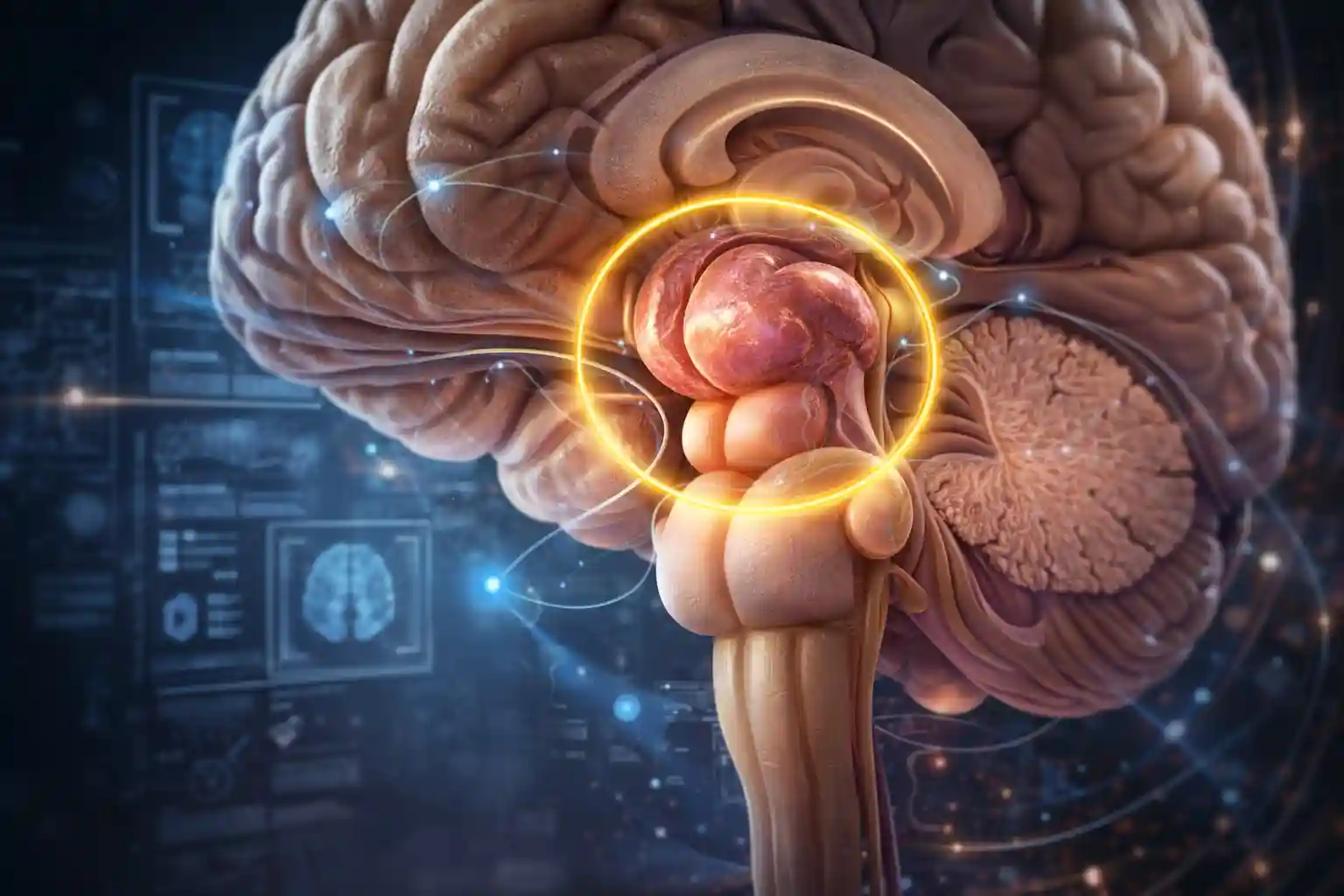
If the brain were a grand Indian household, the cortex would be the talkative uncle with opinions on everything, the lobes would be the siblings arguing over territory, and the brainstem would be the old, silent grandmother sitting in the corner – saying nothing, doing everything.
And if the brainstem is the old grandmother of the nervous system, then the midbrain is her sharp-eyed middle-aged son: quiet, alert, always watching, rarely speaking, but missing nothing.
The midbrain occupies a precarious position as the top floor of the brainstem. It is small, central, and unforgiving. It sits between thought and survival, linking the higher brain above to the ancient machinery below. It governs eye movements, posture, reflexes, alertness. It decides where we look, what we notice, and how we orient ourselves in the world. It is not interested in drama, only efficiency.
Patients with midbrain problems rarely arrive with complaints that sound serious. They come with oddities. “Doctor, my eyes don’t move the way they used to.” “I feel awake but strangely detached.” “I keep bumping into things I can see.” The symptoms feel vague until anatomy gives them meaning.
A retired schoolteacher came to see me with his wife, both immaculately dressed, both slightly irritated with each other in that way only long marriages manage. His hair was neatly oiled, his spectacles spotless. He sat upright, composed, and mildly offended by his own body. “I can read perfectly,” he said, “but I cannot look up to meet my wife’s eyes when she scolds me.” His vertical gaze was restricted, his eyelids heavy, his reflexes subtly altered.
His MRI showed a small brain tumour nestled deep within the midbrain – a glioma. In neurosurgery, there are few words that instantly quiet a room like that one. Not because it is always aggressive, but because of where it lives. A midbrain glioma is not something you chase. It is something you respect.
This is not a place for heroic resections or dramatic gestures. The midbrain does not tolerate enthusiasm. The safest surgery here is often the smallest one – a navigation-guided biopsy, planned meticulously, executed gently, and stopped early.
On the day of surgery, the atmosphere in the operating room was noticeably different. No rush. No bravado. The navigation system became our compass, mapping a precise, minimally disruptive path through safe corridors. Each movement was deliberate, each decision weighed. We burred a small hole in the skull and cut the dura. The biopsy needle advanced millimetre by millimetre, guided by coordinates registered before we started. The tissue was sampled, haemostasis secured, and we withdrew. The surgery was brief; the responsibility wasn’t.
Postoperatively, the schoolteacher woke up unchanged – which, in this part of the brain, is the best possible outcome. His gaze limitation persisted. His dignity remained intact. His wife smiled with visible relief. “At least he can still hear me,” she said. He rolled his eyes sideways – a small victory for neurology and marriage.
The biopsy gave us clarity. Treatment followed. Life adjusted. He received radiation and then chemotherapy, which shrank the tumour substantially. His gaze improved over a few months. Now he could see right through her, and she wasn’t too happy with that either.
The midbrain teaches surgeons a lesson early in their careers: That doing less can sometimes mean doing it right. That intervention does not always mean removal. That courage occasionally lies in knowing when to stop.
Evolutionarily ancient, the midbrain predates language and logic. It reacts before thought. It turns the head before fear registers. It is the reason we flinch, orient, and attend. It reminds us that much of what keeps us functional operates beyond our awareness. And perhaps that is its quiet wisdom: That control is often subconscious. That survival does not require insight. That not all battles are meant to be fought head-on. The midbrain does not demand attention; it simply keeps you oriented, alert, and alive. And sometimes, the best thing a surgeon can do is listen to that silence – and leave it undisturbed.


24 thoughts on “The brainstem part 1: The midbrain”
Wow! That was a well written article. It’s always fascinating to know more about our brain.
Thanks.
Great article..as always.hats off to you and your team👌🤲
Lovely, I liked the way you compared the brain to a family. I could visualise all the members in my family at the precise location!
Love the way you Pen down these stories Mazda , you’re jus Fab . 🌸✨👌🫰
You make it all appear so simple and so relatable! Thank you!!
The brainstem seems like our grannies wise but demanding due respect under all conditions. Theoretically we could pass as non practicing brain doctors for sure reason of giving us such a clear picture of all it’s parts n functions.Thank u doctor.
Yes Mazda you have truly exemplified what Ludwig Mies Van der Rohe said aeons ago….”Less is always more”
Totally echo your comments.
Dr Mazda, you are a gift to patients & readers! Salutations!
Fantastic expose of the palpable respect and masterly regard of this wonderful organ called the brain that you possess in abundance, Dr Mazda. Congratulations!! Small wonder that you and your team consistently grow from strength to strength.
The article itself was like the midbrain – crisp, observant, pithy and epigrammatic. Every word weighed and necessary. Absolutely loved it.
I grew up thinking that there was nothing more complicated than a human brain. Reading your series on the brain, I think it is one of the simplest devices. Doctor, you epitomise Einstein’s principle: “If you can’t explain it simply, you don’t understand it well enough”.
Your mastery of the subject distilling complex, technical, or jargon-heavy concepts into clear, simple terms that can be understood by someone without specialized knowledge is so commendable and readable.
Written cautiously with the respect the midbrain deserves! Nothing of this was taught in Biology at school or college – so a great learning experience from your article. Thank you Doctor Mazda!
Thanks, as always, for the clarity. It helps me understand myself quite a bit.
Once again doctor, a fascinating article by you. You have made these complex chapters in my books on Neuroscience come alive. Thank you!
Please, please write books on Neuroscience and Neuroanatomy.
Another gem, Mazda. You’ve turned the midbrain into that wise family elder who says nothing, judges everything, and somehow keeps the whole household running. A brilliant reminder that in some parts of the brain (as in life) enthusiasm is best kept on a tight leash. Neuroscience with restraint, wisdom, and just the right amount of wit.
The biopsy needle advanced millimeter by millimeter, and as I finished reading this , I was realized I was holding my breath all along.
Goosebumps 🙌🙌
Super write up Dr Mazda! I loved the way you have compared the brain to a family.
I loved the grandmom comparison too
You make us understand and respect surgeons who understand how much they should intervene and how much to leave to god and nature
Thank you Dr.Mazda.. Always enjoy reading your articles.. simply explained in a humorous way..
This one… giving Family as an example is too good.. Loved it.
I am graced that reading and learning about the Doctor, his thought and Humor as well
First time when I saw you in Shilong , immediately I decided to be in touch with you always
Thanks Doctor once again
What an insight. Now I know what governs me….none other – my mind brain. Ho ho ha ha.
Great n well written article, as always.
As always learning is a part of your theises, but this time it’s good that for once the husband can look straight into the Wife eyes.
What a superb article on the midbrain. Soooooo informative with a dash of humour! What’s new about that, Dr. Mazda??!! You are three good!