
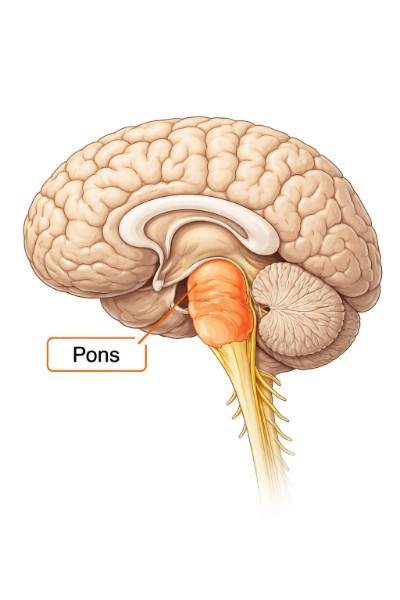
The pons is the diplomat of the brainstem. It connects, negotiates, and mediates. Anatomically named after the Latin word for bridge, it does exactly that – it links the brain to the body, movement to expression, wakefulness to sleep. If the midbrain watches, the pons communicates.
The pons is also deeply invested in your face. It governs blinking, smiling, chewing, tearing, and many of the expressions you assume are yours alone. When it misbehaves, it does not do so discreetly.
A middle-aged gentleman walked into my clinic with half his face staging a quiet protest. One eyebrow refused to rise. One eye would not close. His mouth tilted sideways, as if unsure of which direction to smile. He was impeccably dressed, with a trimmed moustache, but his hair was dishevelled. His wife sat beside him, concerned but perceptive. “Doctor,” she said, “he looks the same, but he doesn’t look like himself.”
He had woken up that morning unable to recognise his own reflection. Speech was slightly slurred. Water escaped the corner of his mouth. The diagnosis, thankfully, was not a stroke or tumour, but something far more common and far more unnerving: Bell’s palsy.
Bell’s palsy is named after Sir Charles Bell, the 19th-century Scottish anatomist who meticulously described the facial nerve and its functions. In an era without imaging, steroids, or Google, Bell managed to map facial paralysis with extraordinary insight. History, occasionally, gets it right.
The facial nerve’s journey is a long and perilous one. It emerges from the pons, travels through a narrow bony canal, and fans out across the face like a conductor directing expression. Any inflammation along this path can silence it temporarily. Viral reactivation, stress, immune responses – the exact cause remains conveniently vague, much like most things that matter.
Bell’s palsy is dramatic. It arrives overnight. Patients go to bed fine and wake up unrecognisable. The fear is immediate. Am I having a stroke? Will my face stay this way forever? Will people think I am winking at them deliberately? The pons, of course, remains unimpressed by panic. It simply waits.
Bell’s palsy, incidentally, has never discriminated between the famous and the forgettable. Julius Caesar is believed to have had episodes of facial weakness, although history remembers him more for crossing rivers than drooping eyebrows. George Clooney developed Bell’s palsy early in his career and recovered completely, going on to become a global ambassador for symmetrical smiles. Angelina Jolie spoke openly about her episode, attributing it to stress – a reminder that even people with extraordinary cheekbones are not immune to neurological mischief. In our part of the world, actors, politicians, news anchors, and at least three uncles at every wedding have experienced it, usually just before an important family photograph. Bell’s palsy, it seems, enjoys timing. It humbles celebrities, startles patients, and reassures everyone else that a crooked smile does not diminish charm; it merely adds character.
Treatment is straightforward. Steroids. Eye care. Reassurance. And patience – the most under-prescribed medication in modern medicine. Recovery usually follows, slowly and unevenly. The smile returns before the blink. The blink before the eyebrow. The face, like a stubborn orchestra, tunes itself instrument by instrument.
The gentleman listened carefully as I explained all this. He nodded, mostly with the functioning side of his face. “So, you’re saying,” he asked, “that this will get better, but not immediately?” Exactly. Weeks later, he returned looking lighter. His eye closed again. His smile was symmetrical enough to fool strangers. His wife leaned over and whispered, “He’s back to annoying me evenly.”
The pons also plays a role in sleep and dreaming, which perhaps explains why patients with Bell’s palsy often report vivid dreams during recovery, the brain rehearsing expression before executing it. Or perhaps the pons simply enjoys drama.
The pons teaches us something essential: that connection matters. That expression is neurological before it is emotional. That even our most personal gestures depend on small bridges deep inside our heads working quietly. And that sometimes, losing your smile temporarily makes you appreciate it more when it returns.
On his final visit, the gentleman grinned fully and said, “Doctor, I can finally take selfies again.” His wife smiled too. The pons had done its job. And, for once, diplomacy had worked well.
2 thoughts on “The brainstem part 2: The pons”
A lovely summary
I saw some comments about a Herbal Doctor called Dr Moses Buba and decided to email him asking for help because I was suffering from Erectile Dysfunction (ED) and he got back to me, he gave me some comforting words with his herbal medication for Erectile dysfunction, Within 14th days of it, i began to feel that his medicine is working , and right now I am free . I am so happy, contact DR Moses Buba now via email buba.herbalmiraclemmedicine@gmail.com or his WhatsApp. +2349046949685 . may God reward you for your good work