
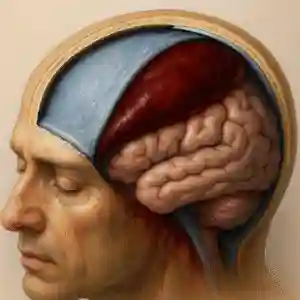
The dura mater is the brain’s personal bodyguard. Tough, fibrous, and uncomplaining, it lines the inside of the skull like the protective cover of a treasured book. It doesn’t get much limelight, but when something threatens it, the consequences can be swift and unforgiving.
In Latin, dura mater means ‘tough mother’, which feels entirely appropriate – it shields, endures, and doesn’t complain. Until it has to.
One rainy night, a call came from the emergency department: A 48-year-old man, Kailash, had been found unconscious at home. His wife said he’d slipped in the bathroom that morning but insisted he had been fine after that. He had gone about his day, eaten lunch, taken a nap – and then he hadn’t woken up.
By the time he reached us, his right pupil was larger than the left, and his breathing had that irregular rhythm that makes one move faster without thinking. A quick CT scan told the story: There was a large acute subdural hematoma, blood trapped between the dura and the brain, compressing it mercilessly to one side – like a crowd boarding a local at Dadar station. There’s a quiet dread that comes with seeing one side of the body fail to keep up with the other, a signal that the brain is running out of space and time.
Here’s the thing about the dura: It doesn’t tear easily. Its leathery raincoat is built for bad weather days. But when a bridging vein between the dura and brain snaps, blood has nowhere to go but into this tight, unforgiving space. The skull can’t expand. Pressure rises. Brain tissue shifts. And the clock starts ticking. I’ve always thought of the dura as the bouncer outside a club – polite when things are calm, but ready to flex when there’s trouble. In this case, the trouble was enough to get us rushing to the operating theatre.
The drill met the skull with that familiar high-pitched whine, sending up fine bone dust – the surgical equivalent of sawdust in a carpenter’s workshop, except the stakes were higher and the deadline shorter. When we lifted the bone flap, the dura stared back – tense, stretched, and with a bluish tint that betrayed the clot beneath. I made a cruciate (cross-shaped) incision with the scalpel. The dura, usually dry and reserved, parted to release a thick, dark clot. It oozed out in layers, each one like the filling of an extremely generous pastry, except here, the excess was life-threatening. Every scoop with the suction catheter lightened the brain’s load. Bit by bit, the compressed hemisphere began to breathe again – pink, glistening, and no longer straining against its confines. Once the last remnants of the clot were out, we irrigated the subdural space with warm saline. The brain relaxed into its natural shape, like a hand unclenching after holding on too tightly. We inspected the surface for bleeding points, sealed what we found, and stitched the dura closed. The bone flap went back, snug as a lid on a well-packed dabba.
People imagine brain injuries are dramatic at the scene – lots of screaming, blood, the loud wail of an ambulance. More often, though, they are deceptively quiet. A knock on the head, a “I’m fine,” a nap that lasts too long. Subdural hematomas can whisper for hours before they roar. And when they roar, you have minutes to answer. If there’s one thing the dura has taught me, it’s this: Protect it, respect it, and never ignore the slow, subtle signs of trouble after a head injury.
Kailash woke up two days later, confused but alive. He asked his wife why the ceiling fan looked different. She burst into tears – the good kind. By the end of the week, he was walking with a little help. On discharge, he shook my hand and said, “Doc, my wife tells me you took a piece of my head off.” “Only temporarily,” I said. “It’s back where it belongs!”
He grinned. “Then I guess I’m a man who can say he’s been out of his mind… and has come back in again.”
14 thoughts on “The dura”
Wawww ! A truly remarkable account. I sincerely appreciate you sharing these exceptional experiences.
Dear Doctor Mazda,
Riveting as your medical articles are, reading them always gives us as insight to the wonderful human being that you are – caring, compassionate, very competent, committed, hugely talented…. and in the end gifted with an amazing sense of humour!!
I look forward to the day I will meet you face-to-face! Be prepared for that hug!!
Like Appendix, Hernia surgeries for General Surgeon, SDH is bread and butter for Neurosurgeon. Only and the main difference is TIME FACTOR. Here you r fighting against the clock.
Another erudite explanation, in simple terms, a condition that has taken many lives in the past but, in the hands of someone as competent as you, the giver of the gift of healing/life.
Thank you also for interspersing your stories with humour. Have a great week ahead
Dear Dr Mazda,
I get to learn a lot from your simple well explained writing about your knowledgeable field. You filter my mind with news knew to me.
God bless you as you save lives.
The brain is such a complicated, I think the most complicated in the human body. Thank the Lord that miracle workers like you can save innumerable lives and bring the person to being normal once again. Feel secure and blessed to have a super human being and great surgeon in our lives. Bless you.
Doc. You send chills down the spine.. but Your competency & skills leave us with the lighter side of the dura..love your style of penning down your experiences.
Doc. You send chills down the spine.. but Your competency & skills leave us with the lighter side of the dura..love your style of penning down your experiences.
As always a pleasure to read and understand more about the brain and its subsidiaries.
For someone who is from the field of story telling its amazing to read the telling format in which you write. The last part where you say respect it, protect it is a way of blessing the parts of our body that we so easily take for granted.
Thanks for the way you write keep going. Its best way of telling stories with knowledge engulfed.
Heyy doc!! Only a braino lyk U can saves others’ brains
Naps change into eternal sleep in so many cases that ive seen!
May the Almighty bless U with more brains to open!
Dearest Dr Mazda sir ….
Many many Thanks for explaining about DURA to us with such a simple explanation……..
Very very simple Language you narrated a complicated Procedure….
Thanks again with your series of Pieces on different Detailed parts of BRAIN…….
Looking forward with your non medical Joyful experience too in your Future pieces …..
Good Luck & God Bless Sir 🌹
Before reaching your doctor it gives you chills but later alls well weather he add something into you or subtract alls well now. UNBELIEVABLE.
I equate this surgery of yours to a master painter using his skill on the canvas. Ofcoyrse yoyr skill saves li
ves. Carry on the good work
I saw some comments about a Herbal Doctor called Dr Moses Buba and decided to email him asking for help because I was suffering from Erectile Dysfunction (ED) and he got back to me, he gave me some comforting words with his herbal medication for Erectile dysfunction, Within 14th days of it, i began to feel that his medicine is working , and right now I am free . I am so happy, contact DR Moses Buba now via email buba.herbalmiraclemmedicine@gmail.com or his WhatsApp. +2349046949685 . may God reward you for your good work