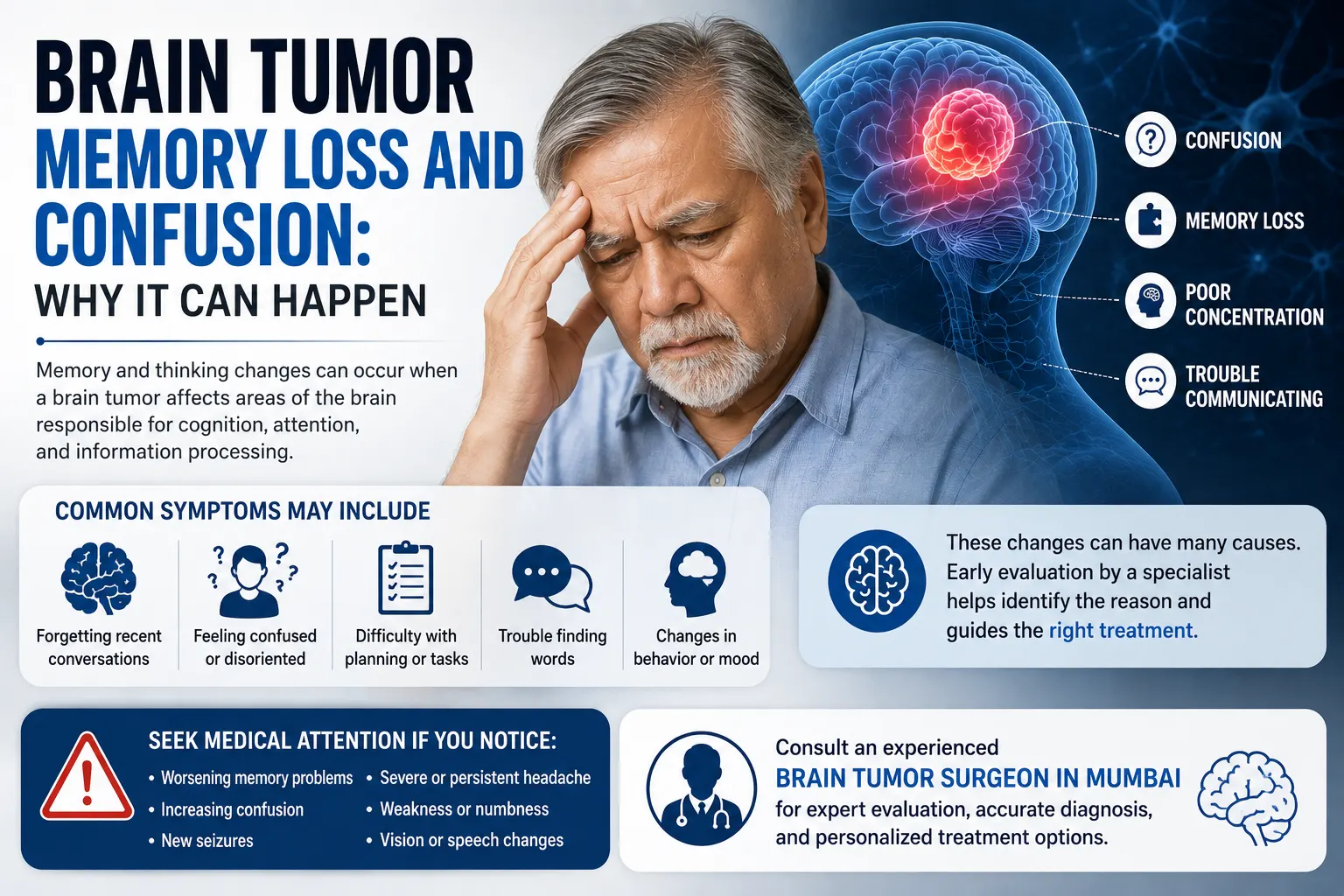
Brain Tumor Memory Loss and Confusion: Why It Can Happen
Forgetting an appointment or occasionally losing track of a name is common. The concern is different when forgetfulness becomes persistent, noticeably worsens, or appears together with confusion, difficulty concentrating, personality changes, seizures, or other neurological symptoms. Brain tumor memory loss can occur when a tumor or its surrounding effects interfere with brain areas involved in memory, attention, language, planning, and information processing.
Still, memory problems alone do not mean that a brain tumor is present. Sleep deprivation, stress, depression, medicines, metabolic problems, dementia, stroke, seizures, and several other conditions can affect memory and thinking.
Brain tumor symptoms also differ considerably between patients because they depend partly on the location and size of the tumor and the function of the affected brain region.
Can a Brain Tumor Cause Memory Loss?
Yes. Brain tumors can sometimes cause memory difficulties, poor concentration, slowed thinking, confusion, or problems organising everyday tasks. These changes may result from the tumor itself, pressure or swelling around it, seizures, or disruption of brain networks involved in cognition. The exact symptoms depend heavily on where the tumor is located.
Cognition is the group of mental abilities that allows us to learn, remember, understand, communicate, concentrate, plan, and make decisions. The National Cancer Institute recognises problems with remembering, speaking, understanding, and concentrating among cognitive symptoms that can occur in people with brain and spinal tumors.
A patient may notice the problem personally, but sometimes the first changes are noticed by a spouse, child, colleague, or another person who knows them well.
What Can Brain Tumor Memory Loss Look Like?
Memory problems are not always as obvious as completely forgetting a person or event. Early changes may be much more subtle.
Possible signs include:
- Repeatedly forgetting recent conversations
- Asking the same question several times
- Difficulty remembering appointments or instructions
- Losing track of familiar daily tasks
- Difficulty learning or retaining new information
- Forgetting familiar words or names more often
- Trouble following a conversation
- Reduced ability to concentrate
- Difficulty planning or completing several steps in order
- Becoming unusually disorganised
- Taking longer than usual to process information
NCI guidance on cognitive difficulties also describes problems with memory, concentration, following instructions, organisation, learning, and completing everyday tasks.
These symptoms are not unique to brain tumors. Their timing, progression, accompanying symptoms, examination findings, and medical history are needed to understand what may be causing them.
Why Can Brain Tumors Affect Memory and Thinking?
There is no single mechanism behind memory problems from a brain tumor. Several factors may contribute.
The Tumor May Affect a Brain Region Involved in Cognition
Different brain regions have different roles.
The temporal regions and connected structures contribute to learning and memory. Frontal brain networks are important for attention, planning, judgment, working memory, problem-solving, and organisation.
A tumor affecting or pressing on these areas may therefore cause cognitive symptoms that look different from a tumor involving a brain region primarily responsible for movement or vision.
Location is a major reason why one patient may initially experience seizures while another develops speech, memory, behaviour, balance, or visual changes.
Swelling Around a Tumor Can Affect Nearby Brain Function
Brain tumors can sometimes be accompanied by swelling in surrounding tissue, known as cerebral edema.
This can place additional pressure on nearby brain structures and contribute to symptoms. The effect depends on the location and extent of the swelling and the individual patient’s condition.
Doctors therefore assess more than the visible tumor itself when reviewing MRI or CT images.
Seizures Can Affect Memory and Awareness
Some brain tumors cause seizures. A focal seizure may temporarily affect awareness, memory, language, or behaviour without necessarily producing dramatic full-body shaking.
The period after a seizure can also include temporary confusion, tiredness, or difficulty remembering what happened.
Repeated unexplained episodes of staring, altered awareness, unusual behaviour, or memory gaps should therefore be discussed with a doctor.
Treatment and Medicines May Also Affect Cognition
For someone already receiving treatment for a brain tumor, cognitive symptoms do not necessarily mean that the tumor itself is worsening.
Memory and concentration can also be affected by cancer treatment, certain medicines, fatigue, poor sleep, emotional distress, pain, and other medical conditions. NCI guidance specifically notes that tumor treatment, medication side effects, sleep problems, and other health conditions can contribute to cognitive symptoms.
The cause needs to be assessed rather than assumed.
What Does Brain Tumor Confusion Mean?
Brain tumor confusion may involve difficulty understanding surroundings, following conversations, maintaining attention, recognising what is happening, making appropriate decisions, or completing familiar tasks.
Family members may describe the person as “not quite themselves” or unusually disoriented.
Confusion can develop gradually, but sudden confusion is a different situation and may require urgent medical attention.
A slowly progressive change may appear as:
- Difficulty following instructions
- Trouble keeping track of time or activities
- Increasing disorganisation
- Poorer judgment
- Difficulty finding words
- Problems understanding information
- Unusual forgetfulness
- Changes in behaviour or personality
Brain tumors can cause changes in memory, concentration, personality, mood, and behaviour, although these symptoms also occur with many other conditions.
Forgetfulness Has Many Other Neurological and Medical Causes
One of the most important parts of assessing forgetfulness neurological causes is not jumping straight to a brain tumor diagnosis.
Memory problems or confusion may also occur with:
- Poor sleep or severe fatigue
- Anxiety or depression
- Medication side effects
- Alcohol or other substances
- Vitamin or nutritional problems
- Thyroid and metabolic disorders
- Infections
- Seizure disorders
- Previous head injury
- Stroke
- Neurodegenerative disorders
- Other neurological illnesses
Even people who already have cancer can experience cognitive changes for reasons unrelated to direct tumor involvement. NCI guidance advises clinicians to consider medicines, other health conditions, fatigue, sleep problems, emotional distress, and other potentially contributing factors when assessing cognitive symptoms.
This is why proper evaluation matters more than trying to identify the cause based on one symptom.
When Do Memory Problems Become More Concerning?
Occasional forgetfulness is common. Concern increases when there is a clear change from a person’s previous level of functioning.
Medical evaluation is advisable when memory problems:
- Are progressively worsening
- Begin interfering with work or normal daily activities
- Are noticed repeatedly by family members
- Occur with increasing confusion
- Appear with a new personality or behaviour change
- Occur alongside persistent or worsening headaches
- Develop with seizures
- Are accompanied by weakness or numbness
- Occur with speech or vision problems
- Are associated with increasing balance difficulties
Brain tumor symptoms may develop slowly, and the exact presentation depends on the area of the brain affected.
None of these symptoms confirms a tumor. They simply indicate that further medical assessment may be appropriate.
How Do Doctors Investigate Brain Tumor Cognitive Changes?
Doctors usually begin with a detailed history.
The patient may be asked when the problem started, whether it is progressing, which types of information are difficult to remember, and how much the symptoms interfere with normal life.
Input from a close family member can be useful when the patient is unaware of some changes.
Neurological Examination
The examination may assess:
- Attention and concentration
- Short-term and longer-term memory
- Speech and language
- Orientation
- Muscle strength
- Sensation
- Reflexes
- Coordination
- Balance
- Eye movements and vision
Doctors may also review medicines, sleep, mood, previous illnesses, and other factors that could affect cognition.
MRI of the Brain
An MRI, or magnetic resonance imaging scan, creates detailed pictures of the brain and surrounding structures.
If symptoms or examination findings suggest a structural neurological problem, brain imaging may be recommended. MRI can show the location, size, and characteristics of a suspected lesion and its relationship to surrounding brain structures.
CT imaging may also be used in particular situations, especially when urgent imaging is required.
If imaging identifies a suspected tumor, the next steps depend on its appearance and clinical context. In many cases, tissue obtained through biopsy or surgery is needed to establish the exact tumor diagnosis, although there are situations where biopsy may not be appropriate or necessary.
How Are Cognitive Problems Treated if a Brain Tumor Is Found?
Treatment depends on what is causing the cognitive symptoms.
For an underlying brain tumor, management may include:
- Active surveillance for selected tumors
- Surgery
- Radiation therapy
- Chemotherapy
- Targeted therapy for certain diagnoses
- Medicines to manage associated symptoms
- Cognitive or rehabilitation support
These options are not interchangeable, and not every patient requires all of them. NCI guidance lists active surveillance, surgery, radiation therapy, chemotherapy, targeted treatment, and supportive care among approaches used for adult central nervous system tumors.
Decisions depend on factors such as tumor type, location, size, neurological symptoms, scan findings, age, general health, and whether the tumor can be treated safely.
Will Memory Improve After Brain Tumor Treatment?
It may improve in some patients, but recovery cannot be guaranteed.
If cognitive problems are partly related to pressure or other reversible effects of a tumor, treatment may help. In other cases, memory difficulties may persist because of damage already present, the location of the tumor, seizures, treatment effects, or other health factors.
Some patients may benefit from occupational therapy, speech and language therapy, neuropsychological assessment, memory strategies, or other rehabilitation depending on their symptoms.
When Is Confusion an Emergency?
Sudden confusion should not be treated in the same way as gradual forgetfulness.
Seek urgent medical evaluation if confusion appears suddenly, particularly if it occurs with:
- Weakness or numbness on one side
- Facial drooping
- Difficulty speaking or understanding speech
- Sudden vision problems
- Severe loss of balance
- Loss of consciousness
- A first seizure
- A sudden severe headache
Sudden confusion, speech difficulty, one-sided weakness, visual changes, trouble walking, and severe unexplained headache can occur with stroke and require emergency assessment.
These symptoms should not be assumed to be caused by a brain tumor.
When Should You Consult a Neurosurgeon?
A neurosurgical review is usually appropriate when MRI or CT imaging identifies a brain tumor or another structural abnormality that may explain the patient’s cognitive or neurological symptoms.
A neurosurgeon may assess:
- The pattern of memory or cognitive change
- Neurological examination findings
- MRI or CT images
- Tumor size and location
- Surrounding swelling
- Whether further investigation is required
- Whether biopsy or surgery has a role
- Potential neurological risks of treatment
- Alternatives to surgery
Patients with a suspected or confirmed brain lesion may benefit from assessment by a brain tumor surgeon in Mumbai to understand what the imaging shows and which treatment options may be appropriate.
Dr. Mazda K. Turel can review symptoms, neurological findings, and scans before discussing whether observation, further investigation, surgery, or another treatment pathway should be considered. A neurosurgical consultation does not automatically mean that surgery is necessary.
Conclusion
Brain tumor memory loss and confusion can occur when a tumor or its surrounding effects interfere with areas responsible for remembering, concentrating, understanding, and organising information. Yet forgetfulness is common and can have many other neurological, medical, emotional, and medication-related causes.
The pattern matters. Memory difficulties that progressively worsen, interfere with normal activities, or appear with seizures, headaches, weakness, speech problems, visual changes, or personality changes deserve medical evaluation.
Sudden confusion, particularly with one-sided weakness or speech difficulty, should be treated urgently rather than assumed to be tumor-related.
If brain imaging identifies a structural lesion, specialist assessment can help establish the diagnosis and determine whether monitoring, surgery, oncological treatment, rehabilitation, or another approach is suitable.
Frequently Asked Questions
Is brain tumor memory loss usually an early symptom?
Brain tumor memory loss can be an early symptom in some patients, particularly when a tumor affects areas or networks involved in memory, attention, behaviour, or executive function. However, it is not a specific early sign. Many more common conditions can cause forgetfulness. Persistent or progressive memory changes deserve assessment, especially when neurological symptoms occur alongside them.
What type of memory problems can a brain tumor cause?
A person may have difficulty remembering recent conversations, learning new information, finding familiar words, concentrating, organising tasks, or following instructions. The exact pattern depends partly on the tumor’s location and other factors affecting brain function. Cognitive symptoms associated with brain tumors can include difficulties with memory, concentration, understanding, and communication.
Can a brain tumor cause confusion without a headache?
Yes. A headache does not have to be present for a brain tumor to produce neurological symptoms. Some patients may instead develop seizures, memory problems, confusion, personality changes, weakness, speech difficulties, or visual symptoms. The absence of headache cannot rule out a brain tumor, just as confusion alone cannot confirm one.
Can brain tumor cognitive changes look like dementia?
They can sometimes resemble aspects of dementia because both may involve memory, behaviour, concentration, planning, or language. However, there are many possible causes of cognitive decline. The timing, progression, neurological examination, medications, medical history, and brain imaging help doctors investigate the reason rather than diagnosing the condition from memory symptoms alone.
Does worsening memory mean an existing brain tumor is growing?
Not necessarily. New or worsening cognitive symptoms in someone with a known brain tumor should be reported to the treating team, but they do not automatically prove tumor growth. Medicines, seizures, fatigue, sleep disturbance, treatment effects, swelling, infection, metabolic problems, or emotional distress may also contribute. Clinical review and sometimes updated imaging are needed to understand the cause.
Can surgery restore memory affected by a brain tumor?
Memory may improve after treatment in some patients, particularly when symptoms are related to a reversible effect such as pressure on surrounding brain structures. However, surgery cannot guarantee cognitive recovery. The outcome depends on the tumor’s location, diagnosis, duration of symptoms, brain areas involved, treatment risks, and other individual factors.
What should family members do if they notice increasing confusion?
Keep track of when the changes started, whether they are becoming more frequent, and any accompanying symptoms such as headache, seizures, weakness, speech changes, or balance problems. Arrange medical evaluation for persistent or worsening changes. If confusion develops suddenly—especially with weakness, speech difficulty, vision problems, or severe headache—seek urgent medical care because an acute neurological condition such as stroke may be responsible.