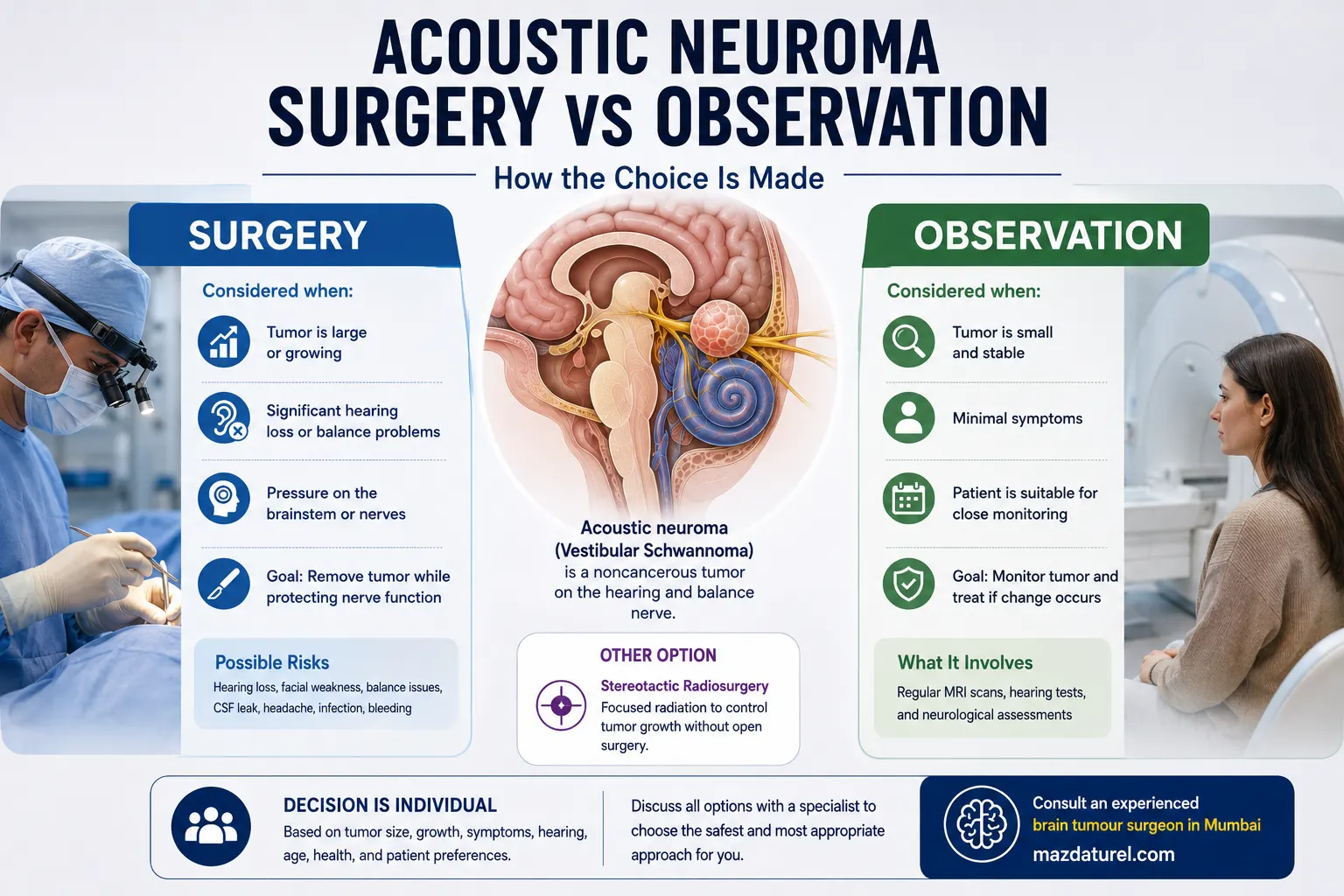
Being diagnosed with an acoustic neuroma does not automatically mean that surgery is the next step. The decision between acoustic neuroma surgery vs observation depends on the tumor’s size, whether it is growing, the patient’s hearing, balance and facial nerve function, age, general health, and how closely the tumor lies to the brainstem and nearby nerves.
Acoustic neuroma, also called vestibular schwannoma, is usually a benign and slow-growing tumor arising from the nerve involved in hearing and balance. Three recognised management approaches are observation, radiation and surgical removal.
For some small tumors, regular MRI scans and hearing tests may be safer than immediate treatment. Larger, growing or increasingly symptomatic tumors may make active treatment more appropriate.
Acoustic Neuroma Surgery vs Observation: What Is the Main Difference?
Observation means monitoring the acoustic neuroma with repeat MRI scans, hearing tests and clinical review without immediately treating it. Surgery aims to physically remove all or part of the tumor. Observation may suit selected small, stable tumors, while surgery becomes more relevant when a tumor is large, growing, compressing nearby structures or causing significant symptoms.
Neither choice is automatically better.
The purpose of treatment planning is to balance tumor control against potential effects on:
- Hearing
- Facial movement
- Balance
- Brainstem function
- Other cranial nerves
- General quality of life
This is particularly important because the hearing, balance and facial nerves lie very close together in the area where vestibular schwannomas grow.
When Can an Acoustic Neuroma Be Observed?
Vestibular schwannoma observation may be appropriate when a tumor is small, producing few symptoms, not clearly growing or discovered incidentally during imaging performed for another reason.
Observation is sometimes called watch and wait for acoustic neuroma, but this wording can be misleading. The patient is not simply waiting without medical care.
Active monitoring commonly involves:
- Repeat MRI scans
- Formal hearing tests
- Review of tinnitus and balance symptoms
- Assessment of facial sensation and movement
- Comparison with previous imaging
Johns Hopkins notes that observation can be considered for very small acoustic neuromas without significant symptoms, as well as in some older patients or people with medical conditions that make intervention less attractive.
NIDCD similarly states that when a vestibular schwannoma is small and not growing, careful MRI monitoring may be reasonable.
What Are Doctors Watching for During Observation?
The most important question is whether the situation remains stable.
Doctors may look for:
- Increase in tumor dimensions or volume
- New contact with the brainstem
- Increasing pressure on surrounding structures
- Progressive hearing loss
- New facial numbness
- Increasing balance problems
- Other neurological changes
A tumor that was reasonable to observe at diagnosis may therefore require treatment later if its behaviour changes.
Does Hearing Loss Mean Surgery Is Necessary?
Not automatically.
One-sided or asymmetric hearing loss is one of the characteristic symptoms of vestibular schwannoma, but the degree of hearing loss alone does not decide treatment.
Doctors also consider:
- How much useful hearing remains
- Whether hearing has deteriorated between tests
- Tumor size and growth
- Age
- Balance function
- The patient’s priorities
- Potential benefit and risk of treatment
A small tumor with stable hearing may sometimes be monitored. Another patient with a growing tumor and declining hearing may have stronger reasons to discuss treatment.
It is also worth knowing that removing the tumor does not guarantee restoration of hearing already lost. Surgery itself can potentially worsen hearing because of the close relationship between the tumor and hearing nerve.
When Is Acoustic Neuroma Surgery More Likely to Be Recommended?
Acoustic neuroma surgery becomes more relevant when the tumor is large, clearly increasing in size, producing significant neurological symptoms or beginning to press on the brainstem or other nearby structures.
Possible reasons to consider surgery include:
- Documented tumor growth
- A relatively large tumor at diagnosis
- Significant brainstem compression
- Increasing neurological symptoms
- Progressive facial numbness
- Significant balance or coordination problems
- Hydrocephalus caused by obstruction of normal fluid pathways
- A tumor whose anatomy makes surgical removal preferable to continued surveillance or radiation
Large vestibular schwannomas can eventually press on the brainstem and cerebellum.
The decision is not made from size alone. A patient’s age, health, hearing status and individual anatomy also matter.
What Is the Goal of Acoustic Neuroma Surgery?
The goal is usually to achieve appropriate tumor removal while protecting neurological function as much as possible.
That balance can be difficult because the tumor grows next to nerves responsible for:
- Facial movement
- Hearing
- Balance
In some cases, attempting to remove every last part of a tumor that is densely attached to the facial nerve may create more neurological risk than leaving a small amount behind and monitoring or treating it differently.
Treatment therefore needs to be individual rather than based on the assumption that complete removal is always the safest endpoint.
Johns Hopkins describes preservation of facial nerve function, optimisation of hearing outcomes and maintenance of quality of life as important priorities in vestibular schwannoma treatment.
What Are the Possible Risks of Acoustic Neuroma Surgery?
The exact surgical risk depends strongly on tumor size, location, existing nerve function and the approach used.
Possible complications may include:
- Hearing deterioration or hearing loss
- Facial weakness
- Facial numbness
- Balance difficulties
- Cerebrospinal fluid leak
- Headache
- Infection
- Bleeding
- Other neurological complications
NIDCD notes that surgery around hearing, balance and facial nerves can sometimes worsen symptoms if those nerves are injured during tumor removal.
For this reason, the decision to operate is not simply based on whether surgery is technically possible. Doctors consider whether the likely benefit justifies the neurological risk for that particular patient.
What Are the Risks of Choosing Observation?
Observation avoids the immediate risks of surgery, but it also has limitations.
The tumor may:
- Grow
- Continue affecting hearing
- Cause increasing balance problems
- Begin affecting neighbouring nerves
- Eventually become more difficult to treat
Hearing can decline even while a tumor is being monitored, which is why hearing tests are useful alongside MRI. NIDCD recommends careful imaging surveillance when a small tumor is being observed.
Observation is therefore most appropriate when the treating team believes the risks of immediate intervention outweigh the risks of careful monitoring.
Missing follow-up appointments can undermine that strategy.
Where Does Radiosurgery Fit Between Observation and Surgery?
Although the main comparison is acoustic neuroma surgery vs observation, there is an important third option: stereotactic radiosurgery.
Stereotactic radiosurgery uses highly focused radiation directed at the tumor. No incision is made, despite the word “surgery.”
The goal is usually to stop or slow further tumor growth rather than physically remove the acoustic neuroma.
It may be considered for selected patients based on factors such as:
- Tumor size
- Tumor growth
- Age
- Medical fitness for surgery
- Hearing status
- Tumor location
- Patient preference
It is not suitable for every vestibular schwannoma. Larger tumors creating significant brainstem compression may require a different approach.
Radiation can also affect nearby hearing, balance and facial nerves, so it should not be viewed as a risk-free alternative.
A Simple Comparison of the Main Treatment Options
Factor | Observation | Surgery | Stereotactic Radiosurgery |
Main aim | Monitor for change | Remove tumor tissue | Control further growth |
Usually considered when | Small/stable tumor, limited symptoms | Larger, growing or significantly symptomatic tumor | Selected small-to-moderate tumors or when surgery may be less suitable |
MRI follow-up | Required | Required after treatment | Required after treatment |
Hearing monitoring | Important | Important | Important |
Immediate procedure risk | None from treatment itself | Surgical and neurological risks | Radiation-related risks |
Tumor physically removed | No | Yes, partially or completely depending on safety | No |
This table is a general guide, not a treatment recommendation. The same tumor size can lead to different decisions in two different patients.
What Tests Help Doctors Make the Choice?
Management begins with understanding both the tumor and the patient’s current nerve function.
MRI
MRI shows:
- Tumor size
- Exact location
- Extension within and outside the internal auditory canal
- Relationship with the brainstem
- Changes compared with earlier scans
NIDCD identifies MRI as critical for determining vestibular schwannoma location and size and for planning treatment.
Audiogram
An audiogram measures hearing in each ear and helps determine whether useful hearing remains.
Serial hearing tests can show whether hearing is stable or deteriorating.
Neurological and Balance Assessment
Doctors may assess:
- Facial movement
- Facial sensation
- Balance
- Coordination
- Walking
- Other cranial nerve functions
These findings matter because a tumor’s effect on the patient is often as relevant as its measurements on MRI.
When Should Symptoms Be Reviewed Earlier Than the Next Scheduled Scan?
Contact the treating team if there is a meaningful change between follow-up appointments, such as:
- Noticeably worsening one-sided hearing
- New facial numbness
- Facial weakness
- Increasing balance difficulties
- New coordination problems
- Persistent or worsening neurological symptoms
Sudden hearing loss deserves prompt medical assessment rather than waiting for the next routine acoustic neuroma appointment. Sudden sensorineural hearing loss is considered a medical emergency because early treatment may matter, regardless of whether an acoustic neuroma is ultimately found to be responsible.
When Should You Consult a Neurosurgeon?
Once MRI confirms a vestibular schwannoma, a neurosurgical review can help determine whether observation, radiosurgery or microsurgical treatment is reasonable.
A specialist may consider:
- Current tumor dimensions
- Growth on serial MRI
- Remaining hearing
- Facial nerve function
- Balance symptoms
- Brainstem compression
- Age and overall health
- Previous treatment
- The patient’s priorities regarding hearing preservation and tumor control
Patients considering management options may seek assessment from a brain tumor surgeon in Mumbai to review the actual MRI and discuss the risks and benefits of each approach.
Dr. Mazda K. Turel can review the patient’s imaging, hearing results and neurological findings before discussing whether continued observation or active treatment may be appropriate.
Conclusion
The decision about acoustic neuroma surgery vs observation is rarely made from one MRI measurement. Small, stable tumors with limited symptoms may often be monitored, while larger, growing or increasingly symptomatic tumors may justify surgery or focused radiation.
Hearing status, facial nerve function, balance, age, overall health and the tumor’s relationship with the brainstem all influence the choice.
Observation is an active treatment strategy that requires reliable follow-up. Surgery offers physical tumor removal but carries neurological risks, while radiosurgery offers another route to tumor control in selected patients.
The most useful decision comes from comparing the actual MRI scans over time and discussing what each option could mean for tumor control, hearing and facial nerve function in the individual patient.
Frequently Asked Questions
Is observation safe for an acoustic neuroma?
Observation can be appropriate for selected small, stable acoustic neuromas, especially when symptoms are limited. It requires planned MRI scans and hearing assessments rather than simply ignoring the tumor. If scans show growth or symptoms worsen, the treatment plan can be reconsidered.
How often is MRI done during vestibular schwannoma observation?
The exact schedule is individual. Johns Hopkins notes that after diagnosis, an additional MRI may be recommended after roughly six to twelve months in patients being observed, with future imaging determined by tumor behaviour and clinical circumstances. Your treating team should set the schedule for your case.
Does a growing acoustic neuroma always need surgery?
No. Growth makes active treatment more relevant, but surgery is not the only option. Depending on tumor size, anatomy, age, health and symptoms, stereotactic radiosurgery may also be considered. Larger tumors or tumors causing significant brainstem pressure may make microsurgery more appropriate.
Can hearing continue to worsen while watching an acoustic neuroma?
Yes. Observation avoids immediate treatment risks, but hearing can deteriorate over time. This is why monitoring commonly combines MRI with hearing tests. A change in hearing does not automatically mean surgery is required, but it can change the balance between observation and active treatment.
Is surgery better than radiosurgery for acoustic neuroma?
Neither is universally better. Surgery removes tumor tissue and may be preferred for larger or compressive tumors. Radiosurgery aims to control growth without an open operation and may suit selected smaller tumors or particular patient circumstances. The decision depends on anatomy, symptoms, hearing, age, health and treatment goals.
Can a small acoustic neuroma be removed instead of observed?
Yes, surgery can sometimes be considered for a small tumor, but the benefits need to outweigh the risks to hearing, balance and facial nerve function. A small size alone does not mean that surgery is necessary. Observation or radiosurgery may also be reasonable depending on growth, symptoms, age and individual priorities.
What makes doctors stop a watch-and-wait acoustic neuroma plan?
A watch and wait acoustic neuroma strategy may be reconsidered if MRI demonstrates meaningful growth, symptoms become more significant, hearing deteriorates, facial symptoms appear or the tumor begins threatening nearby structures. The exact threshold for changing treatment is individual rather than based on one universal measurement.