Struggling to find a familiar word, suddenly using the wrong name for an object, or having difficulty understanding a conversation can be concerning—especially when these changes are new or progressively worsening. Brain tumor speech problems can occur when a tumor, surrounding swelling, or seizure activity affects brain networks involved in speaking, understanding language, reading, or writing.
The exact problem depends strongly on the tumor’s location. A person may know what they want to say but be unable to produce the words clearly. Another person may speak fluently yet have difficulty understanding what others are saying. Brain tumors can also cause slurred speech, although that is different from a language disorder.
Speech changes alone do not diagnose a brain tumor. Stroke, seizures, migraine, medicines, infections, and several neurological conditions can produce similar symptoms.
Can a Brain Tumor Cause Speech and Language Problems?
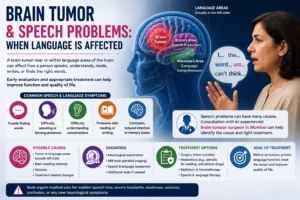
Yes. A brain tumor can cause speech or language problems when it affects brain areas and connecting pathways involved in communication. Depending on the location, a person may struggle to find words, form sentences, understand speech, read, write, or speak clearly. Swelling around a tumor and seizures can also temporarily worsen these abilities.
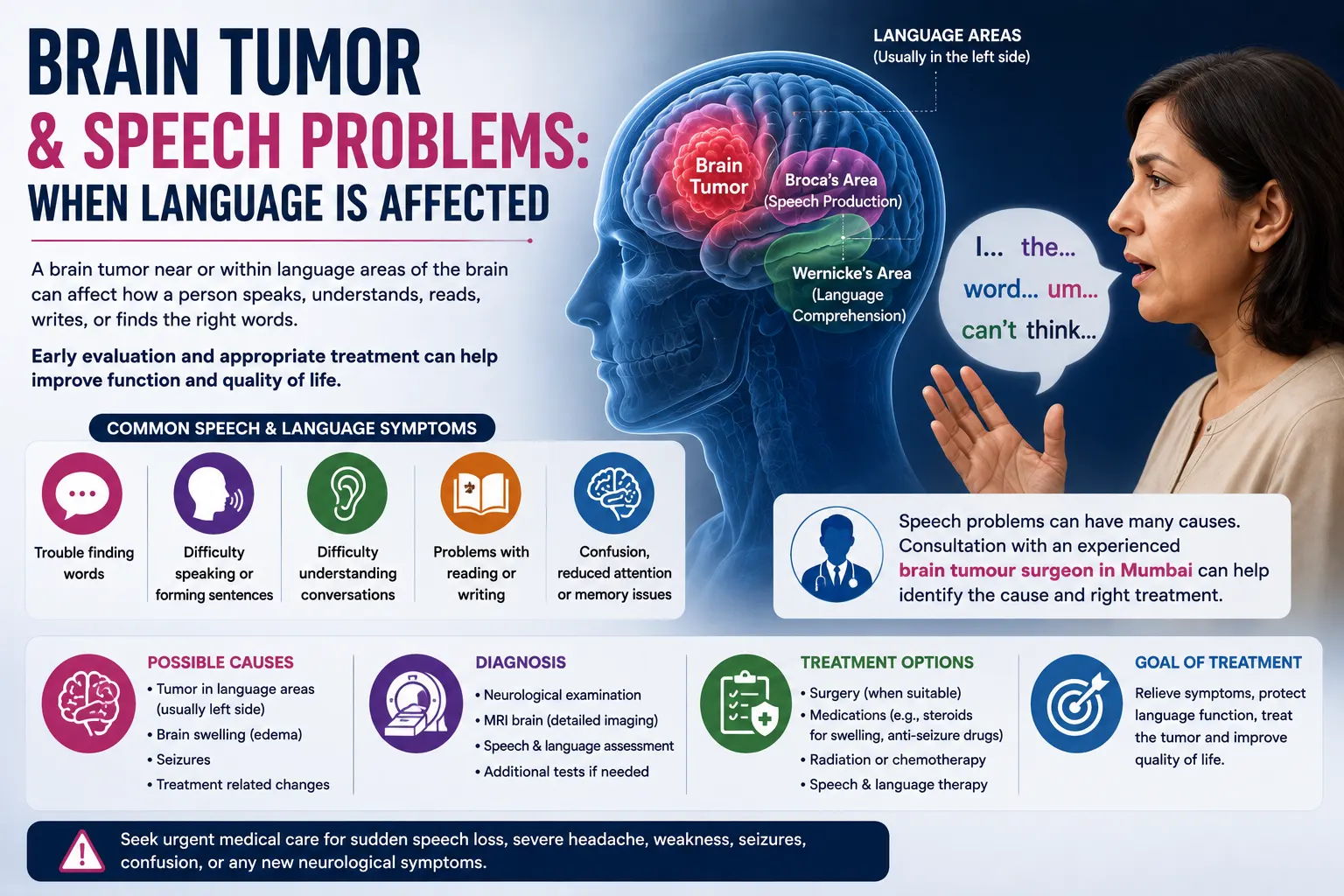
Language is not controlled by one isolated spot in the brain. It relies on interconnected networks involving the frontal, temporal, and parietal regions, usually with stronger language dominance in one cerebral hemisphere.
For many people, the dominant language hemisphere is the left side of the brain. A lesion in this region can therefore interfere with naming, sentence formation, comprehension, reading, or writing.
The symptom pattern also depends on:
- Tumor size
- Exact location
- Rate of growth
- Surrounding cerebral edema or swelling
- Seizures
- Previous surgery or treatment
- Individual organisation of language functions
What Do Brain Tumor Speech Problems Sound Like?
Communication difficulties are not always obvious.
Possible brain tumor language problems include:
- Frequently struggling to find familiar words
- Using an incorrect word for an object
- Pausing unusually often during conversation
- Speaking in very short or incomplete sentences
- Difficulty understanding what another person says
- Problems following longer instructions
- Difficulty reading previously familiar material
- Problems writing meaningful sentences
- Repeating words or phrases incorrectly
- Speech that sounds confused or does not fit the conversation
Other patients may have speech that sounds slurred, slow, weak, or poorly coordinated.
These differences matter because doctors try to determine whether the problem involves language processing or the physical production of speech.
Aphasia and Slurred Speech Are Not the Same Thing
The words “speech problem” can describe several different neurological symptoms.
What Is Aphasia?
Aphasia is a disorder of language. A person may have difficulty speaking, understanding spoken language, reading, or writing even though the muscles of the mouth and throat are working.
Aphasia from a brain tumor may develop when a lesion affects the dominant language networks.
Someone with aphasia might:
- Know an object but be unable to name it
- Replace one word with another
- Understand simple sentences but struggle with complex ones
- Speak fluently while producing sentences that do not make sense
- Have difficulty reading or writing
The exact pattern depends on which parts of the language network are affected.
What Is Dysarthria?
Dysarthria is different. The person knows what they want to say and understands language, but speech becomes unclear because the muscles involved in speaking are weak or poorly coordinated.
It may sound:
- Slurred
- Slow
- Quiet
- Strained
- Poorly articulated
Brain tumors affecting movement pathways, the brainstem, or areas responsible for coordinating speech muscles can potentially produce this pattern.
A neurological examination helps distinguish one problem from the other.
Why Does Tumor Location Matter?
The location of the tumor often explains the type of communication difficulty.
Tumor Near Frontal Language Networks
A tumor near language area in the dominant frontal region may interfere with producing speech.
The person may:
- Speak slowly
- Use short phrases
- Struggle to get words out
- Know what they want to communicate but have difficulty expressing it
Movement problems affecting the opposite side of the body may also occur if nearby motor areas are involved.
Tumor Near Temporal Language Networks
Parts of the temporal lobe are involved in understanding spoken language and connecting words with meaning.
A tumor affecting these networks may cause:
- Difficulty understanding speech
- Trouble selecting appropriate words
- Fluent but confusing sentences
- Problems remembering verbal information
Parietal Language Network Involvement
Parts of the parietal lobe contribute to reading, writing, naming, calculation, and integration of language information.
A lesion in this region may result in a combination of language, reading, writing, or sensory difficulties.
The brain’s functional organisation varies somewhat between people. This is one reason surgeons cannot always rely on anatomical landmarks alone when operating close to language networks.
Can Brain Tumor Swelling Make Speech Worse?
Yes.
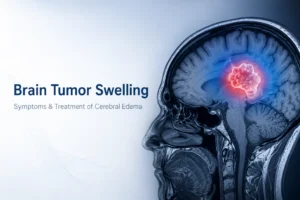
A tumor may be surrounded by cerebral edema, meaning excess fluid in nearby brain tissue. This can interfere with the function of language networks even outside the main tumor.
If swelling increases, a patient who previously had mild word-finding difficulty may notice that communication becomes more difficult.
Doctors may sometimes use corticosteroid medicines to reduce tumor-related brain swelling when clinically appropriate. The treatment plan depends on the diagnosis, symptoms, scan findings, and overall condition.
Medication should not be started, stopped, or increased without medical supervision.
Can Seizures Cause Temporary Language Problems?
Yes.
Some brain tumors irritate the surrounding cortex and trigger focal seizures. If a seizure involves language-related brain regions, the person may temporarily be unable to:
- Speak
- Understand language
- Name objects
- Read normally
Confusion or communication difficulty can also persist for a period after the seizure ends.
Repeated episodes of sudden language difficulty should therefore be described carefully to the medical team. Their timing and duration can provide important diagnostic clues.
How Are Speech Problems Investigated?
Doctors first need to determine whether the communication problem is related to language, speech-muscle control, cognition, hearing, or another cause.
Neurological Examination
The assessment may include:
- Naming objects
- Repeating words or sentences
- Following spoken instructions
- Reading
- Writing
- Facial and tongue movement
- Arm and leg strength
- Sensation
- Memory and attention
This can help identify which neurological functions are affected.
MRI of the Brain
An MRI, or magnetic resonance imaging scan, creates detailed images of the brain and surrounding structures.
It can show:
- Whether a tumor or other structural lesion is present
- Its exact location
- Size
- Surrounding swelling
- Relationship with language-related areas
- Pressure on nearby structures
Brain tumor symptoms depend heavily on tumor location and size, and speech problems are among recognised neurological presentations.
Speech and Language Assessment
A speech-language pathologist may perform more detailed testing.
Assessment can examine:
- Word finding
- Sentence formation
- Comprehension
- Reading
- Writing
- Speech clarity
- Cognitive communication
These findings are useful not only for diagnosis but also for surgical planning and rehabilitation.
How Does a Speech Problem Affect Brain Tumor Surgery?
If a tumor is close to important language networks, the neurosurgeon has to balance tumor removal with the risk of creating or worsening aphasia.
In selected patients, awake brain surgery with language mapping may be considered.
During part of an awake craniotomy, the patient may be asked to:
- Name pictures
- Read words
- Count
- Answer questions
- Repeat phrases
The surgeon can gently stimulate small areas of the brain while the patient performs these tasks. If stimulation temporarily interrupts language, that area can be identified as functionally important and protected.
Mayo Clinic describes awake mapping as a way to identify brain areas responsible for speech, movement, vision, and understanding in real time, helping surgeons remove tumor while reducing the risk of damage to essential functions.
Not every brain tumor requires awake surgery.
What Treatments May Help Brain Tumor Language Problems?
Treatment depends on why the communication problem is occurring.
Options may include:
- Surgery when safe tumor removal is appropriate
- Medicines to manage tumor-related swelling
- Anti-seizure treatment when seizures are involved
- Radiation therapy
- Chemotherapy or other systemic treatments depending on tumor type
- Speech and language rehabilitation
Brain tumor surgery may involve complete or partial removal depending on how close the tumor is to healthy functional brain tissue.
Speech Therapy and Rehabilitation
Speech-language therapy can be useful before or after treatment.
Therapy may focus on:
- Word retrieval
- Understanding language
- Reading and writing
- Sentence formation
- Speech clarity
- Alternative communication strategies
Recovery varies. Some language problems improve when tumor pressure or swelling is reduced, while others may persist when language networks have been significantly affected.
No operation or rehabilitation programme can guarantee complete restoration of speech.
When Is Speech Difficulty an Emergency?
A slowly progressive language problem should be medically assessed, but sudden speech difficulty requires urgent attention.
Seek emergency medical care if someone suddenly develops:
- Difficulty speaking
- Difficulty understanding speech
- Facial drooping
- Weakness or numbness on one side
- Sudden vision changes
- Severe loss of balance
- Loss of consciousness
- A first seizure
Sudden speech or language difficulty can be a sign of stroke and should not be assumed to come from a known brain tumor.
A new seizure, rapidly worsening confusion, or sudden neurological deterioration also warrants urgent assessment.
When Should You Consult a Neurosurgeon?
Neurosurgical assessment becomes relevant when MRI identifies a brain tumor close to language-related areas or when a known tumor is causing progressive communication problems.
A consultation may include discussion of:
- The tumor’s exact MRI location
- Whether language networks are nearby
- The realistic goal of surgery
- Whether functional mapping is useful
- Whether awake surgery may be appropriate
- Risks of temporary or permanent language changes
- Whether biopsy rather than extensive removal is safer
- Rehabilitation after treatment
Patients with an identified lesion may seek evaluation from a brain tumor surgeon in Mumbai to understand how tumor location affects treatment planning.
Dr. Mazda K. Turel can review the neurological examination and actual MRI images before discussing whether surgery, further testing, or another treatment approach may be appropriate.
Conclusion
Brain tumor speech problems can range from mild word-finding difficulty to aphasia, impaired comprehension, reading or writing problems, or slurred speech. The exact pattern depends on where the tumor and surrounding changes affect the brain’s communication networks.
Speech symptoms should never be used to diagnose a tumor on their own. Neurological examination, MRI, and speech-language assessment help identify what is being affected and why.
For a tumor near language area, treatment planning has to balance tumor control with preservation of communication. Functional mapping and awake surgery may help achieve that balance in selected patients.
Progressive communication changes deserve medical evaluation, while sudden difficulty speaking or understanding language should be treated as an emergency because stroke and other acute neurological conditions can present in the same way.
Frequently Asked Questions
Can brain tumor speech problems come and go?
Yes. Brain tumor speech problems may fluctuate, particularly when seizures, fatigue, medications, or changing brain swelling contribute to the symptoms. However, repeated or progressive communication problems still need evaluation. Sudden episodes of speech loss can also have causes such as seizures or stroke and should not automatically be attributed to the tumor.
What is aphasia from a brain tumor?
Aphasia brain tumor symptoms occur when a lesion interferes with brain networks responsible for language. The person may struggle to find words, form sentences, understand speech, read, or write. Aphasia is different from slurred speech because the main problem is processing language rather than simply controlling the muscles used to speak.
Does difficulty finding words always mean a brain tumor?
No. Occasional word-finding difficulty is common and can occur with fatigue, stress, ageing, migraine, medication effects, and many neurological conditions. Persistent or progressively worsening word-finding problems become more concerning when they are accompanied by seizures, weakness, headaches, personality changes, or other neurological symptoms.
Which side of the brain controls speech?
Language function is most commonly concentrated in the left cerebral hemisphere, although individual organisation varies. Some language functions are distributed across wider networks involving both sides of the brain. This variation is one reason functional mapping may be useful before or during surgery for a tumor located near language-related regions.
Can speech improve after brain tumor surgery?
It can, particularly if the communication problem was partly caused by tumor pressure or surrounding swelling. However, recovery depends on tumor location, duration of symptoms, brain tissue involvement, surgery, and individual neurological factors. Some patients need speech-language rehabilitation, and full recovery cannot be guaranteed.
Why would awake surgery be used for a tumor near the language area?
Awake surgery allows the team to test language while operating. The patient may name objects, read, or answer questions while small areas of the brain are mapped. This provides real-time information that can help the surgeon distinguish tumor from nearby tissue essential for speech and understanding.
Can radiation or chemotherapy affect speech?
They can indirectly affect communication in some patients through fatigue, treatment-related swelling, cognitive effects, or changes involving the tumor itself. New or worsening speech problems during treatment should be reported rather than automatically assumed to be a normal treatment side effect. The treating team may need to review medications, examination findings, and imaging.