Noticing that one arm feels heavier, one leg keeps dragging, or one side of the body has gradually become harder to control deserves medical attention. Brain tumor one sided weakness can occur when a tumor or the swelling around it affects areas of the brain responsible for voluntary movement.
The pattern depends on where the abnormality is located. A tumor affecting the motor pathways on one side of the brain may cause weakness on the opposite side of the body. The change may involve only an arm or leg initially, or it may affect the face, arm, and leg together. Brain tumors are one possible explanation, but stroke, seizures, nerve disorders, and several other neurological conditions can cause similar symptoms.
Sudden one-sided weakness should always be treated as an emergency because stroke is a much more immediate concern.
Can a Brain Tumor Cause Weakness on One Side?
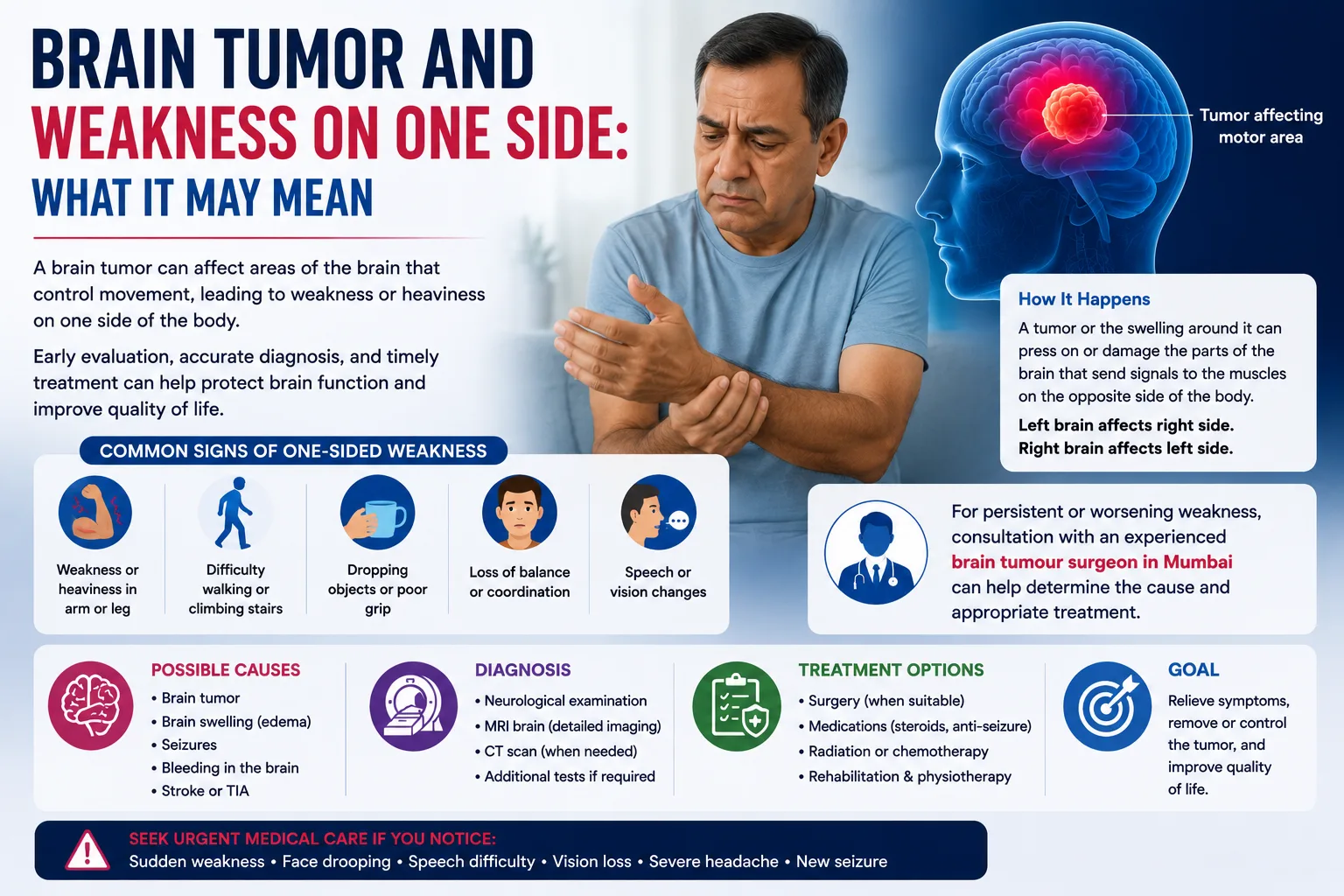
Yes. A brain tumor can cause one-sided weakness if it affects the frontal lobe, motor cortex, brainstem, or nerve pathways responsible for controlling movement. The tumor itself, pressure on nearby brain tissue, or surrounding swelling may interfere with signals travelling from the brain to the muscles.
Doctors call partial weakness on one side of the body hemiparesis. If movement is completely lost, the term hemiplegia may be used.
One-sided weakness can involve:
- The face
- One arm
- One leg
- The arm and leg together
- The face, arm, and leg on the same side
NCI guidance notes that people with brain tumors may experience weakness on one side of the body and that tumors involving the frontal lobes or brainstem can contribute to weakness.
Why Can a Tumor on One Side of the Brain Affect the Other Side?
The main part of the brain involved in voluntary movement is the motor cortex, located in the frontal lobe.
Nerve signals beginning here travel through deeper parts of the brain and brainstem before continuing into the spinal cord. Most major motor fibres cross before reaching the muscles.
Because of this arrangement, a tumor affecting the left cerebral motor pathway can commonly produce weakness on the right side of the body, while a tumor on the right can produce left-sided weakness.
The exact pattern is not always this simple. Tumors involving deeper brain structures or the brainstem can create more complicated combinations of weakness, facial symptoms, balance problems, eye-movement changes, or swallowing difficulties.
What Does Brain Tumor Arm Weakness Feel Like?
Brain tumor arm weakness may begin subtly rather than as complete loss of movement.
A person may notice:
- Frequently dropping objects
- Reduced grip strength
- Difficulty opening jars or turning keys
- Trouble lifting the arm normally
- Difficulty buttoning clothes
- Handwriting becoming less controlled
- One arm drifting downward when held out
- Fine finger movements becoming difficult
NCI describes arm and shoulder weakness as difficulty picking things up, holding objects, or performing routine daily activities.
Weakness should be distinguished from numbness. Someone may have normal sensation but reduced strength, or both symptoms may occur together depending on the affected brain region.
How Can Brain Tumor Leg Weakness Present?
Brain tumor leg weakness may first appear as a change in walking rather than an obvious inability to move the leg.
Possible signs include:
- Dragging one foot
- Tripping more frequently
- Difficulty climbing stairs
- Trouble getting up from a chair
- One leg feeling unusually heavy
- Reduced confidence while walking
- Loss of balance
- Falls
- Difficulty walking longer distances
NCI notes that weakness affecting the legs or hips can cause reduced movement, imbalance, difficulty walking, and increased falls.
If weakness progressively worsens over days, weeks, or months, neurological evaluation is appropriate.
What Other Brain Tumor Neurological Symptoms May Occur With Weakness?
One-sided weakness becomes more concerning for a central neurological problem when it appears together with other symptoms.
Possible brain tumor neurological symptoms include:
- New seizures
- Persistent or changing headaches
- Numbness or tingling
- Speech difficulty
- Problems understanding language
- Blurred or double vision
- Loss of part of the visual field
- Memory problems
- Confusion
- Personality or behavioural changes
- Balance difficulties
- Nausea or vomiting
Brain tumor symptoms depend heavily on tumor size, location, and growth rate. Mayo Clinic lists loss of movement in an arm or leg, balance problems, speech difficulties, confusion, memory changes, seizures, and visual problems among possible presentations.
Having several of these symptoms still does not prove that a tumor is present. Proper neurological assessment is required.
Can Brain Swelling Make Weakness Worse?
Yes.
A tumor can be surrounded by cerebral edema, meaning swelling within nearby brain tissue. This swelling may interfere with normal nerve signalling and increase pressure on surrounding brain structures.
A patient who previously had mild weakness might therefore become noticeably weaker if the surrounding edema increases.
NCI notes that brain-tumor-related weakness may also be caused by treatment-associated swelling or injury to brain tissue.
When symptomatic edema is present, doctors may use corticosteroid medicines such as dexamethasone in selected patients while treating the underlying cause.
Steroids should only be taken under medical supervision because the appropriate dose and duration vary, and prolonged corticosteroid use can itself contribute to muscle weakness.
How Do Doctors Investigate One-Sided Weakness?
The first task is to determine whether the weakness is actually present and which part of the nervous system may be responsible.
Neurological Examination
A doctor may compare both sides of the body and assess:
- Arm and leg strength
- Grip
- Facial movement
- Reflexes
- Sensation
- Coordination
- Walking
- Balance
- Speech
- Vision
- Mental function
The pattern can provide clues about whether the problem comes from the brain, spinal cord, peripheral nerves, muscles, or another source.
MRI of the Brain
If a structural brain problem is suspected, an MRI may be recommended.
An MRI, or magnetic resonance imaging scan, creates detailed pictures of the brain and can show:
- A brain tumor or other lesion
- Tumor size and location
- Surrounding swelling
- Pressure on nearby structures
- Relationship with motor areas and pathways
Brain tumor symptoms depend on which area is affected, so combining the examination with imaging is particularly useful.
CT Scan
A CT scan may be used when urgent brain imaging is required, particularly when symptoms appear suddenly.
If one-sided weakness began abruptly, emergency teams need to consider stroke or bleeding before assuming the problem is tumor-related.
How Is Hemiparesis From a Brain Tumor Treated?
Hemiparesis from a brain tumor is treated by addressing both the underlying tumor and the factors contributing to weakness.
Depending on the diagnosis, treatment may include:
- Surgery
- Radiation therapy
- Chemotherapy
- Targeted treatment for selected tumors
- Medicines for brain swelling
- Anti-seizure medicines when required
- Physical rehabilitation
The appropriate plan depends on tumor type, location, size, pathology, scan findings, symptoms, age, and overall health.
Can Surgery Improve One-Sided Weakness?
It may in selected patients.
If weakness is caused partly by pressure from a removable tumor or surrounding edema, reducing that pressure may allow neurological function to improve.
However, improvement cannot be promised.
Weakness may persist if the tumor has infiltrated or permanently damaged important motor pathways. Brain surgery itself can also cause temporary or permanent weakness when an operation is close to areas controlling movement.
Mayo Clinic lists weakness or paralysis of the face, arms, or legs among recognised risks of brain tumor surgery and notes that risk depends significantly on tumor location.
The surgical objective is therefore usually maximum safe treatment, not tumor removal at the expense of movement.
Why Rehabilitation Matters
Treatment of the tumor and recovery of movement are related but separate goals.
Physical therapy can help patients work on:
- Muscle strength
- Walking
- Balance
- Transfers from bed or chair
- Coordination
- Safer movement at home
- Endurance
Occupational therapy may help with everyday activities such as dressing, eating, bathing, writing, and using the affected hand.
Rehabilitation can be needed after brain tumor surgery when weakness or other neurological changes affect normal function.
The amount of improvement varies according to the cause and severity of the neurological deficit.
Sudden One-Sided Weakness Is an Emergency
A gradually developing weakness in someone with a brain tumor and a sudden weakness are very different situations.
If one side of the face, arm, or leg suddenly becomes weak or numb, seek emergency medical care immediately.
Other stroke warning signs include:
- Facial drooping
- Sudden speech difficulty
- Difficulty understanding speech
- Sudden vision problems
- Sudden trouble walking
- Loss of balance or coordination
- Sudden severe headache
NINDS identifies sudden weakness of the face, arm, or leg—especially on one side—as a major stroke warning sign.
Even a person with a known brain tumor can still have a stroke. Do not assume sudden weakness is simply the tumor getting worse.
When Should You Consult a Neurosurgeon?
A neurosurgical review becomes relevant when MRI identifies a brain tumor that may be responsible for progressive weakness or when the lesion lies close to motor pathways.
A consultation may consider:
- Which part of the brain is affected
- Whether the weakness fits the tumor location
- Amount of surrounding swelling
- Tumor size and growth
- Whether surgery may relieve pressure
- How closely the tumor lies to motor pathways
- What neurological risks surgery may carry
- Whether biopsy, radiation, or another treatment is preferable
- Rehabilitation needs
Patients with an identified brain lesion may seek evaluation from a brain tumor surgeon in Mumbai to review the MRI and discuss whether surgery or another treatment approach may be appropriate.
Dr. Mazda K. Turel can assess the scan alongside neurological examination findings and current strength before discussing treatment options.
Conclusion
Brain tumor one sided weakness can occur when a tumor, surrounding swelling, or treatment-related changes interfere with the areas and pathways responsible for movement. The weakness may involve an arm, a leg, the face, or the entire side of the body, and the pattern often provides clues about which brain region is affected.
Still, one-sided weakness should never be assumed to come from a tumor without evaluation. MRI and neurological examination help identify the underlying cause and guide treatment.
Progressive weakness in someone with a known or suspected brain lesion deserves specialist review. Sudden weakness is different: it should be treated as a medical emergency because stroke, bleeding, seizures, and other acute neurological conditions may cause the same symptom.
Frequently Asked Questions
Can a brain tumor cause weakness only in one arm?
Yes. A tumor affecting the part of the motor system that controls the arm may produce predominantly brain tumor arm weakness. The person may notice reduced grip, dropping objects, difficulty lifting the arm, or problems with fine hand movements. However, arm weakness can also arise from stroke, neck problems, nerve compression, or muscle disorders.
Can a brain tumor cause weakness only in one leg?
Yes. Brain tumor leg weakness may occur if a lesion affects motor pathways controlling the leg. It may present as dragging the foot, frequent tripping, trouble climbing stairs, or reduced balance. Doctors use neurological examination and imaging to determine whether the source is the brain, spine, nerves, muscles, or another condition.
What is hemiparesis in a brain tumor?
Hemiparesis means reduced strength affecting one side of the body. Hemiparesis brain tumor symptoms may involve the face, arm, and leg together or only part of one side. The weakness can result from the tumor itself, pressure on motor pathways, surrounding edema, or treatment-related effects.
Does one-sided weakness mean a brain tumor is large?
Not necessarily. Location can matter more than overall size. A relatively small tumor affecting an important motor pathway can cause noticeable weakness, while a larger lesion elsewhere may not affect movement. Doctors need to review both the neurological examination and MRI rather than estimating severity from tumor size alone.
Can weakness improve after brain tumor treatment?
It can, particularly when weakness is related to reversible pressure or swelling. Recovery is less predictable if brain tissue or motor pathways have been permanently damaged. Surgery, treatment of edema, and rehabilitation may all contribute to improvement, but no specific amount of recovery can be guaranteed.
Can seizures cause temporary one-sided weakness?
Yes. Some people develop temporary weakness after a seizure, sometimes called postictal or Todd’s weakness. It can resemble stroke or tumor-related neurological deterioration. Because sudden weakness has several potentially serious causes, a new episode needs medical assessment rather than being diagnosed at home.
When should brain tumor one sided weakness be treated as an emergency?
Brain tumor one sided weakness needs emergency evaluation if it appears suddenly, becomes rapidly worse, or occurs with facial drooping, speech difficulty, vision loss, loss of consciousness, severe headache, or major balance problems. Stroke and other acute neurological conditions can produce these symptoms and need immediate assessment.