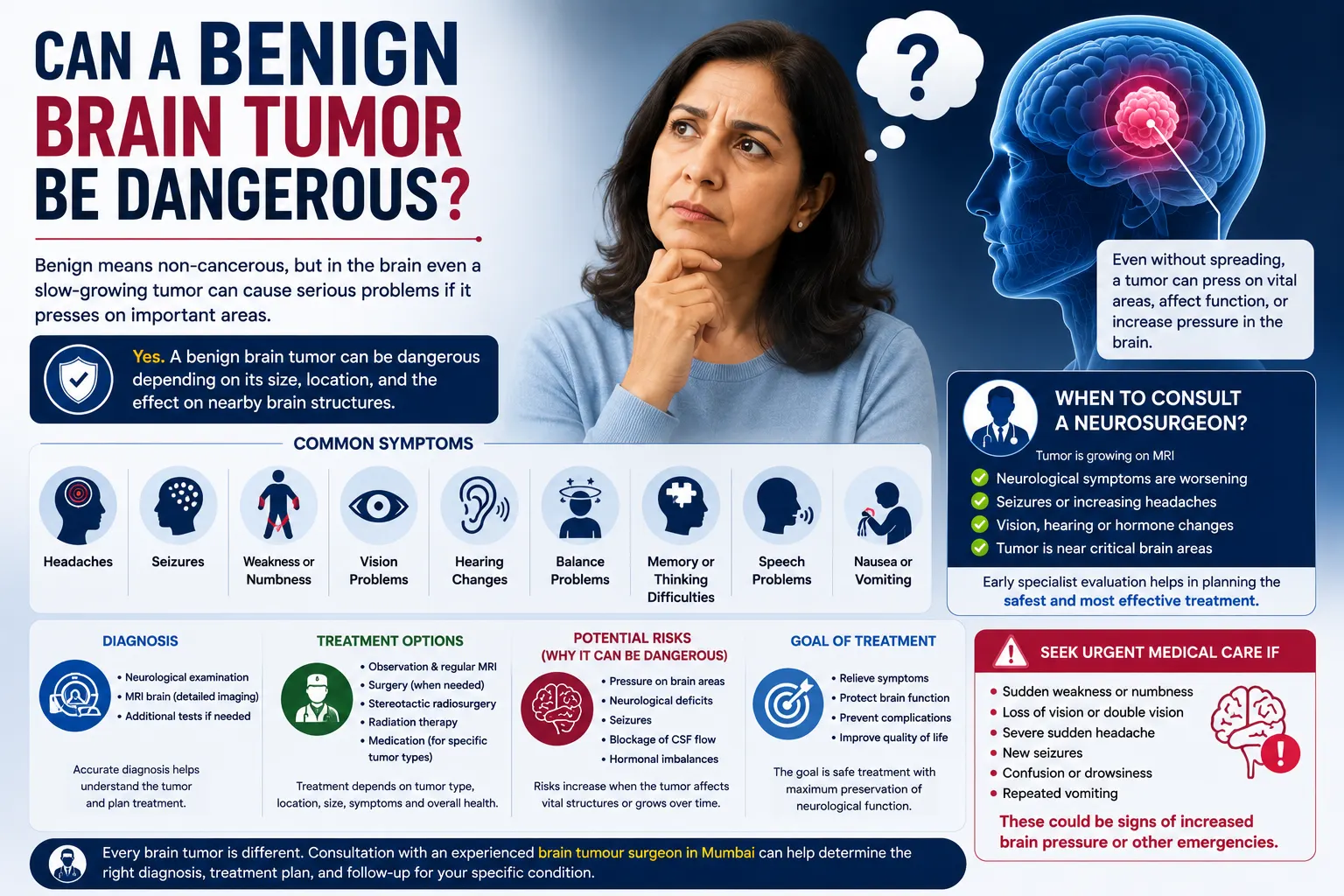
The word “benign” can sound reassuring, but in the brain it does not always mean harmless. So, can a benign brain tumor be dangerous? Yes. A noncancerous brain tumor may grow slowly and usually does not spread to distant organs, yet it can still become medically serious if it presses on the brain, nerves, blood vessels, or pathways that carry cerebrospinal fluid.
The effect depends greatly on where the tumor is located. A small tumor near an optic nerve, brainstem, or other critical structure may cause significant symptoms, while a larger tumor elsewhere may remain unnoticed for some time.
Some benign tumors need only MRI monitoring. Others require surgery, radiation, radiosurgery, or tumor-specific medication. The treatment decision depends on the tumor type, location, growth, symptoms, and individual health.
Can a Benign Brain Tumor Be Dangerous Even Though It Is Not Cancer?
Yes. A benign brain tumor can be dangerous because the skull provides limited space for a growing mass. Even without spreading to other organs, a tumor can compress brain tissue, cranial nerves, blood vessels, or cerebrospinal fluid pathways and interfere with important functions such as movement, vision, hearing, speech, balance, memory, or hormone control.
This is the main difference between the words benign and safe.
Benign generally describes the biological behaviour of the tumor. Many benign brain tumors:
- Grow relatively slowly
- Have more clearly defined borders
- Do not spread throughout the body like metastatic cancer
But location matters enormously inside the skull.
Johns Hopkins notes that even benign brain tumors can become dangerous when their size or location causes compression and neurological dysfunction.
Why Can a Noncancerous Brain Tumor Cause Serious Problems?
Several mechanisms can make the non cancerous brain tumor risk clinically important.
Pressure on Important Brain Tissue
A growing mass takes up space inside the skull.
If it begins pressing on an area responsible for movement, speech, memory, or vision, symptoms may develop even though the tumor itself is not malignant.
For example, pressure on motor pathways may cause weakness, while compression of visual structures may lead to reduced or lost vision.
Pressure on Cranial Nerves
Cranial nerves connect the brain with structures involved in:
- Vision
- Eye movement
- Hearing
- Balance
- Facial sensation
- Facial movement
- Swallowing
- Speech
A benign tumor growing along one of these nerves can gradually interfere with its function.
A vestibular schwannoma, for example, is typically noncancerous but may cause one-sided hearing loss, tinnitus, and balance problems because it develops near the hearing and balance nerves.
Blocking Cerebrospinal Fluid
Cerebrospinal fluid, or CSF, normally circulates around the brain and spinal cord.
A tumor can occasionally block these pathways, causing fluid to accumulate. This condition is called hydrocephalus.
The resulting pressure may contribute to:
- Headache
- Nausea
- Vomiting
- Problems walking
- Increasing confusion
- Drowsiness
Mayo Clinic identifies obstruction of cerebrospinal fluid and pressure within the brain as possible complications of benign tumors.
Hormonal Problems
Pituitary tumors may be benign yet still cause major health problems by producing too much of a hormone or interfering with normal pituitary function.
Depending on the hormone involved, symptoms may include menstrual changes, fertility problems, sexual difficulties, unusual weight or body changes, excessive thirst and urination, or thyroid and cortisol-related problems.
What Are Common Benign Brain Tumor Symptoms?
Benign brain tumor symptoms depend on the tumor’s size, location, and growth rate.
Possible symptoms include:
- Persistent or changing headaches
- Seizures
- Weakness or numbness
- Balance or walking difficulties
- Blurred or double vision
- Loss of part of the visual field
- Hearing changes
- Tinnitus
- Difficulty speaking or understanding language
- Memory or concentration problems
- Personality or behavioural changes
- Nausea or vomiting
- Hormonal changes
Some tumors produce no symptoms at all and are discovered accidentally during an MRI performed for another reason.
Symptoms from benign tumors may also develop slowly over months or years, making them easier to overlook initially.
Does Tumor Location Matter More Than Size?
Sometimes, yes.
There is no universal size at which a benign tumor becomes dangerous.
A relatively small lesion may cause significant neurological problems if it develops beside a critical structure. Examples include:
- Near the optic nerves: progressive vision problems
- Near the hearing nerve: hearing loss or tinnitus
- Near the brainstem: balance, swallowing, eye movement, or other cranial nerve symptoms
- Near the motor cortex: weakness
- Near language areas: speech or comprehension problems
- In the pituitary region: visual and hormonal symptoms
Conversely, certain slowly growing tumors may become relatively large before producing obvious symptoms if they arise in an area that can accommodate gradual compression.
This is why treatment decisions cannot be made from a measurement on the MRI report alone.
Are All Benign Brain Tumors Treated Immediately?
No.
A small, asymptomatic tumor that appears slow-growing may sometimes be safely monitored rather than treated immediately.
This approach is called active surveillance or observation.
During surveillance, doctors may use:
- Repeat MRI scans
- Neurological examinations
- Hearing or visual testing when relevant
- Hormone testing for pituitary lesions
- Review of new symptoms
NCI and Mayo Clinic both recognise active surveillance as an option for selected slow-growing, asymptomatic brain tumors.
The purpose is to avoid treatment risks when intervention is not yet providing a meaningful benefit.
A decision to observe does not mean the tumor can be forgotten. Follow-up is important because growth or new symptoms may change the treatment plan.
When Does a Benign Brain Tumor Need Treatment?
Benign brain tumor treatment becomes more likely when the tumor:
- Is growing on follow-up MRI
- Causes neurological symptoms
- Produces seizures
- Threatens vision or hearing
- Creates significant brain pressure
- Blocks cerebrospinal fluid
- Causes clinically important hormonal problems
- Compresses the brainstem or other critical structures
Treatment options depend on the exact diagnosis.
Surgery
Surgery may be considered when the tumor can be removed safely and doing so is expected to reduce symptoms, relieve pressure, or prevent neurological deterioration.
The goal is usually to remove as much tumor as can be done safely while protecting normal brain function. Complete removal is not always appropriate when a tumor is tightly attached to important nerves, blood vessels, or functional brain tissue.
Stereotactic Radiosurgery
Stereotactic radiosurgery is focused radiation rather than open surgery.
It may be considered for selected benign tumors, particularly when conventional surgery is less suitable, part of the tumor remains after surgery, or a tumor grows during follow-up.
Radiation Therapy
Fractionated radiation may be appropriate for certain tumors depending on size, location, diagnosis, and relationship with sensitive structures.
Medication
Some benign tumors have specific medical treatments.
For example, certain pituitary tumors, particularly prolactinomas, may respond to medication and may not require surgery as the first treatment.
The correct strategy depends on what type of tumor is actually present.
Can a Benign Tumor Come Back?
Yes.
Benign does not necessarily mean a tumor can never recur.
NCI notes that benign CNS tumors may recur after treatment even though they rarely spread into other tissues.
The chance of recurrence varies according to:
- Tumor type
- Location
- Biological characteristics
- How much tumor could safely be removed
- Previous treatment
For this reason, some patients require long-term MRI surveillance after treatment.
When Should Symptoms Be Treated as an Emergency?
Many benign tumors grow slowly. Sudden neurological symptoms, however, should not be assumed to be part of that slow process.
Seek emergency medical care for:
- A first seizure
- Sudden weakness or numbness
- Sudden difficulty speaking
- Sudden significant vision loss
- Loss of consciousness
- Rapidly increasing confusion
- Repeated vomiting with neurological deterioration
- A sudden or rapidly worsening severe headache
Mayo Clinic specifically recommends urgent assessment for first seizures, sudden weakness, speech or vision problems, confusion, repeated vomiting, and severe sudden or worsening headache in people with possible benign brain tumors.
These symptoms can also occur with stroke, bleeding, infection, seizures, and other neurological emergencies.
When Should You Consult a Neurosurgeon?
A neurosurgical consultation is relevant when an MRI identifies a benign or possibly benign tumor that is growing, causing symptoms, or located near critical brain structures.
A neurosurgeon may review:
- The actual MRI images
- Tumor type and likely diagnosis
- Size and exact location
- Growth compared with earlier scans
- Pressure on the brain or nerves
- Neurological symptoms
- Whether continued observation is reasonable
- Whether surgery is appropriate
- Whether focused radiation is an alternative
- The neurological risks of treatment
Patients who need specialist evaluation may consult a brain tumor surgeon in Mumbai to understand whether the safest approach is observation or active treatment.
Dr. Mazda K. Turel can review symptoms, neurological findings, and imaging before discussing whether surgery, continued monitoring, radiation-based treatment, or another approach may be suitable.
Conclusion
So, can a benign brain tumor be dangerous? Yes—but not simply because a tumor exists. The clinical risk depends on what it is doing to the brain and nearby nerves.
A noncancerous tumor may remain stable for years and require only observation. Another may threaten vision, hearing, movement, hormone function, or normal cerebrospinal fluid flow even though it grows slowly.
MRI findings, neurological symptoms, tumor growth, location, and overall health help determine whether monitoring, surgery, radiosurgery, radiation, or another treatment is appropriate.
The key message is that “benign” should not be interpreted as “nothing to worry about,” but it also should not create unnecessary fear. Careful specialist review can identify which tumors need treatment and which can be safely watched.
Frequently Asked Questions
Can a benign brain tumor become life-threatening?
Yes, in selected situations. A benign tumor may become serious if it compresses the brainstem, blocks cerebrospinal fluid, causes severe pressure inside the skull, or damages structures controlling essential neurological functions. The danger depends more on location, growth, and effect on nearby tissues than on whether the tumor is labelled cancerous.
Can a small benign brain tumor be dangerous?
It can. A small tumor beside an optic nerve, brainstem, cranial nerve, or another critical structure may produce important neurological symptoms. Size alone therefore does not determine risk. Doctors review the tumor’s precise MRI location, symptoms, growth pattern, and relationship with nearby structures before recommending treatment.
Does a benign brain tumor always need surgery?
No. Some small, asymptomatic and slow-growing tumors can be monitored with regular MRI scans. Surgery becomes more relevant if the tumor grows, produces symptoms, threatens neurological function, or causes significant pressure. Radiation, radiosurgery, and tumor-specific medicines are alternatives in selected situations.
Can a benign tumor cause seizures?
Yes. A brain tumor can irritate surrounding brain tissue and disturb normal electrical activity, which may trigger seizures. A first seizure should receive medical assessment because tumors are only one possible cause.
Can a benign brain tumor cause permanent neurological damage?
It can if prolonged compression or involvement of an important nerve or brain area causes lasting injury. Whether neurological function improves after treatment depends on the tumor’s location, how long symptoms have been present, the degree of nerve or brain involvement, and individual recovery. Treatment cannot guarantee complete restoration of lost function.
Is a noncancerous brain tumor less serious than brain cancer?
In general, benign tumors tend to grow more slowly and do not invade or spread in the same way as malignant tumors. However, a noncancerous tumor can still be medically serious because the brain and skull contain many structures where even slow pressure can cause significant neurological problems.
Can a benign brain tumor grow back after surgery?
Yes. Recurrence is possible depending on tumor type, location, and whether complete removal was safely achievable. Follow-up MRI scans may therefore be recommended even after treatment. The surveillance schedule is individual rather than the same for every benign brain tumor.