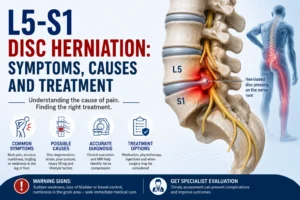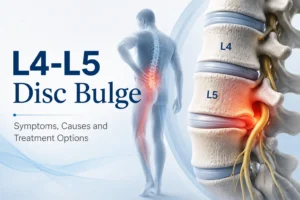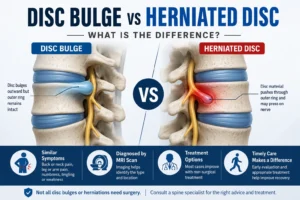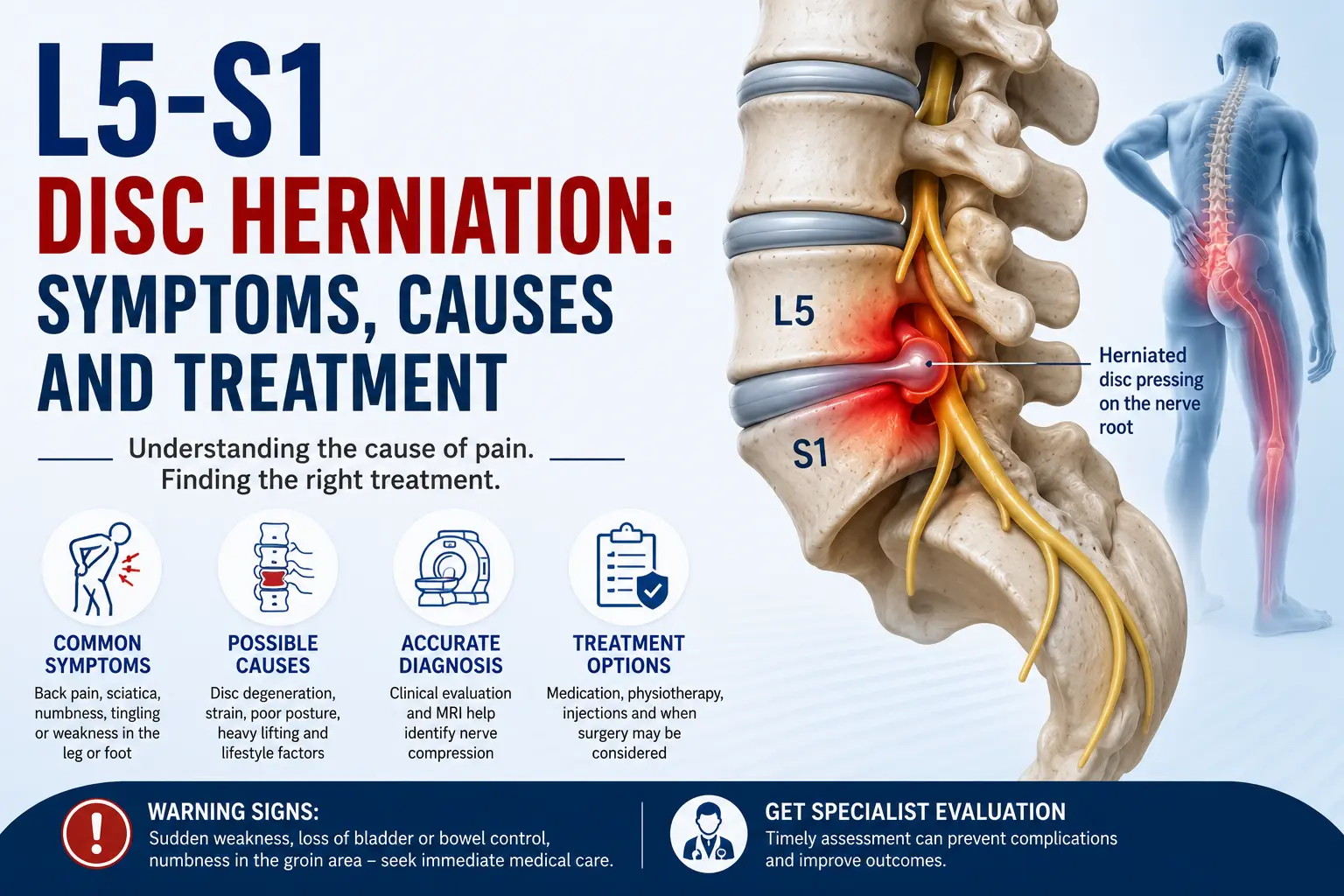
An L5-S1 disc herniation means that material from the disc between the L5 and S1 vertebrae has moved beyond its normal boundary. If this material presses on a nearby nerve root, it can cause pain, numbness, tingling or weakness extending from the lower back into the leg or foot.
Spinal discs sit between the vertebrae and help absorb forces during movement. Each disc contains a softer centre surrounded by a stronger outer layer.
A herniation develops when some of the inner disc material pushes through or beyond a weakened area of the outer portion.
The L5-S1 level sits close to the base of the spine and experiences considerable mechanical loading during activities such as bending, lifting, sitting and twisting.
Not every herniation causes symptoms. Its clinical importance depends largely on whether it irritates or compresses a nerve.
What Are the Common L5 S1 Disc Symptoms?
Symptoms vary depending on the direction of the herniation and which nerve is affected.
Possible L5 S1 disc symptoms include:
- Lower back pain
- Pain in the buttock
- Shooting or burning pain down one leg
- Pain extending into the calf or foot
- Tingling or pins and needles
- Numbness in part of the leg or foot
- Weakness in certain ankle or foot movements
- Difficulty walking normally when weakness is significant
Pain caused by irritation of a lumbar or sacral nerve root is known as radicular pain. People commonly refer to this type of pain as sciatica.
Symptoms may become more noticeable during movements or activities that increase pressure around an irritated nerve. Coughing or sneezing can also worsen radiating leg pain in some patients.
Which Nerve Is Usually Affected at L5-S1?
A central or paracentral L5-S1 disc herniation commonly affects the S1 nerve root. However, a herniation positioned farther to the side in the neural foramen can affect the exiting L5 nerve root. This is why the level written on an MRI does not, by itself, tell the full story.
With S1 nerve root irritation, symptoms may include:
- Pain travelling through the buttock and back of the leg
- Pain or altered sensation along the outer side of the foot
- Difficulty pushing the foot downward
- Difficulty standing or walking on the toes in more noticeable weakness
- Reduced or absent ankle reflex in some patients
The neurological pattern associated with L5 involvement is somewhat different and may include weakness lifting the foot or big toe.
Clinical examination helps doctors determine whether L5 S1 nerve compression seen on imaging corresponds with the patient’s actual symptoms.
Can L5-S1 Disc Herniation Cause Sciatica?
Yes. L5 S1 sciatica can occur when a herniated disc irritates or compresses a nerve that contributes to the sciatic nerve. The pain usually travels from the lower back or buttock down the leg and may be accompanied by tingling, numbness or weakness.
Sciatica is a description of a symptom pattern rather than a diagnosis by itself.
Pain may feel:
- Sharp
- Burning
- Electric-like
- Shooting
- Deep or aching
Some patients have significant leg pain with relatively little back pain.
Sciatica can have several causes, including disc herniation and spinal narrowing. Proper medical evaluation is needed to identify the source rather than assuming that any leg pain is due to an L5-S1 disc problem.
Why Does an L5-S1 Disc Herniation Develop?
A disc herniation may develop gradually or become symptomatic after a particular movement.
Common contributing factors include natural disc degeneration with age, repeated lifting, frequent bending or twisting and physically demanding activities.
Other factors that may increase stress on the spinal discs include:
- Lifting heavy objects with poor technique
- Excess body weight
- Smoking
- Limited regular physical activity
- Repetitive occupational loading
- Family tendency toward disc problems
- Long periods of sitting in some individuals
Sometimes symptoms begin after lifting or twisting. In other cases, there is no obvious injury.
This does not mean every episode of lower back pain represents a disc herniation. Muscles, joints and other structures can produce similar symptoms.
How Do Doctors Diagnose an L5-S1 Disc Herniation?
Diagnosis starts with the symptoms rather than the scan.
A doctor may ask where the pain begins, where it travels, whether numbness is present and whether the patient has noticed difficulty moving the ankle or foot.
Neurological Examination
The examination may assess:
- Muscle strength
- Sensation in different parts of the leg and foot
- Knee and ankle reflexes
- Walking pattern
- Heel and toe walking
- Straight-leg raising
The straight-leg raise test involves gradually lifting the patient’s leg while the knee remains straight. Reproduction of radiating leg pain can support the presence of lumbar nerve root irritation in the appropriate clinical setting.
MRI Scan
An MRI, or magnetic resonance imaging scan, produces detailed images of the discs, nerves and surrounding soft tissues.
It can help determine:
- Where the disc is herniated
- How far disc material extends
- Which nerve may be affected
- Whether other spinal abnormalities are present
MRI can confirm the location of a herniated disc and demonstrate which nerves may be affected. However, the image still has to be compared with the patient’s symptoms and neurological examination.
Are Other Tests Needed?
Not every patient requires additional tests.
X-rays cannot directly show a herniated disc but may sometimes be used to assess bone-related problems or other causes of back pain.
Electromyography, commonly called EMG, may be considered in selected situations to assess nerve and muscle function, particularly when the source of weakness or nerve symptoms is uncertain.
What Are the L5 S1 Disc Treatment Options?
L5 S1 disc treatment is based on the severity of symptoms, neurological findings, MRI appearance and how the patient responds to initial treatment. Many herniated discs can initially be managed without surgery when there is no progressive weakness or other serious neurological problem.
Staying Appropriately Active
Complete bed rest is generally not the goal.
Patients may need to temporarily reduce movements that clearly worsen radiating pain, while continuing suitable daily movement as tolerated.
Light walking can be useful for some people, although activity should be adjusted if it significantly increases leg pain, numbness or weakness.
Medicines
A doctor may recommend medicines to control pain or inflammation depending on the patient’s medical history and symptom severity.
Some patients with nerve-related pain require different prescription medicines. Medication should be individualised because side effects, existing health conditions and interactions with other medicines need consideration.
Physiotherapy
Physiotherapy may help restore movement and gradually improve spinal support.
Depending on the condition, rehabilitation may involve:
- Mobility exercises
- Core strengthening
- Gradual return to normal activity
- Posture and movement training
- Advice about bending and lifting
Exercise selection should match the patient’s symptoms. A routine that is appropriate for uncomplicated back pain may not be suitable for someone with significant nerve weakness.
Epidural or Nerve Root Injections
In selected patients with persistent nerve-related leg pain, a steroid injection around the affected nerve may be considered.
The aim is generally to reduce inflammation and improve pain control. It does not necessarily remove the disc herniation itself. Image guidance is commonly used when injections are performed around a specific nerve.
Patients needing a more detailed assessment can learn about available approaches to slip disc treatment and how treatment is selected according to symptoms and imaging.
When Is Surgery Considered for L5-S1 Disc Herniation?
Having a herniated disc on an MRI does not by itself justify surgery.
Surgical assessment may become appropriate when a patient develops:
- Significant or progressive muscle weakness
- Persistent disabling leg pain despite suitable conservative treatment
- Numbness accompanied by neurological deficits
- Difficulty standing or walking because of nerve dysfunction
- Clear nerve compression that matches the clinical findings
- Bladder or bowel dysfunction requiring urgent evaluation
For selected disc herniations, a discectomy may be performed. During this procedure, the portion of disc material responsible for compressing the nerve is removed.
Most patients with herniated discs do not require surgery, but persistent pain, substantial weakness, walking difficulty or bladder and bowel problems can change the treatment decision.
What Are the Possible Risks and Recovery Expectations?
Recovery varies considerably between patients.
Someone treated without surgery may gradually increase activity as pain and nerve irritation improve. Physiotherapy can then focus on rebuilding strength, mobility and confidence with daily movement.
After surgery, recovery depends on factors such as:
- The procedure performed
- Severity of nerve compression
- Duration of symptoms before treatment
- Muscle weakness before surgery
- Age and overall health
- Type of work
- Other spinal conditions
Pain and nerve recovery do not necessarily happen at the same rate. Numbness or weakness may take longer to improve when a nerve has been significantly irritated or compressed.
Surgical procedures also have potential risks, including infection, bleeding, nerve injury, leakage of spinal fluid, recurrent disc problems and risks related to anaesthesia. The relevance of each risk depends on the procedure and individual clinical situation.
Which Warning Signs Need Urgent Medical Attention?
Most L5-S1 disc herniations are not emergencies. Certain symptoms should be assessed urgently.
Seek prompt medical attention for:
- New inability or difficulty passing urine
- New loss of bladder control
- New loss of bowel control
- Numbness around the genitals, buttocks or inner thighs
- Rapidly progressing weakness in one or both legs
- Major new difficulty standing or walking because of weakness
A large lumbar disc herniation can rarely compress multiple nerves of the cauda equina, the group of nerves at the lower end of the spinal canal.
Urinary retention, bowel or bladder dysfunction, saddle-area numbness and significant lower-limb weakness are recognised warning signs of cauda equina syndrome and require immediate medical assessment.
When Should You Consult a Neurosurgeon?
Specialist review may be useful when L5-S1 disc herniation causes persistent sciatica, significant numbness, muscle weakness or symptoms that continue despite appropriate non-surgical care.
A neurosurgical consultation does not automatically mean an operation will be recommended.
Patients with significant lumbar nerve symptoms may benefit from evaluation by a neurosurgeon such as Dr. Mazda K. Turel, who can assess the symptom pattern, muscle strength, reflexes and MRI findings before discussing whether continued conservative treatment, further testing or surgery is appropriate.
Questions to Ask During Your Consultation
Useful questions include:
- Does the L5-S1 herniation actually explain my symptoms?
- Is the L5 or S1 nerve affected?
- Is there evidence of muscle weakness?
- Can I continue with non-surgical treatment?
- Which activities are safe for me?
- Is physiotherapy appropriate at this stage?
- Would an injection be useful in my situation?
- What would make surgery necessary?
- What are the risks if surgery is recommended?
- What recovery can I realistically expect?
The answers should be based on the individual’s symptoms and examination rather than the MRI description alone.
Conclusion
An L5-S1 disc herniation can produce anything from mild lower back discomfort to significant sciatica, numbness or muscle weakness. The symptoms depend on the position of the herniated material and the nerve affected, with the S1 nerve commonly involved in central or paracentral L5-S1 herniations.
Treatment should not be decided from an MRI report alone. Symptoms, neurological examination, nerve function and imaging all need to fit together.
Many patients can begin with non-surgical management, while persistent disabling symptoms or progressive neurological weakness may require specialist evaluation. New bladder or bowel problems, saddle-area numbness or rapidly worsening leg weakness should be treated as warning signs requiring urgent medical assessment.
Frequently Asked Questions
1. Is L5-S1 disc herniation serious?
An L5-S1 disc herniation is not automatically serious. Its importance depends on whether the disc is compressing a nerve and whether the patient has pain, numbness or weakness. A small herniation can sometimes produce significant symptoms if it is positioned against a nerve, while another herniation may be present on MRI without causing meaningful symptoms.
2. Where does L5-S1 disc pain usually travel?
If an L5-S1 herniation affects the S1 nerve root, pain may travel from the buttock down the back of the thigh and calf toward the outer part of the foot. The exact pattern varies. Some patients experience mainly leg pain, while others have both lower back pain and sciatica. Examination is needed because similar symptoms can result from other spinal conditions.
3. Can L5 S1 nerve compression cause foot weakness?
Yes. If S1 is significantly affected, weakness may occur in muscles involved in pushing the foot downward, which can make standing or walking on the toes more difficult. If the exiting L5 nerve is affected instead, the weakness pattern may involve lifting the foot or big toe. New or worsening weakness should be medically evaluated.
4. Can an L5-S1 disc herniation improve without surgery?
Yes. Many patients can initially be managed with non-surgical treatment such as appropriate activity, medication and physiotherapy. Some may also be considered for injections. Surgery is generally reserved for selected situations, including persistent disabling symptoms, significant neurological weakness or urgent nerve compression. Treatment should be based on the individual clinical picture rather than MRI appearance alone.
5. Is walking good for L5 S1 sciatica?
Gentle walking is often encouraged as tolerated rather than prolonged bed rest. However, the appropriate amount of activity depends on the patient’s symptoms. Walking that produces rapidly increasing leg pain, numbness or weakness should not simply be pushed through. A doctor or physiotherapist can advise on suitable activity based on the individual condition.
6. How do I know if my L5-S1 disc problem needs surgery?
There is no single MRI measurement that determines this for every patient. Surgery may be discussed when there is progressive weakness, persistent disabling sciatica despite suitable treatment or significant nerve compression that matches the neurological examination. New bladder or bowel dysfunction, saddle numbness or rapidly worsening weakness requires urgent assessment rather than a routine appointment.
7. Can an L5-S1 disc herniation come back after treatment?
Symptoms can recur in some patients, whether initial treatment was conservative or surgical, because spinal discs continue to undergo normal mechanical and age-related changes. Recurring back or leg pain does not necessarily mean the same disc has herniated again. A new clinical assessment may be required if symptoms return, particularly when numbness or weakness develops.