
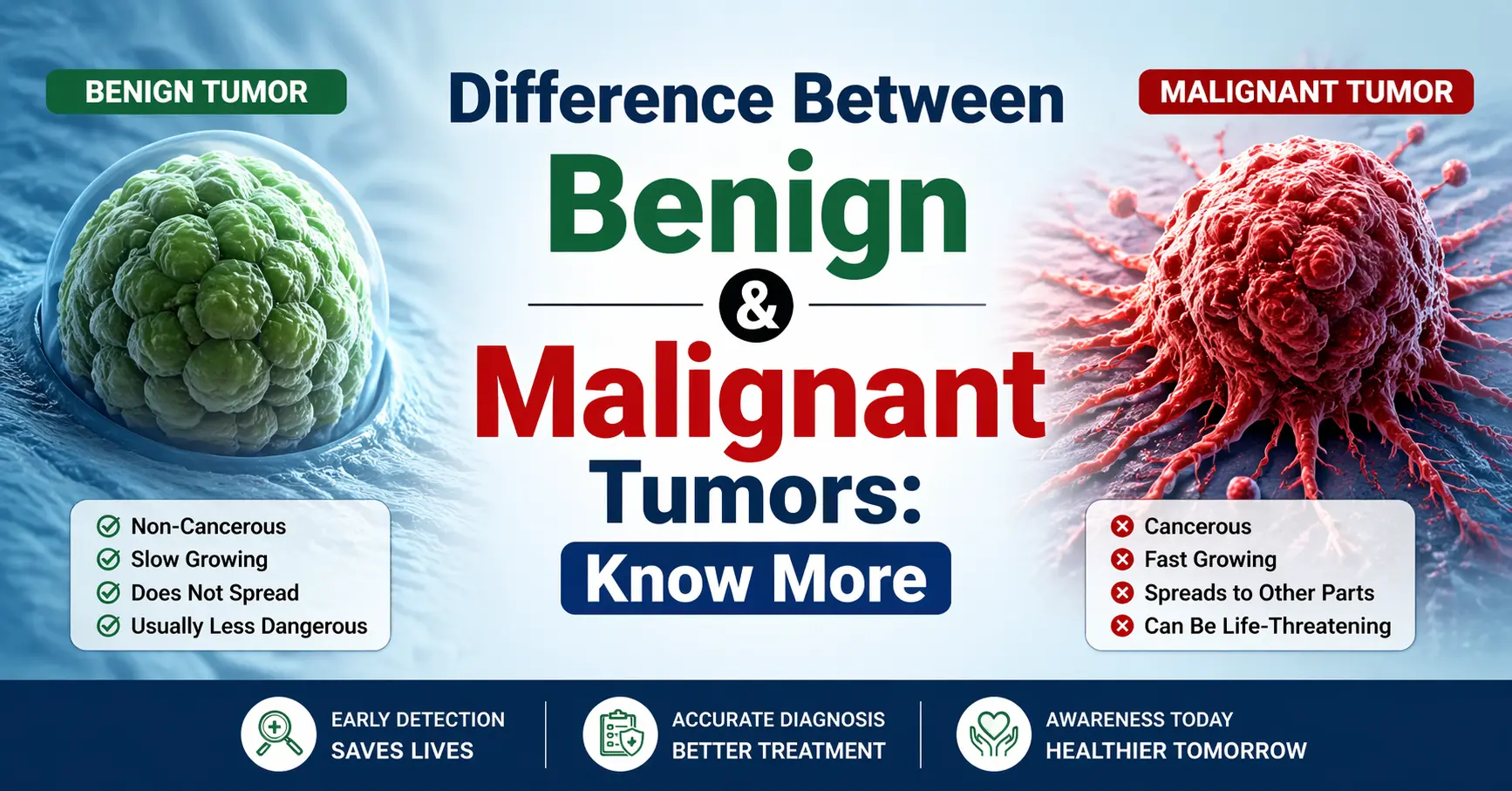
When someone hears the word “tumor,” the first reaction is usually fear. But here’s the truth: not all tumors are cancerous. Understanding the difference between benign and malignant tumors can help you make better decisions, avoid panic, and seek the right treatment at the right time.
In this guide, we’ll break everything down in a simple, real-world way, no heavy jargon, no confusion. Just clear answers.
What is a Tumor?
A tumor is simply an abnormal growth of cells in the body. Normally, our cells grow, divide, and die in a controlled way. But when this process goes off track, cells start growing uncontrollably, forming a lump or mass.
Tumors can develop anywhere:
- Brain
- Breast
- Lungs
- Skin
- Bones
But the key difference lies in how they behave.
What is a Benign Tumor?
A benign tumor is non-cancerous. It grows slowly and usually stays in one place.
Key Characteristics:
- Does not spread to other parts of the body
- Grows slowly
- Often surrounded by a protective capsule
- Usually not life-threatening
Common Examples:
- Lipoma (fat tissue tumor)
- Fibroids (in the uterus)
- Adenomas
Even though benign tumors are not cancer, they can still cause problems depending on their size and location. For example, a benign brain tumor can press on critical areas of the brain and affect function.
What is a Malignant Tumor?
A malignant tumor is cancerous. It grows aggressively and can spread to other parts of the body through a process called metastasis.
Key Characteristics:
- Invades nearby tissues
- Can spread through blood or lymph
- Grows rapidly
- Can be life-threatening
Common Examples:
- Carcinoma
- Sarcoma
- Leukemia
Malignant tumors require immediate medical attention because they can damage organs and disrupt normal body functions.
Difference Between Benign and Malignant Tumors (Quick Comparison)
Feature | Benign Tumor | Malignant Tumor |
Nature | Non-cancerous | Cancerous |
Growth Speed | Slow | Fast |
Spread | Does not spread | Spreads (metastasis) |
Risk Level | Usually low | High |
Recurrence | Rare | Common |
Treatment | Often surgical removal | Surgery + chemo/radiation |
How Do Tumors Develop?
Tumors form due to changes (mutations) in DNA. These mutations disrupt normal cell control.
Common Causes:
- Genetic factors
- Exposure to radiation
- Smoking
- Environmental toxins
- Hormonal imbalances
In many cases, the exact cause is unknown. That’s why regular check-ups matter.
Symptoms to Watch Out For
Symptoms vary depending on the tumor type and location. But here are some general warning signs:
Common Symptoms:
- Unexplained lumps or swelling
- Persistent headaches
- Sudden weight loss
- Fatigue
- Changes in skin or moles
- Seizures (in brain tumors)
Not every symptom means cancer but ignoring them is risky.
Why Location Matters More Than Type (Sometimes)
Here’s something most people don’t realize:
A benign tumor in a critical area (like the brain) can be more dangerous than a malignant tumor in an early stage.
For example:
- A benign brain tumor can press on nerves, affecting speech, vision, or movement
- It may still require surgical removal
If you’re dealing with neurological symptoms, it’s important to consult an expert. You can explore more about specialized care here:
https://mazdaturel.com/brain-tumor-surgeon-in-mumbai/
Diagnosis: How Doctors Tell the Difference
Doctors don’t guess – they use a combination of tests.
Common Diagnostic Methods:
- MRI / CT Scan
- Biopsy (most important)
- Blood tests
- PET scan
A biopsy is the only way to confirm whether a tumor is benign or malignant.
Treatment Options
Treatment depends on:
- Type of tumor
- Size
- Location
- Patient’s overall health
For Benign Tumors:
- Observation (if harmless)
- Surgical removal
- Medication (in some cases)
For Malignant Tumors:
- Surgery
- Chemotherapy
- Radiation therapy
- Targeted therapy
Early diagnosis often means simpler treatment and better outcomes.
Can a Benign Tumor Become Malignant?
In most cases, benign tumors remain non-cancerous.
However:
- Some tumors can become malignant over time
- Certain types need regular monitoring
This is why follow-ups are important even after diagnosis.
Importance of Early Detection
Early detection can:
- Reduce treatment complexity
- Improve survival rates
- Prevent complications
Especially for brain-related tumors, early diagnosis can make a significant difference in preserving function and quality of life.
If you’re looking for expert consultation or advanced treatment options, you can visit:
https://mazdaturel.com/brain-tumor-surgeon-in-mumbai/
Real-Life Perspective: What Patients Often Get Wrong
Let’s clear some common misconceptions:
“Benign means no problem”
Not always. Location matters.
“All tumors are cancer”
False. Many are harmless.
“No symptoms = no tumor”
Some tumors stay silent for years.
When Should You See a Doctor?
Don’t wait for things to get worse.
Consult a doctor if you notice:
- Persistent headaches
- Vision problems
- Seizures
- Unexplained lumps
- Sudden behavioral changes
Early action can save time, money, and health.
Final Thoughts
Understanding the difference between benign and malignant tumors is not just medical knowledge, it’s awareness that can protect you and your loved ones.
- Benign tumors are usually slow and localized
- Malignant tumors are aggressive and can spread
- Both need proper evaluation
Don’t ignore symptoms. Don’t assume. Get clarity.
FAQs: Difference Between Benign and Malignant Tumors Know More
1. What is the main difference between benign and malignant tumors?
Benign tumors are non-cancerous and do not spread, while malignant tumors are cancerous and can spread to other parts of the body.
2. Are benign tumors completely harmless?
Not always. They can cause serious problems if they grow in sensitive areas like the brain or spine.
3. Can malignant tumors be cured?
Yes, especially if detected early. Treatment success depends on the type, stage, and overall health of the patient.
4. How fast do malignant tumors grow?
Malignant tumors generally grow faster than benign ones, but growth rate can vary.
5. Do benign tumors need surgery?
Only if they cause symptoms, grow rapidly, or affect nearby organs.
6. How are tumors diagnosed?
Through imaging tests like MRI or CT scans, and confirmed with a biopsy.
7. Can lifestyle changes prevent tumors?
Healthy habits can reduce risk, but not all tumors are preventable.
8. Is every lump a tumor?
No. Some lumps are harmless cysts or infections. Still, they should be checked.


5 thoughts on “Difference Between Benign and Malignant Tumors Know More”
1xbet зеркало, 1xbet – это удобный способ
доступа к ставкам в любое время.
Look into my web site … https://1xbet-zpdbe.cfd
1xbet зеркало, 1xbet гарантирует доступ к множеству
азартных ставок.
Here is my homepage https://1xbet-ri1qx.cfd/
официальный сайт 1xbet, 1xbet предлагает широкий выбор
игр на спорт. Пользователи могут узнать интересные возможности для
игры и имущества.
My web-site – https://1xbet-x2fzi.sbs/
Использование 1xbet зеркало, 1xbet позволит вам получить доступ к любимым играм и ставкам даже в случае блокировок.
Also visit my site :: 1xbet-00txx.sbs
1xbet зеркало, 1xbet — это удобный
способ доступа к платформе для ставок.
Also visit my homepage – 1xbet-8kv8l.cfd