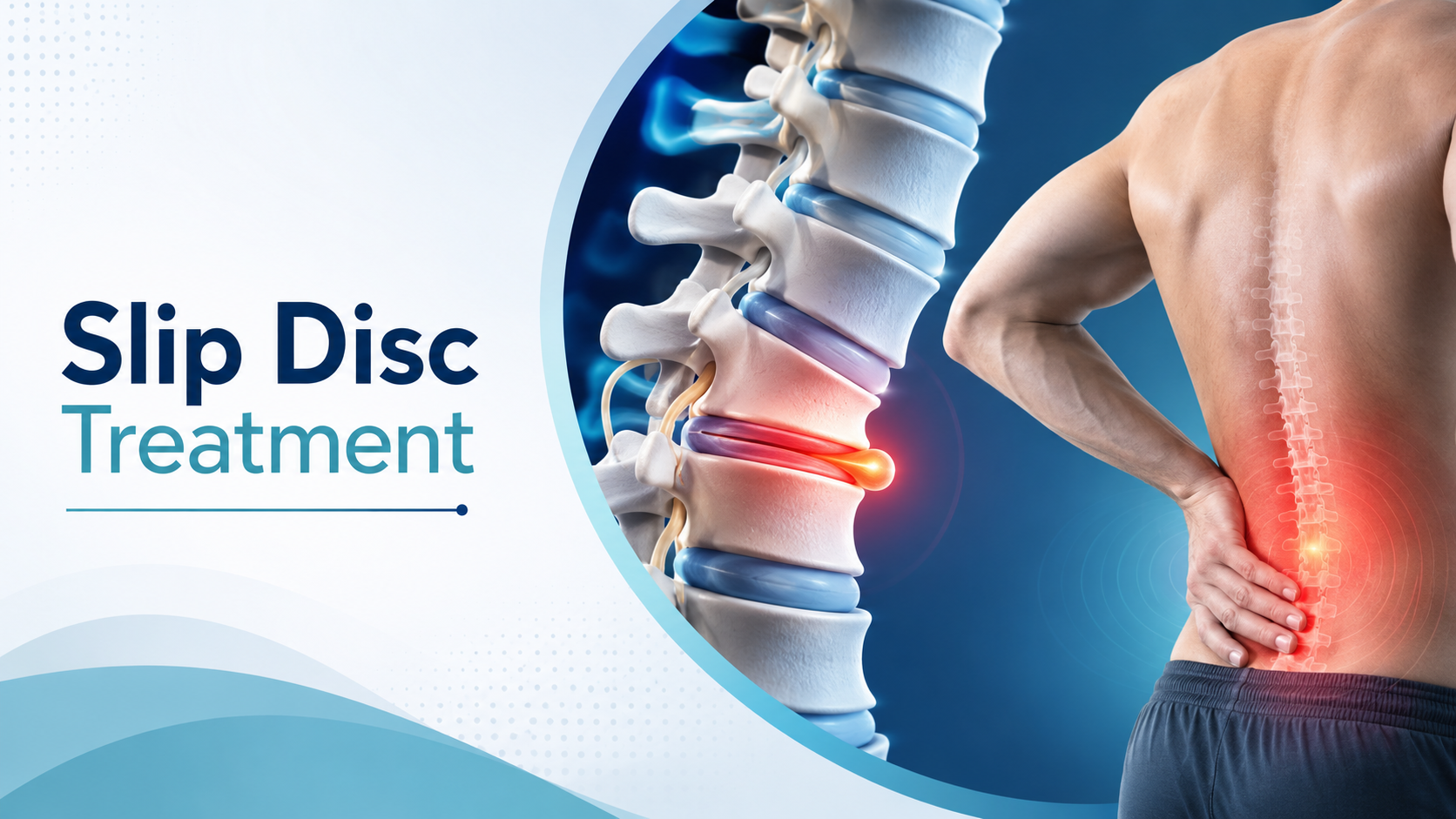
A slip disc can cause back pain, neck pain, leg pain, arm pain, tingling, numbness, weakness, and difficulty with movement. For some people, symptoms remain mild and improve with rest, medicines, and physiotherapy. For others, the pain may become severe, travel into the arms or legs, and interfere with walking, sitting, sleeping, or working.
Slip disc treatment depends on the location of the disc problem, symptom severity, nerve pressure, weakness, spinal cord involvement, and how the patient responds to non-surgical care. Not every slip disc needs surgery. In many cases, early diagnosis and the right treatment plan can help reduce pain and improve function.
A slip disc is also commonly called a herniated disc or disc prolapse. It can occur in the lower back, known as the lumbar spine, or in the neck, known as the cervical spine. The symptoms depend on which disc is affected and whether it is pressing on nearby nerves.
This guide explains slip disc symptoms, causes, diagnosis, treatment options, recovery expectations, and when you should consider seeing a spine specialist.
Slip disc symptoms can vary widely. Some people have only back pain, while others develop nerve-related symptoms.
Common signs include:
Back Pain or Neck Pain
Pain may begin in the lower back or neck. It may feel sharp, dull, stiff, or deep.
Pain Travelling to the Leg
A lumbar slip disc may cause pain that travels from the lower back into the buttock, thigh, calf, or foot. This is commonly described as sciatica.
Pain Travelling to the Arm
A cervical slip disc may cause pain that travels from the neck into the shoulder, arm, hand, or fingers.
Tingling or Numbness
Nerve pressure may cause tingling, pins and needles, or numbness in the arm or leg.
Weakness
Weakness may occur when nerve signals are affected. This can cause difficulty lifting the foot, gripping objects, raising the arm, or walking normally.
Pain While Sitting or Bending
Some patients feel worse while sitting, bending forward, lifting, coughing, or sneezing.
Difficulty Walking
Severe nerve pain or weakness can affect walking, balance, and daily mobility.
Causes of Slip Disc
A slip disc can develop due to several reasons. Sometimes it occurs suddenly after lifting or twisting, while in other cases it develops gradually due to wear and tear.
Common causes include:
- Age-related disc changes
- Repeated bending or lifting
- Poor posture
- Sudden twisting movement
- Heavy physical work
- Sedentary lifestyle
- Weak back and core muscles
- Injury or trauma
- Excess body weight
- Long hours of sitting
As discs age, they may lose flexibility and become more prone to bulging or rupture.
Slip Disc in the Lower Back
A slip disc in the lower back often affects nerves that travel into the legs. This can cause sciatica-like symptoms.
Possible symptoms include:
- Lower back pain
- Buttock pain
- Pain travelling down one leg
- Tingling in the leg or foot
- Numbness
- Weakness
- Difficulty standing or walking
- Pain worsening with sitting or bending
A lumbar slip disc should be evaluated if pain is severe, persistent, or associated with weakness or numbness.
Slip Disc in the Neck
A slip disc in the neck can affect nerves going into the shoulder, arm, and hand.
Possible symptoms include:
- Neck pain
- Shoulder pain
- Arm pain
- Tingling in fingers
- Numbness in the hand
- Weak grip
- Difficulty lifting the arm
- Hand clumsiness
Dr. Mazda Turel’s website includes spine-related care areas such as cervical spine surgery, neck and back pain treatment, and minimally invasive spine surgery. His website also discusses a cervical disc herniation pressing on a nerve in one of his spine-related writings.
When Is Slip Disc Serious?
A slip disc becomes more concerning when it affects nerve function or spinal cord function.
Seek medical attention if you experience:
- Severe pain not improving with treatment
- Pain spreading to the arm or leg
- Numbness
- Weakness
- Foot drop
- Poor grip strength
- Difficulty walking
- Loss of balance
- Bladder or bowel problems
- Pain after injury
- Symptoms worsening over time
Sudden weakness, hand clumsiness, foot drop, or bladder-related symptoms should not be ignored. Dr. Mazda Turel’s spine specialist page also highlights weakness, hand clumsiness, foot drop, and bladder symptoms as warning signs that may indicate serious nerve compression.
How Is a Slip Disc Diagnosed?
Diagnosis begins with a detailed medical history and physical examination. The doctor will ask about the pain location, duration, triggers, radiation, numbness, weakness, previous treatment, and daily limitations.
A spine examination may check:
- Back or neck movement
- Muscle strength
- Reflexes
- Sensation
- Walking pattern
- Straight leg raise
- Balance
- Signs of nerve compression
Depending on the symptoms, the doctor may advise imaging tests such as MRI or X-rays. MRI is commonly used to assess discs, nerves, and spinal canal space.
The diagnosis should match both the patient’s symptoms and imaging findings. A disc bulge seen on MRI does not always mean surgery is needed.
Slip Disc Treatment Options
Slip disc treatment depends on the severity of symptoms and the degree of nerve pressure. The main goal is to reduce pain, improve function, protect nerve health, and help the patient return to daily activity safely.
Treatment options may include:
- Rest and activity modification
- Medicines
- Physiotherapy
- Posture correction
- Lifestyle changes
- Pain management options
- Spine specialist evaluation
- Surgery in selected cases
Not every patient needs the same treatment. The plan should be personalized according to symptoms and examination findings.
Non-Surgical Slip Disc Treatment
Many patients improve with non-surgical care, especially when there is no severe weakness or spinal cord compression.
Non-surgical treatment may include:
Medicines
Doctors may prescribe pain medicines, muscle relaxants, anti-inflammatory medicines, or nerve pain medicines depending on the symptoms.
Physiotherapy
Physiotherapy can help improve flexibility, posture, muscle strength, and movement confidence.
Activity Modification
Patients may be advised to avoid heavy lifting, sudden bending, prolonged sitting, or activities that worsen pain.
Posture Correction
Good posture reduces repeated stress on the spine.
Exercise
Once acute pain improves, guided exercises may help strengthen the back, neck, and core muscles.
Lifestyle Support
Weight management, regular movement, and ergonomic improvements can support recovery.
When Is Surgery Needed for Slip Disc?
Surgery may be considered when symptoms are severe, progressive, or not improving despite appropriate non-surgical treatment.
Surgery may be discussed when there is:
- Severe nerve compression
- Progressive weakness
- Foot drop
- Persistent sciatica
- Severe arm pain due to cervical disc pressure
- Spinal cord compression
- Bladder or bowel involvement
- Pain affecting daily life despite treatment
- Recurrent symptoms with clear nerve compression
Dr. Mazda Turel’s website lists slipped disc, disc prolapse, sciatica, spinal stenosis, spinal cord compression, and nerve compression among spine conditions treated. It also mentions that each case is reviewed carefully so the treatment plan matches the patient’s exact condition.
Types of Surgery for Slip Disc
The surgical approach depends on the location and severity of the disc problem.
Possible surgical approaches may include:
Microdiscectomy
This may be used for selected lumbar disc problems where a disc fragment is pressing on a nerve.
Decompression
This aims to relieve pressure on nerves or the spinal cord.
For selected neck disc problems, surgery may be considered when there is nerve or spinal cord compression.
Minimally Invasive Spine Surgery
In selected patients, minimally invasive techniques may help treat spine problems with smaller approaches.
Dr. Mazda Turel’s website lists minimally invasive spine surgery and complex spine surgery among his spine care areas. His profile also mentions fellowship training in minimally invasive and complex spine surgery at Rush University, Chicago, USA.
Recovery After Slip Disc Treatment
Recovery depends on the severity of the disc problem, type of treatment, patient health, nerve involvement, and how early treatment is started.
Recovery may involve:
- Pain reduction
- Improved movement
- Gradual return to activity
- Physiotherapy
- Posture correction
- Avoiding heavy strain
- Follow-up with the doctor
- Strengthening exercises
- Lifestyle changes
Some patients recover with non-surgical treatment over time. Others may need surgery if nerve compression is severe or symptoms persist.
After surgery, recovery is guided by the surgeon’s instructions. Patients may need rest, wound care, medicines, walking, physiotherapy, and follow-up visits.
Can Slip Disc Heal Without Surgery?
Many slip disc cases can improve without surgery, especially when symptoms are mild or moderate and there is no major weakness or spinal cord pressure. The body may gradually reduce inflammation around the nerve, and symptoms may improve with conservative care.
However, medical evaluation is important when symptoms are severe, persistent, or neurological.
A patient should not ignore worsening weakness, numbness, walking difficulty, or bladder-related changes.
Slip Disc and Sciatica
Sciatica is a common symptom of lumbar slip disc. It occurs when the sciatic nerve or related nerve roots are irritated.
Sciatica may cause:
- Pain from lower back to leg
- Burning pain
- Tingling
- Numbness
- Electric shock-like pain
- Pain while sitting
- Difficulty walking
Sciatica caused by slip disc may improve with non-surgical treatment, but severe or persistent cases need specialist evaluation.
Slip Disc and Nerve Compression
Nerve compression is the main reason slip disc symptoms can spread into the arm or leg. When a disc presses on a nerve root, pain may travel along the nerve pathway.
Nerve compression may cause:
- Radiating pain
- Numbness
- Tingling
- Weakness
- Reflex changes
- Loss of function in severe cases
The presence of weakness is especially important because it may indicate that nerve function is affected.
Slip Disc and Spinal Cord Compression
A cervical slip disc can sometimes compress the spinal cord. This may cause symptoms beyond neck and arm pain.
Possible signs include:
- Hand clumsiness
- Difficulty walking
- Balance problems
- Leg stiffness
- Weakness
- Coordination problems
- Bladder symptoms in severe cases
Spinal cord compression should be evaluated early because delayed treatment may lead to worsening neurological problems.
Lifestyle Changes for Slip Disc Recovery
Lifestyle changes can support recovery and reduce the risk of recurrence.
Helpful steps include:
- Avoid heavy lifting during recovery
- Use proper lifting technique
- Maintain healthy body weight
- Avoid prolonged sitting
- Take breaks from desk work
- Use ergonomic seating
- Strengthen core muscles
- Stay physically active
- Avoid sudden twisting
- Follow physiotherapy guidance
Good spine habits are important even after pain improves.
Mistakes to Avoid During Slip Disc Recovery
Patients often make mistakes that delay recovery or worsen symptoms.
Avoid:
- Ignoring leg or arm weakness
- Taking painkillers repeatedly without diagnosis
- Doing aggressive exercises during severe pain
- Heavy lifting too early
- Sitting for long hours without breaks
- Relying only on massage
- Ignoring bladder or bowel symptoms
- Delaying evaluation when pain worsens
Proper guidance can prevent unnecessary complications.
You should consider seeing a spine specialist if:
- Pain lasts more than a few weeks
- Pain travels to the leg or arm
- Numbness or tingling is present
- Weakness develops
- Walking becomes difficult
- Pain does not respond to treatment
- MRI shows nerve compression
- Symptoms keep returning
- Bladder or bowel symptoms occur
A spine specialist can help decide whether conservative care is enough or whether surgery should be considered.
Dr. Mazda K. Turel’s website presents him as a neurosurgeon in Mumbai practicing at Wockhardt Hospital, Mumbai Central. His spine-related services include cervical and lumbar spine surgery, minimally invasive spine surgery, neck and back pain treatment, spinal tumors, spinal trauma, spinal infections, and craniovertebral junction surgery.
His website also lists slipped disc, disc prolapse, sciatica, spinal stenosis, spinal cord compression, and nerve compression among spine conditions evaluated and treated.
For patients with persistent back pain, leg pain, neck pain, arm pain, weakness, or MRI-reported disc compression, specialist evaluation can help identify the correct treatment path.
Questions to Ask Your Doctor
Before starting slip disc treatment, patients can ask:
- What is causing my pain?
- Is a nerve being compressed?
- Is my slip disc mild, moderate, or severe?
- Can I recover without surgery?
- What warning signs should I watch for?
- What activities should I avoid?
- Do I need physiotherapy?
- When should I repeat follow-up?
- Is surgery necessary in my case?
- What recovery can I expect?
Clear answers help patients make informed decisions.
Slip disc treatment depends on symptoms, severity, nerve pressure, and the patient’s overall condition. Many patients improve with medicines, physiotherapy, posture correction, and lifestyle changes. However, surgery may be required when there is severe or progressive nerve compression, weakness, spinal cord involvement, or persistent pain despite treatment.
Back pain or neck pain should not be ignored when it travels into the arm or leg, causes numbness, weakness, or affects walking. Early evaluation can help identify the cause and guide the right treatment plan.
For patients with suspected slip disc, disc prolapse, sciatica, or nerve compression, consultation with a spine specialist can help determine whether non-surgical care is enough or whether advanced treatment is needed.
What is slip disc treatment?
Slip disc treatment may include medicines, physiotherapy, activity modification, posture correction, pain management, and surgery in selected cases.
Can slip disc heal without surgery?
Many slip disc cases improve without surgery, especially when symptoms are mild or moderate and there is no major weakness or spinal cord compression.
When does slip disc need surgery?
Surgery may be needed when there is severe nerve compression, progressive weakness, foot drop, spinal cord compression, bladder symptoms, or pain not improving despite treatment.
What are the symptoms of slip disc?
Symptoms may include back pain, neck pain, leg pain, arm pain, tingling, numbness, weakness, difficulty walking, and pain that worsens with sitting or bending.
Is sciatica caused by slip disc?
A lumbar slip disc can cause sciatica when it irritates or compresses nerves going into the leg.
Is slip disc dangerous?
A slip disc can become serious if it causes severe nerve compression, weakness, spinal cord compression, or bladder and bowel problems.
How long does slip disc recovery take?
Recovery time varies depending on severity, treatment type, nerve involvement, and patient health. Some improve with conservative care, while others may need surgery and guided rehabilitation.
Should I see a spine surgeon for slip disc?
You should see a spine specialist if pain persists, travels to the arm or leg, causes weakness or numbness, affects walking, or does not improve with treatment.