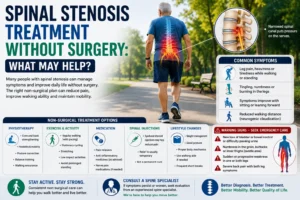
A diagnosis of spinal stenosis does not automatically mean an operation is required. Spinal stenosis treatment without surgery may help control pain, improve walking tolerance and maintain strength and mobility, particularly when symptoms are mild to moderate and there is no progressive neurological weakness.
Non-surgical care does not usually reverse the structural narrowing of the spinal canal. Instead, treatment focuses on reducing symptoms and helping the patient function better despite the narrowing. Physical therapy, appropriately selected exercises, activity changes, medicines and, in some cases, spinal injections may be considered. Current guidance supports beginning with non-operative treatment when there are no findings requiring urgent surgical evaluation.
The right plan depends on the location of stenosis, symptoms, examination findings and MRI results.
Can Spinal Stenosis Be Treated Without Surgery?
Yes. Many patients can initially receive spinal stenosis treatment without surgery. Physiotherapy, exercise, activity modification, medication and selected injections may help manage symptoms. Surgery is generally considered when symptoms remain significantly disabling despite conservative care or when neurological problems such as progressive weakness develop.
This article mainly discusses lumbar spinal stenosis, which affects the lower back and may cause pain, heaviness, tingling or weakness in the legs during standing or walking.
Non-surgical treatment is more likely to be suitable when:
- Symptoms remain manageable
- Muscle strength is stable
- Walking is limited but still possible
- Bladder and bowel function remain normal
- Symptoms have not been rapidly progressing
- The patient can participate in rehabilitation
An MRI showing a narrow spinal canal is only part of the decision. Some people have significant narrowing on imaging but relatively few symptoms.
What Symptoms Can Non-Surgical Treatment Help?
Lumbar stenosis typically affects the nerves travelling from the lower back into the legs.
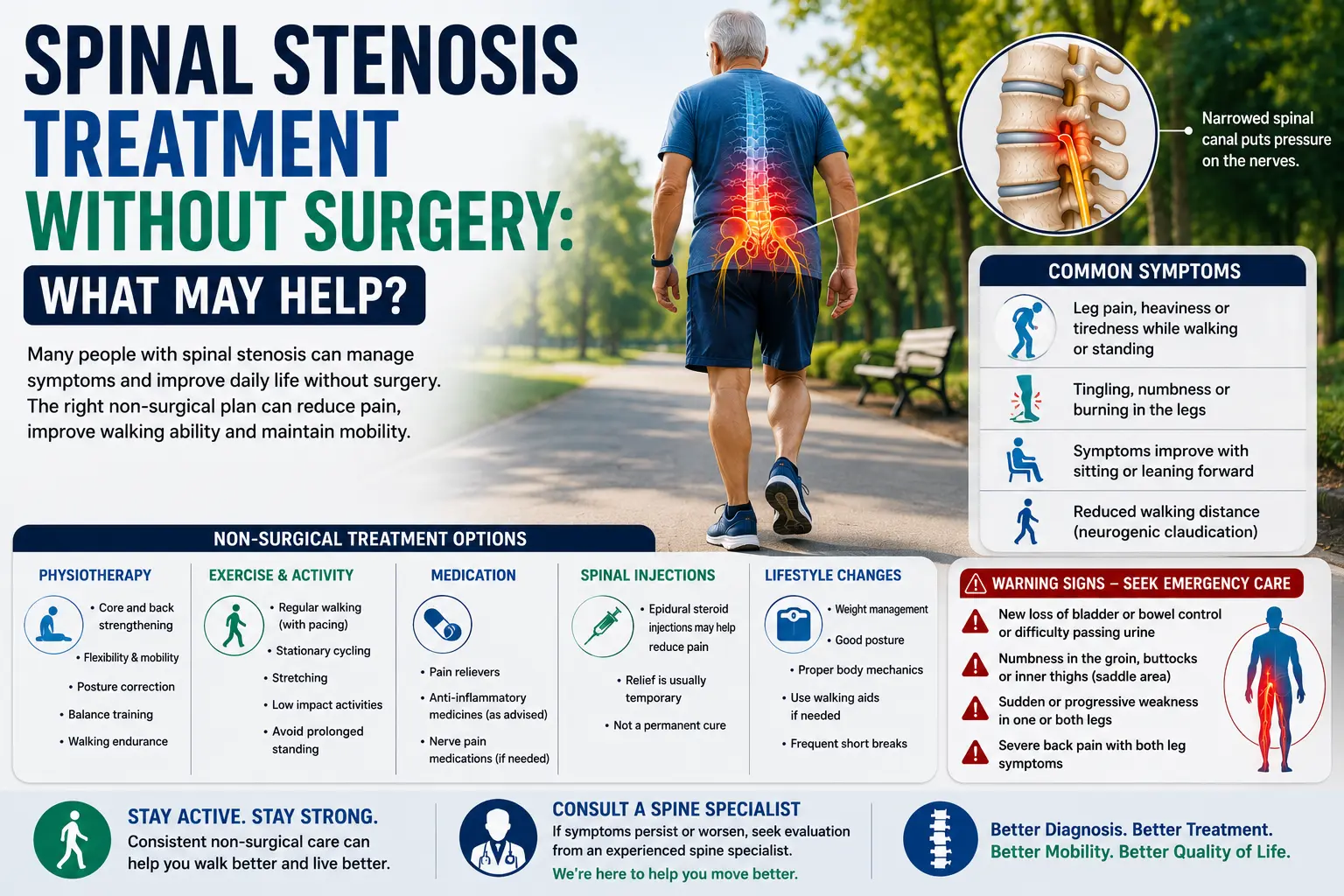
Symptoms may include:
- Lower back discomfort
- Buttock pain
- Burning or aching in the legs
- Leg heaviness
- Tingling or numbness
- Weakness
- Difficulty standing for long periods
- Reduced walking distance
A common pattern is neurogenic claudication. This means leg symptoms develop or worsen while standing or walking and improve after sitting or leaning forward.
Treatment is often aimed at helping patients walk farther, remain active and perform everyday activities with less discomfort.
What Does Non Surgical Spinal Stenosis Treatment Include?
There is no single treatment that works for every patient.
A non surgical spinal stenosis treatment plan may combine several approaches rather than relying on one medicine, injection or exercise.
1. Physiotherapy for Lumbar Spinal Stenosis
Lumbar stenosis physiotherapy can help improve strength, endurance, balance and movement. It does not physically remove bone spurs or permanently enlarge a narrowed spinal canal, but it may help the body function better and make everyday activities more manageable.
A physiotherapist may work on:
- Core and trunk strength
- Leg strength
- Hip mobility
- Balance
- Walking endurance
- Posture
- Safer movement strategies
Some people with lumbar stenosis feel more comfortable in a slightly forward-bent position because lumbar flexion can increase the available space around compressed nerves.
This explains why certain patients can cycle comfortably or walk farther while leaning on a shopping trolley than while standing completely upright.
The exercise programme still needs to be individualised. A person with significant weakness, balance problems or another spinal condition may require a different approach.
2. Spinal Stenosis Exercises
There is no single set of spinal stenosis exercises suitable for everyone.
Depending on the examination, rehabilitation may include:
- Gentle mobility exercises
- Core strengthening
- Hip and leg strengthening
- Stationary cycling
- Walking with appropriate pacing
- Balance exercises
- Flexibility work
Exercise and physical therapy may improve pain and walking ability in the short term, although high-quality evidence identifying one superior exercise programme remains limited.
That is an important distinction. Exercise can be useful without being a cure for the structural narrowing itself.
Should You Keep Walking?
In many cases, yes.
Complete inactivity may reduce strength and endurance. Instead, patients can often use activity pacing.
For example:
- Walk a comfortable distance
- Take a short break when symptoms develop
- Resume when symptoms settle
- Gradually increase activity as tolerated
A cane or walker may be recommended for some patients. Apart from improving stability, a walker may allow a slightly forward-leaning position that reduces symptoms for certain people.
Stop and seek medical advice if walking begins to produce increasing weakness rather than just temporary discomfort.
3. Medicines for Spinal Stenosis Pain Relief
Medicines may provide spinal stenosis pain relief, but they do not correct the narrowed spinal canal.
Treatment may include anti-inflammatory or other pain-relieving medicines when medically appropriate.
NSAIDs, or nonsteroidal anti-inflammatory drugs, may help some patients with chronic low back pain. However, they are not suitable for everyone and can have gastrointestinal, kidney, cardiovascular and other risks depending on the individual’s health.
Medication decisions should consider:
- Age
- Kidney function
- Stomach problems
- Heart conditions
- Other medicines
- Type of pain
- Other health conditions
Long-term opioid treatment is generally avoided where possible because of side effects and dependence risks. Evidence for several medicines commonly used for nerve pain is also mixed when specifically applied to lumbar spinal stenosis.
Patients should therefore avoid assuming that a stronger medicine is necessarily a better long-term solution.
4. Can Epidural Injections Help Spinal Stenosis?
Epidural injections may be considered in selected patients, particularly when nerve-related leg pain is prominent.
A medication is injected around the irritated nerve structures, generally using imaging guidance.
The purpose is to reduce inflammation and pain. An injection does not remove spinal narrowing.
Evidence suggests that epidural corticosteroid injections may provide modest short-term benefit in some patients, but they should not be expected to provide reliable long-term relief.
Mayo Clinic also notes that repeated steroid injections have potential risks, so they need to be considered carefully rather than used indefinitely.
An injection may be useful when temporary pain reduction helps a patient participate more effectively in rehabilitation.
5. Activity and Lifestyle Changes
Small adjustments can sometimes make day-to-day symptoms easier to manage.
These may include:
- Breaking long walks into shorter sessions
- Avoiding prolonged standing when it repeatedly triggers symptoms
- Changing position regularly
- Maintaining suitable physical activity
- Using a walking aid when recommended
- Managing excess body weight where relevant
- Following safe lifting techniques
Weight reduction may reduce mechanical load on the lower back for patients who are overweight, although it does not directly reverse stenosis.
The aim is not to create a long list of permanent restrictions. It is to remain as active as reasonably possible without repeatedly provoking severe symptoms.
How Do You Know Whether Non-Surgical Treatment Is Working?
Progress is better measured by function than by expecting the MRI to change.
Useful improvements may include:
- Walking farther before symptoms begin
- Standing longer
- Fewer sitting breaks
- Less leg heaviness
- Reduced pain
- Improved balance
- Better leg strength
- Greater ability to perform everyday activities
A person who previously had to sit after five minutes of walking may notice that they can gradually remain active for longer.
Keeping a simple record of walking time, leg symptoms and daily activity can make follow-up discussions more useful.
When May Treatment Without Surgery Not Be Enough?
Conservative treatment should not continue indefinitely when neurological function is deteriorating.
Specialist reassessment becomes more important if there is:
- Progressive leg weakness
- New foot drop
- Increasing numbness
- Repeated falls
- Rapidly worsening walking ability
- Persistent disabling symptoms despite appropriate treatment
Surgery may also be discussed when pain and walking restriction continue to significantly affect daily life after a reasonable trial of conservative management.
The main principle of lumbar stenosis surgery is usually decompression, which creates more space for compressed nerves. The exact procedure depends on the anatomy, presence of spinal instability and individual clinical circumstances.
Surgery should not be recommended from the MRI appearance alone.
What Symptoms Need Urgent Medical Attention?
Most lumbar spinal stenosis progresses gradually and is not an emergency.
Certain symptoms are different.
Seek urgent medical assessment for:
- New difficulty passing urine
- New loss of bladder control
- New bowel-control problems
- Numbness around the genitals, buttocks or inner thighs
- Rapidly worsening weakness in one or both legs
- Major new difficulty standing or walking because of weakness
These symptoms may indicate severe compression of the lower spinal nerves, including possible cauda equina syndrome.
Progressive neurological deficits are also a reason for earlier surgical evaluation rather than continuing routine conservative treatment.
When Should You Consult a Neurosurgeon?
A neurosurgical consultation may be useful when spinal stenosis is significantly reducing walking ability, producing persistent nerve-related leg symptoms or causing measurable neurological weakness.
Consulting a surgeon does not mean that an operation has already been decided.
Patients can seek assessment from a spine specialist in Mumbai when symptoms persist despite conservative treatment or the significance of an MRI finding is unclear.
A neurosurgeon such as Dr. Mazda K. Turel can compare walking symptoms, muscle strength, sensation and imaging before discussing whether continued non-operative care remains appropriate or whether decompression should be considered.
Conclusion
Spinal stenosis treatment without surgery can be a reasonable starting point for many patients whose neurological function remains stable. Physiotherapy, appropriately selected exercises, activity pacing, medication and carefully chosen injections may help reduce pain and maintain walking ability.
These treatments are designed mainly to manage symptoms and improve function; they do not necessarily reverse the underlying spinal narrowing.
Progress can be judged by practical changes such as walking farther, standing longer and managing daily activities more comfortably. If symptoms continue to significantly limit life, or weakness, foot drop or increasing numbness develops, specialist assessment becomes more important. New bladder or bowel dysfunction, difficulty passing urine or saddle-area numbness requires urgent medical evaluation rather than continued home treatment.
Frequently Asked Questions
1. Can spinal stenosis treatment without surgery work?
Yes. Spinal stenosis treatment without surgery can help many patients manage pain, maintain strength and improve mobility, particularly when neurological function is stable. Treatment may combine physiotherapy, exercise, appropriate medication and activity modification. Conservative treatment generally manages symptoms rather than permanently reversing the structural narrowing.
2. What is the best exercise for lumbar spinal stenosis?
There is no single best exercise. Some patients tolerate cycling, supported walking, core exercises and movements performed in slight spinal flexion well, but the correct programme depends on symptoms, balance and neurological findings. A physiotherapist can adjust exercises according to the individual’s walking tolerance and strength rather than relying on a universal online routine.
3. Can walking make spinal stenosis worse?
Walking does not usually damage the spine simply because temporary neurogenic claudication symptoms occur. Many patients are encouraged to remain active within a tolerable range. Short walks with breaks may work better than one long walk. Increasing weakness, foot drop or progressively worsening neurological symptoms should be assessed rather than pushed through.
4. Can physiotherapy cure lumbar spinal stenosis?
Physiotherapy does not remove bone spurs, enlarged joints or thickened ligaments responsible for structural stenosis. Its role is to improve strength, mobility, endurance, balance and symptom management. For some people this is enough to maintain satisfactory function without surgery.
5. How long should I try non-surgical treatment before considering surgery?
There is no fixed period that applies to every patient. The decision depends on symptom severity, neurological findings, walking limitation and response to conservative care. Significant or progressive weakness may require earlier specialist assessment, while stable symptoms may allow a longer trial of non-operative management.
6. Do epidural injections cure spinal stenosis?
No. Epidural injections do not enlarge a narrowed spinal canal. They may reduce inflammation and provide temporary pain relief in selected patients, particularly when nerve-related leg pain is present. Current evidence supports them mainly as a short-term symptom-management option rather than a permanent treatment.
7. How do I know when spinal stenosis needs surgery?
Surgery may be considered when significant pain or walking limitation persists despite appropriate conservative treatment, or when neurological function is deteriorating. Progressive weakness, foot drop and substantial functional decline deserve specialist review. New bladder or bowel dysfunction or saddle-area numbness requires urgent medical assessment.