
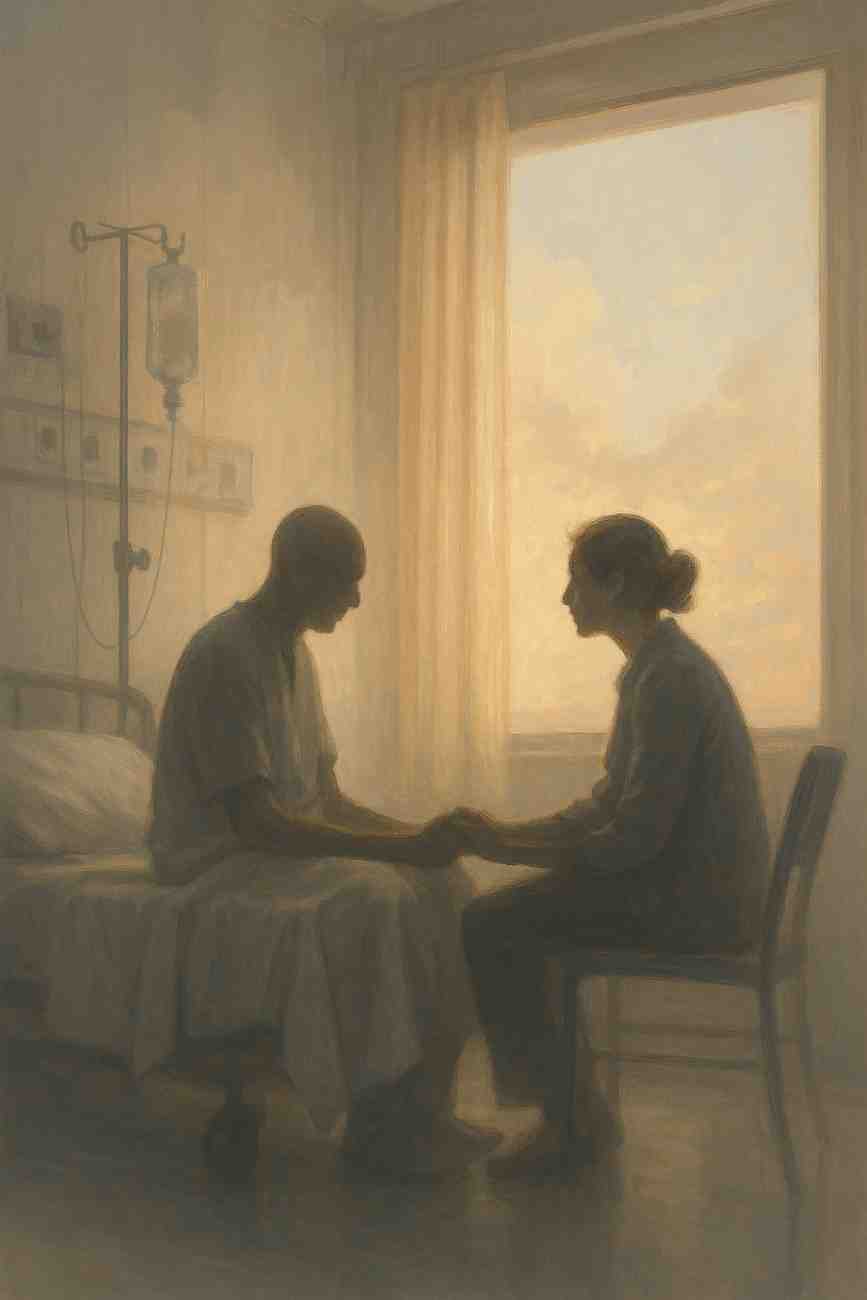
Loneliness is the quiet epidemic — cured, sometimes, by nothing more than company.
The body survives on science; the soul survives on whoever shows up.
I’m a self-professed astute observer of human medical conditions, and this is one of them.
Hospitals are not lonely places, but they contain a lot of lonely people. Over the years, I’ve realised that recovery after surgery doesn’t depend only on the precision of a scalpel or the dosage of a drug. It often depends on who waits for you outside the ICU.
A wound heals faster when there’s someone to change the dressing with care, even if they use the wrong tape. The heart beats steadier when it recognises another voice nearby. And patients who have someone to hold their hand recover sooner than those who have only hospital linen for company.
In most private hospitals, there’s an unspoken hierarchy of caregiving. The wealthy outsource affection. Patients are looked after by nurses, ward boys, dietitians, physiotherapists, and occasionally by family members who make brief appearances between business calls. They arrive with hampers of dry fruits and the latest gadgets to “cheer up Dad” before disappearing again into traffic.
The poor, on the other hand, bring devotion. I’ve seen old men sleeping under their wives’ bed because there isn’t another option. Sons spoon-feeding their mothers soup with the same reverence with which one might pay obeisance to a deity. Daughters massaging their fathers’ feet as if trying to press life back into them. Their love is raw, inconvenient, unpaid, and utterly medicinal.
A few years ago, an elderly couple came to see me. He was ninety-two, she was eighty-nine – both slightly stooped but perfectly synchronised, the kind of couple that walks together without needing to speak. She had a compression fracture in her spine after a minor fall. “Doctor, fix her,” he said, as if I were a tailor and her vertebrae a loose button. We treated her conservatively, but age is a fragile thing. She developed a chest infection and passed away one morning. He was inconsolable. “We were married for sixty-seven years,” he said, his hands trembling. Three hours later, he collapsed and died too. His heart was fine. His will wasn’t. The body, it seems, can only live so long when its reason for living leaves the room.
Loneliness doesn’t just visit the elderly, it haunts youngsters too. During my fellowship in America, I was astonished at how often patients came in alone for major procedures. They’d drive themselves, park, sign the consent, get operated on, and then Uber home post-op, their discharge summary folded neatly next to a salad. No family, no fuss, no waiting arms. Independence taken to its tragic extreme.
In India, we do the opposite. We arrive with entire neighbourhoods. Aunties bring food, cousins bring opinions, and all ask if there is free parking. It’s chaos, but it’s a living, breathing kind of chaos – proof that we still care enough to crowd.
Even so, I often see old patients come to my clinic alone. They walk in with scans tucked under their arms, sit quietly on a chair, and wait their turn. When I ask who’s come with them, they say, “No one, Doctor. My children live abroad.” They smile as if it’s a badge of pride. But when I tell them they’ll need surgery or prolonged care, the smile falters. “Who will stay with you?” I ask. They look down. That pause, heavier than any diagnosis, is what I’ve come to recognise as surgical loneliness.
A few months ago, a widower in his seventies came in for a spine procedure. He lived alone in a flat filled with books and dust. After surgery, he insisted on going home the same day. “Who’ll help you up the stairs?” I asked. “My Alexa,” he said. We laughed. The next morning, he called to thank me – “Not for the operation,” he said, “but for asking that question.”
Loneliness, like cholesterol, creeps up quietly. It doesn’t show up on blood tests but corrodes everything that keeps us alive. You can see it in the eyes of patients who have no one to call, no one to text, no one with whom to share the fear that their next operation might be their last. Science doesn’t yet have a metric for love, but I sometimes think it’s the most potent post-op antibiotic.
Yet, amid the sterility of wards, I’ve witnessed small acts of human repair: a nurse who sings to an old woman while changing her bandage; a ward boy who feeds a paralysed man lunch, joking about cricket scores; a junior resident who sits with a patient long after rounds are done. These moments don’t show up on discharge summaries, but they are where healing truly begins.
We are creatures wired for connection. When that connection breaks, so do we. Machines may monitor pulse, pressure, and oxygen, but they can’t measure hope. Hope isn’t quantifiable. It’s given quietly, in the way a hand rests on another, or in a voice that whispers, “I’m here.”
My all-time favourite Jagjit Singh once sang,
“Mujhe tasalli na do, sirf baithe raho,
Waqt mere marne ka tal jaayega.”
(Don’t console me, just sit with me; time itself will delay my death.)
I’ve seen it happen – in ICUs, in waiting rooms, in homes. Sometimes, love keeps people alive longer than medicine does.
In the same ghazal, Anwar Mirzapuri writes,
“Yeh kam hai ke maseeha ke rehne se hi,
Maut ka bhi iraada badal jaaye?”
(Isn’t it something, that the mere presence of a healer can make even death change its mind?)
However, even among doctors, there’s a peculiar kind of loneliness. We spend our days surrounded by strangers. We talk endlessly but rarely speak. Our WhatsApp groups are busy, but our hearts stay in airplane mode. Loneliness isn’t the absence of people – it’s the absence of being seen. The business of a 16-hour day masks it all.
I recently read somewhere that medicine is considered to be the loneliest profession, because doctors rarely speak well of other doctors and colleagues are rarely friends. We attend the same conferences, exchange polite smiles, even click photos together. We’re co-surgeons, co-authors, and co-panellists – but seldom companions. A possible reason for this is that medicine, unlike most professions, is built on rank and hierarchy. Only the ‘toppers’ get surgery. Only the ‘best’ get post-graduation. Only a handful ‘make it big’. So, we start running – not to be better doctors, but to be better than other doctors. It’s not malice, it’s conditioning. But the repercussions are lethal.
Studies from reputed show that doctors report the highest rates of professional isolation compared to engineers, lawyers, or corporate professionals. One study found that over 60% of physicians have no close professional friends outside their immediate workplace. Besides the obvious mental health repercussions, this is damaging even on a professional front: When doctors stop trusting each other, they stop learning from each other. When envy replaces empathy, the whole ecosystem suffers – and everyone loses, especially the patients.
Technology may let us replace joints, valves, and vertebrae, but it cannot replace the presence of another human being. Machines heal the body; only people heal the soul.
We are all caretakers, whether we admit it or not. The question is: When the time comes, will we be the ones holding a hand, or the ones waiting for someone to hold ours?

76 thoughts on “The Surgical Loneliness”
Dear Doc,
Such a wonderful and realistically written article. It’s true-even before thinking about a surgery or who your doctor would be, we think as to whom we could depend on to care for us post the surgery.
You have nailed the patiently thinking.
Thanks for the article.
Rightly said sir
When the patient is in icu the relative outside decides everything for that patient and if that relative with doctor take a right decision then patient becomes better faster.
One wrong decision and patient in icu gets complications.
I have seen as family physician the patients who have more relatives and well wishers they recover fast as the patient knows somebody is there to take care of him.
Next is God who gives us the right direction,right person and right decision in difficult situation.
I agree each and every point of view in this article.
And article written from the heart. It is so rewarding to know another who appreciates and understands the dire needs of a lonely soul.
Perhaps you are indifferent to the fact that your depth of understanding, your integrity, your compassion and your God given brilliance makes you stand out in today’s world of deciet and greed.
Stand tall, stay firm and never let the mediocrity surrounding you pull you down.
Good Luck and God Bless.
I have read so many articles written by your pen (or mouse, thumb, or whatever input mode you deploy)
But this is the first one I’ve read written by your soul!
Your article resonated with me, Mazda.
It moved me, it teared me up, it gave me hope, and it filled my heart with love and affection for a young doctor who I would love to hold close my heart!!
Bless you!
Very well written article.
I wish there r volunteers to help not only patients but Doctors too if tey r open to the concept!
However one has to learn to live alone without getting affected by the loneliness decease. One has to find ways and means to b occupied with something that interests him/her.
So very spot on! And so very well -expressed. Totally with humanity.
This also has parallels in education fields other than medicine.
Thank you. Your writings are a must-read always.
Dear Doctor…
So true…. Loneliness is not seen… it’s experienced…. we crave for that 1 smile… 1 hi…. 1 touch… 1 hug…. that 1 take care note….
Your writing is beautiful, true and most of all comes from experience and soul.
Thank you….
Prof Mazda Turel Your reflection on “surgical loneliness” moved me deeply. You captured the quiet ache that lives behind the science, the silent space where presence becomes the truest form of healing. Thank you for illuminating what so many of us feel yet rarely express. Your words matter.
Dearest Dr Mazda sir ……
First time ever your hand has touched not surgeon knife but human feelings…..
Loneliness is such a sensitive & emotional subject you have touched so deeply and correctly…..
The difference between US & India on tackling loneliness is so aptly described in your wonderful non medical subject sir ……
You deserve a special salute for coming out of your OT experience & describing every little detailed explanation what’s happening in mind of Lonely patients ….
Again first time mentioning Gazals of Jagjit ji shows soft tissues in your brain 🤣🤣🤣
Keep on trying various new new subjects out of your comfort of medical topics & be TRUE ALLROUNDER SIR 🥰🥰🥰
Dear Dr Mazda,
Your wonderful article has touched my heart. Afterall machines, computers are made by human being, but they cannot be replaced with human touch. Yes, loneliness is a curse but some love this lifestyle only to realize later on in life the need to have a human companion when they are sick or hospitalized. You have created awareness to all the loners. In exceptional cases some have no choice. Enjoyed reading your article, very much needed in todays time. I wait to read your social messages. Blessings.
Empathetically written truth. Witnessing it daily almost .
Very true sir, our middle class generation wants to see children enjoying the abroad lifestyle and hence sacrificing.
In the end God knows what they feel. Many children not even return back.
Didn’t realise how a doctor in his quest for excellence loses out on true friendship.
This blog moved me with its touching stories of the elderly patients and caregivers.
Bless you Dr Mazda. May you never feel this distance and Loneliness in your life time! Your fans and family are always there for you. ❤️
I agree 100%what you have written a kind word, a caring hand and time spent with patient post op can do wonders,the will to live . Munna bhai MBBS movie shows this.
What an excellent article Dr. Mazda. But then you have always lived up to your skills in writing.
Thank you!
It’s an amazing article with so much care for every person this make so much sense👍🏻
Loneliness is the main reason which kills person from inside
We all hope for the best end of our life
In Shaa Allah Aameen
And Dr you are an amazing person inside out by allowing us to read such amazing article
Dear Mazda,
It’s a really amazing heart touching write up … true facts of real life…keen observation and really appreciate your human touch in healing of the patients
A deeply thought provoking article. You’ve captured something profound. Beneath all the science, our greatest need is still connection. Healing isn’t just biological, it’s relational. The body recovers through skill, but the soul recovers through companionship. Your reflection is a reminder that in the end, we survive not because of what medicine does to us, but because of who stands with us.
And while you speak of doctors being the loneliest, I must say that you’re the exception. You have more friends, well-wishers, and admirers than anyone I know, which probably has everything to do with the way you show up for people
God Bless you always
Dear Dr Mazda,
This is truly an introspective post. It would appear to most that your medic cohort is full of bonhomie, joie de vivre and milk of human kindness. But it seems that somewhere along the way, the team bonding and team spirit has been lost. It is no wonder that you turn to sports or activities like book clubs, hiking, cycling, mountaineering or canoe racing where you can build or maintain basic, loyal friendships across a wide spectrum of professions. After all, no man is an island especially a doctor.
Dr Mazda,
Thank you for this article it’s a masterpiece .So inspiring and true in every sense about healing ,recovery and what the presence of someone does to our soul and wellbeing in and out of hospital in everyday lives for patients and also Drs.The link on post surgery recovery and will to live with the chemistry of someone’s presence.Medicinal science is deeper from these insights.
God bless you Dr Mazda Turel.
Such a beautiful and eye opening article. It made me cry to think so many have lost their way and substituted empathy with material stuff.
Very realistic and touchy article.Its become very common nowadays for sons and daughters to send money from wherever they r in the world but not to give time to their ailing parents.Money seems to replace all kinds of soft human emotions esp.in this age of highly paid jobs and both partners earning. Thanks for reminding us about the value of personal care .
Superb !
Nothing can be more truthful than what is written by this Doctor. As a person who is dealing with loneliness since four years, this article expresses almost every feeling that a lonely, sick person undegoes in silence.
Salute to the Doctor.❤️
Beautifully written – thank you
Awesome article, Sir. It reminded me of my own story that happened almost 35 years ago, causing life changing injuries requiring multiple plastic surgeries and nearly a decade of PTSD requiring medication and counselling. What stood out then was the amazing support of family and friends, both physically and financially. I agree: loneliness kills……..
The mantra for it: avoid social isolation, read, listen to music ( including Ghazals) travel if possible, form ‘walking groups’ but avoid isolation at all costs…..
How beautifully captured….Medicine heals the body, but people heal the soul 🙏The bitter truth of life. As we age, we need true companions
I have always felt this deeply. Visiting hours may help hospital administration, but increased Visiting hours will definitely help the patient to recover faster. We medicos need to be more humane… understanding n caring
Excellent diagnosis Sir, but I am a senior citizen with very few caring relatives feel the same same about life. God bless the lucky ones.
Fantastic and you hit the arrow on the Bulls eye , loneliness is the biggest pandemic of our times
As a surgeon and a human being I completely relate to this article , dr Turel
Very aptly written
A FANTABULOUS ARTICLE!!!!
could relate to every word as if they were mine( as a doctor n also as a patient lying in the ICU when the sister in charge oiled n braided my hair after my recovery from an MI on day3!)
By far u seem to understand not only the brain but also the emotions it births with every situation!!!
Very very well written!!!
Finally, a Doctor to speak up. It astonishes me how greed can numb people, be they Doctors or others.
FEEL GUILTY WASNT THEIR FOR MY FATHER TRIED TO REPAIR THAT WITH MOTHER FEEL BLESSED WHEN SON & DAUGHTER A COUSEN ARE HANDS ON FOR ME lost wife 26 YEARS AGO.
“However, even among doctors, there’s a peculiar kind of loneliness. We spend our days surrounded by strangers. We talk endlessly but rarely speak. Our WhatsApp groups are busy, but our hearts stay in airplane mode. Loneliness isn’t the absence of people – it’s the absence of being seen.”
The poignancy made me pause and reflect. Like a pendulum at its extremes, we either see Doctors as either Gods … or Beasts. We neglect to observe their will to stay centered.
Wonderful insights into human feelings. Could relate to every word.
Jappi in Munna bhai MBBS beautifully conveys the same
Thank you Dr
Wonderful insights into human feelings. Could relate to every word.
Jappi in Munna bhai MBBS beautifully conveys the same
Thank you Dr
Well said..so what is the solution? Should we measure success in schools and training with the collaboration quotient? Sad that it would be necessary.
Well said..so what is the solution? Should we measure success in schools and training with a collaboration quotient? Sad that it would be necessary.
So beautifully written. It is truly heartbreaking to see how loneliness has become one of the deepest wounds our elders carry today, especially with the changes in family structures. As healthcare professionals, we are not just caregivers , we often become their companions, their support, and sometimes the only comforting presence in their day. Caring for them and easing that loneliness is a deeply human and meaningful responsibility.
superb narration of real time scenario of doctors.
since last few yrs from covid times and thereafter I have left cabin ,now consulting open with staffs ,only checking patient in close room and discussion is open forum .
it makes u more comfortable.
Appreciate your minute observations.
Excellent post Mazda.Straight from the heart.No question that healing is accelerated when you have someone beside you, by just being there.Struck an emotional chord.!
Dear Dr. Mazda
Awesome, soul touching article! Perfect observations about pts postop recovery, which I also observe in my practice.
Loneliness which is more often seen in western countries is slowly creeping into India. Nowadays people are connected digitally but not emotionally.
I love reading your all articles.
Thanks for another informative web site. Where else may just I get
that type of info written in such a perfect manner?
I’ve a undertaking that I am just now running on, aand I
have been at the look out for such information.
You have so movingly captured in simple words how our social connections to others during times of acute illness and vulnerability can become our strength, resilience and cheer, aiding in faster and surer recovery. Loneliness is a major public health issue in America, as documented in Dr. Vivek Murthy’s book “Together.”
Dear Sir,
Your words are so touching because they come from the bottom of your heart. Our profession not only deals with the human body but their sentiments too. Loneliness is that termite which devour one from within. Only a sympathetic doctor can detect the loneliness in the patient’s eyes while seeing for icterus or anemia !
It is sad but true that this incurable “disease” is widely spreading.
Dear Doc,
I had a recent traumatic accident which involved facial surgery and i was jn shock, trauma, fear and anger. I felt i had lost a huge part of my identity. But before i could dip into a downward spiral, I started to see what I had missed seeing thusfar. I realized that i had been blessed to be treated by a plastic surgeon who not only dressed my wounds but also healed my soul. His gentle care and cheerful nature, and the way music keeps his soul alive, the way he passes that gentleness, care and comfort with effortlesnness and ease to all his patients and their near and dear ones, is truly worth admiring. Every act of his addresses only one question…”how will my patient feel and how do i comfort his/her loved ones”…I don’t know how I shall repay him this debt of gratitude for giving me a second life. Salute to the sincere and most genuine human, professional and doctor i have ever known.
You have captured a sad reality of our world. Poignantly. And insightfully.
I am a doctor too .
Due to unavoidable reasons I couldn’t do my post graduation.
I was left behind by my own so called friends.
I had clinical accumen ,by God’s grace ,opened Maternity home ,successfully ran it for 30 yrs.
But still I think ,if and if only friends could be friends always not judging you by degrees.
Yes ,Doctors are alone between many many people.!!!!
Well written and factual . We as human beings are not made to be alone
A sad tale ..have been through it all.spending almost a month in the hospital with covid.
Beautifully brought out the sad reality. Very poignant and thought provoking.
I am grateful i was introduced to Easy Recovery Assets. They really saved my life after i almost lost all my savings to a fraudulent Investment company, He help me to recover all my money back from the Scam company i made an investment not knowing i was been fooled and scam by this online trolls even after i made some reports to my bank but they could not help out, i remain thankful to ( easyrecoveryasset@gmail. com )for his diligent services and for saving my life