
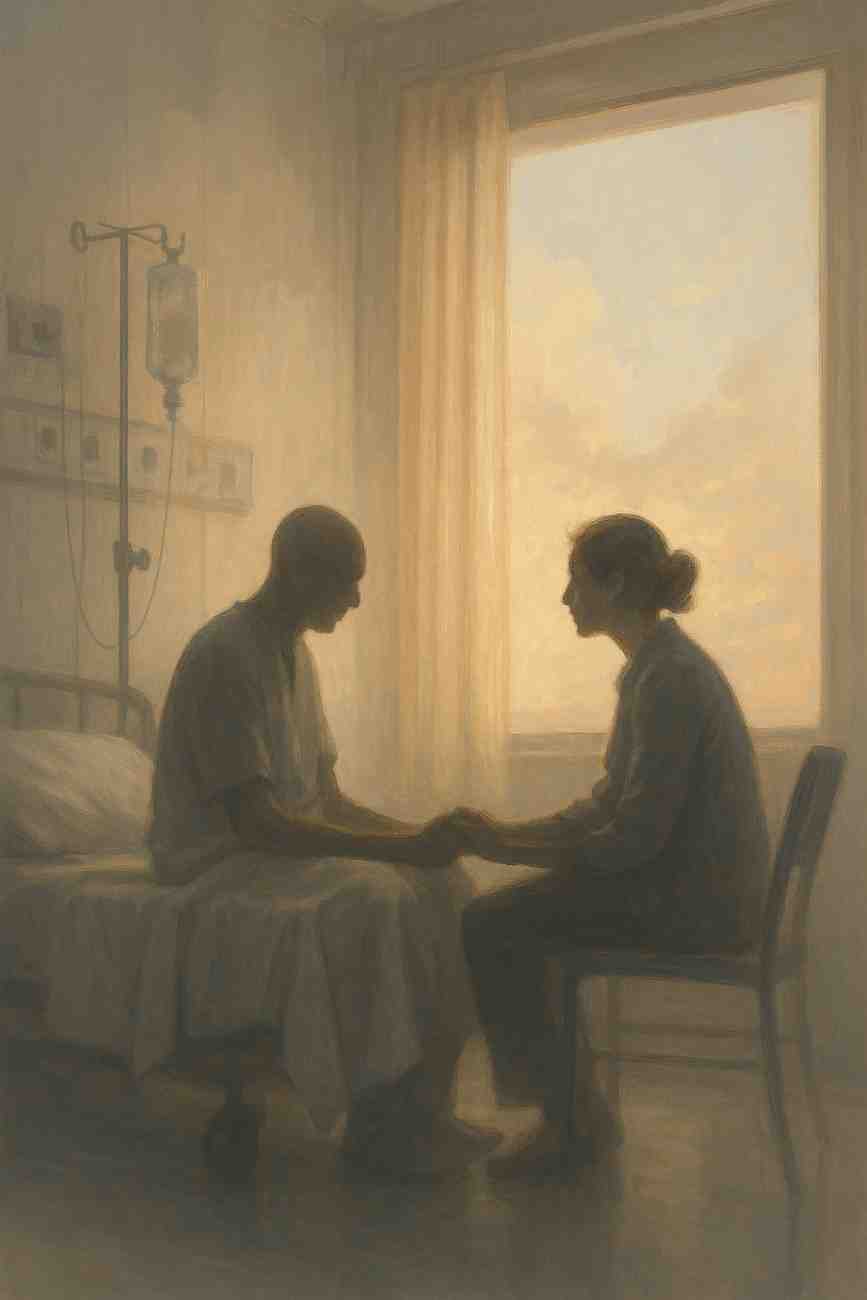
Loneliness is the quiet epidemic — cured, sometimes, by nothing more than company.
The body survives on science; the soul survives on whoever shows up.
I’m a self-professed astute observer of human medical conditions, and this is one of them.
Hospitals are not lonely places, but they contain a lot of lonely people. Over the years, I’ve realised that recovery after surgery doesn’t depend only on the precision of a scalpel or the dosage of a drug. It often depends on who waits for you outside the ICU.
A wound heals faster when there’s someone to change the dressing with care, even if they use the wrong tape. The heart beats steadier when it recognises another voice nearby. And patients who have someone to hold their hand recover sooner than those who have only hospital linen for company.
In most private hospitals, there’s an unspoken hierarchy of caregiving. The wealthy outsource affection. Patients are looked after by nurses, ward boys, dietitians, physiotherapists, and occasionally by family members who make brief appearances between business calls. They arrive with hampers of dry fruits and the latest gadgets to “cheer up Dad” before disappearing again into traffic.
The poor, on the other hand, bring devotion. I’ve seen old men sleeping under their wives’ bed because there isn’t another option. Sons spoon-feeding their mothers soup with the same reverence with which one might pay obeisance to a deity. Daughters massaging their fathers’ feet as if trying to press life back into them. Their love is raw, inconvenient, unpaid, and utterly medicinal.
A few years ago, an elderly couple came to see me. He was ninety-two, she was eighty-nine – both slightly stooped but perfectly synchronised, the kind of couple that walks together without needing to speak. She had a compression fracture in her spine after a minor fall. “Doctor, fix her,” he said, as if I were a tailor and her vertebrae a loose button. We treated her conservatively, but age is a fragile thing. She developed a chest infection and passed away one morning. He was inconsolable. “We were married for sixty-seven years,” he said, his hands trembling. Three hours later, he collapsed and died too. His heart was fine. His will wasn’t. The body, it seems, can only live so long when its reason for living leaves the room.
Loneliness doesn’t just visit the elderly, it haunts youngsters too. During my fellowship in America, I was astonished at how often patients came in alone for major procedures. They’d drive themselves, park, sign the consent, get operated on, and then Uber home post-op, their discharge summary folded neatly next to a salad. No family, no fuss, no waiting arms. Independence taken to its tragic extreme.
In India, we do the opposite. We arrive with entire neighbourhoods. Aunties bring food, cousins bring opinions, and all ask if there is free parking. It’s chaos, but it’s a living, breathing kind of chaos – proof that we still care enough to crowd.
Even so, I often see old patients come to my clinic alone. They walk in with scans tucked under their arms, sit quietly on a chair, and wait their turn. When I ask who’s come with them, they say, “No one, Doctor. My children live abroad.” They smile as if it’s a badge of pride. But when I tell them they’ll need surgery or prolonged care, the smile falters. “Who will stay with you?” I ask. They look down. That pause, heavier than any diagnosis, is what I’ve come to recognise as surgical loneliness.
A few months ago, a widower in his seventies came in for a spine procedure. He lived alone in a flat filled with books and dust. After surgery, he insisted on going home the same day. “Who’ll help you up the stairs?” I asked. “My Alexa,” he said. We laughed. The next morning, he called to thank me – “Not for the operation,” he said, “but for asking that question.”
Loneliness, like cholesterol, creeps up quietly. It doesn’t show up on blood tests but corrodes everything that keeps us alive. You can see it in the eyes of patients who have no one to call, no one to text, no one with whom to share the fear that their next operation might be their last. Science doesn’t yet have a metric for love, but I sometimes think it’s the most potent post-op antibiotic.
Yet, amid the sterility of wards, I’ve witnessed small acts of human repair: a nurse who sings to an old woman while changing her bandage; a ward boy who feeds a paralysed man lunch, joking about cricket scores; a junior resident who sits with a patient long after rounds are done. These moments don’t show up on discharge summaries, but they are where healing truly begins.
We are creatures wired for connection. When that connection breaks, so do we. Machines may monitor pulse, pressure, and oxygen, but they can’t measure hope. Hope isn’t quantifiable. It’s given quietly, in the way a hand rests on another, or in a voice that whispers, “I’m here.”
My all-time favourite Jagjit Singh once sang,
“Mujhe tasalli na do, sirf baithe raho,
Waqt mere marne ka tal jaayega.”
(Don’t console me, just sit with me; time itself will delay my death.)
I’ve seen it happen – in ICUs, in waiting rooms, in homes. Sometimes, love keeps people alive longer than medicine does.
In the same ghazal, Anwar Mirzapuri writes,
“Yeh kam hai ke maseeha ke rehne se hi,
Maut ka bhi iraada badal jaaye?”
(Isn’t it something, that the mere presence of a healer can make even death change its mind?)
However, even among doctors, there’s a peculiar kind of loneliness. We spend our days surrounded by strangers. We talk endlessly but rarely speak. Our WhatsApp groups are busy, but our hearts stay in airplane mode. Loneliness isn’t the absence of people – it’s the absence of being seen. The business of a 16-hour day masks it all.
I recently read somewhere that medicine is considered to be the loneliest profession, because doctors rarely speak well of other doctors and colleagues are rarely friends. We attend the same conferences, exchange polite smiles, even click photos together. We’re co-surgeons, co-authors, and co-panellists – but seldom companions. A possible reason for this is that medicine, unlike most professions, is built on rank and hierarchy. Only the ‘toppers’ get surgery. Only the ‘best’ get post-graduation. Only a handful ‘make it big’. So, we start running – not to be better doctors, but to be better than other doctors. It’s not malice, it’s conditioning. But the repercussions are lethal.
Studies from reputed show that doctors report the highest rates of professional isolation compared to engineers, lawyers, or corporate professionals. One study found that over 60% of physicians have no close professional friends outside their immediate workplace. Besides the obvious mental health repercussions, this is damaging even on a professional front: When doctors stop trusting each other, they stop learning from each other. When envy replaces empathy, the whole ecosystem suffers – and everyone loses, especially the patients.
Technology may let us replace joints, valves, and vertebrae, but it cannot replace the presence of another human being. Machines heal the body; only people heal the soul.
We are all caretakers, whether we admit it or not. The question is: When the time comes, will we be the ones holding a hand, or the ones waiting for someone to hold ours?

76 thoughts on “The Surgical Loneliness”
There is another way. All should practise at least to some extent… Make friends with yourself. Enjoy your own silent company, often sit alone in darkness. Then one begins to relate to nature, space, animals trees, and find friends waiting to bond & communicate in every thing around us. I haven’t died yet, but the idea of being alone as I step out is full of joy
Dear Bharti i see you as a very mature and sorted soul. To love ones own company you need to develop yourself into a beautiful human being.
But yes some times seeking friends is also important.
Loved your write up. You’ve written with so much of senstivity .
Beautiful sentiments showing the reality boldly.
I always laugh and make others laugh in the hospital. Some people think I’m crazy..oh well, better me crazy than others lonely.
Dr Turel Sir
Wonderfully explained and very well written
It’s true. Most of the Poor people have lots unconditional love and affection.Most of the rich people have lots of Money. Love and affection may be.….
Hi Mazda…..what a wonderful n soul searching article you have written
In this fast paced rat race where the population is growing at a alarming pace but irony is people are getting more lonelier that ever
Dear Dr. Turel,
Your article resonates with all of us who have looked after our parents in their old age. With due respect to West in technology, there is lots to learn from East in compassion & sensitivities. In this rat-race we achieve a lot but are lonlier at the top. Your insight into your article is exemplary.
Hope this article is read by all young budding Doctors studying in School Of Medicines all over the World.
能感受到热爱。继续保持 真情。 三疊泉瀑布 有趣的 旅游资源, 继续发展 继续下去。感谢!
你 百分百 启发人心。多写些! 圣殿旁园 关注更新, 我体会到, 各国更亲近。谢谢 旅行气氛。
Very beautiful words of wisdom well written. A lesson to all.
Beautifully articulated
I always say the friends are the windows in the room. Without windows room will be dark.
Dr Mazda, your articles are always a treat, so genuine , insightful and straight from the heart ! This particular one is movingly outstanding a great guide to one and all
Very thoughtful article. There needn’t be loneliness in anyone’s life, be they doctor’s, engineers, financial wizards or any human being . One’s childhood memories, college days, good stories read, good music heard, memories of good friends we had, the occasional good time we had spent with our siblings, children — these will give you a hand to hold on to, even if you do not have another humanbeing’s physical presence.
This is one of the most well-articulated articles published in recent times. While much of the present situation can be attributed to broader changes in society, a part of it must also be attributed to developments within the field of medicine. In our younger days, we had the concept of the family doctor, and the need to consult anyone beyond them arose only in cases of major illness. There was a personal touch and familiarity for every patient.
However, with the rise of corporate culture in the delivery of medical services, every patient has increasingly become a source of revenue, and that personal connection has diminished. The visiting-hour restrictions imposed by corporate hospitals have further distanced family and friends from patients, weakening the support system that once played a vital role in healing.
So true Dr Mazda Turel. During covid pandemic while looking after my mother in busy Covid ICU, I realised how life changes for doctors when they are accompanying their loved one. I saw apathy and neglect.
Doctors especially residents, interns need to spend time to talk to the families especially geriatric patients , they heal much faster if we give 3-5 min of smile and some talking with them.
Surgical loneliness as u rightly pointed out both ways – patients and doctors both can be lonely ( in fact they are lonely mostly nowadays )
Here is my article i wrote few years back on this….
https://www.editorialmanager.com/bas/l.asp?i=376394&l=6QBHFB32
Neukunden können sich über einen attraktiven Willkommensbonus freuen, der bis zu 100 € und 150 Freispiele über sieben Tage enthält, wobei schon eine Einzahlung von nur 10 € ausreicht. Gemeint sind damit in der Regel virtuelle Spielotheken, die ihren Sitz in Deutschland haben oder hierzulande lizenziert sind und echtes Geldspiel anbieten. Außerdem darf es nicht möglich sein, simultan an mehreren Slots gleichzeitig zu spielen. Mit der deutschen Lizenz gehen auch Einschränkungen bei den Spielangeboten einher. Diese Einordnung hilft, den Anbieter für Neueinsteiger, ambitionierte Spieler oder Gelegenheitsspieler zu empfehlen.
Auch wenn Sie in einem seriösen Online-Casino spielen, lohnt es sich, über die einzelnen Arten von Boni Bescheid zu wissen und deren Bedingungen zu verstehen. Ein jeder Entwickler verfügt über ein bestimmtes Portfolio an Spielen wie Slots, Tisch- und/oder Kartenspielen. Bevor Sie sich in einem Online-Casino anmelden, um mit Echtgeld zu spielen, sollten Sie sich unbedingt über den Anbieter informieren. Zudem können Sie Live-Dealer-Spiele nicht mit Spielgeld spielen, da dieses Angebot aufgrund des technischen Aufwands mit Betriebskosten verbunden ist. Auch Brettspielen oder TV-Shows nachempfundene Titel haben es mittlerweile in die Reihen der Live-Casinospiele geschafft. In einem Live-Casino spielen Sie also nicht gegen eine Maschine und den RNG, sondern Sie spielen gegen echte Menschen.
References:
https://online-spielhallen.de/beste-online-casino-app-2025-schnell-sicher-einfach/
Ein- und Auszahlungen sind jedoch gebührenfrei und meist schnell; Mindesteinzahlung rund 20 € ist kundenfreundlich. Paysafecard, Skrill und Neteller sind für DE-Kunden teils nicht verfügbar, und Krypto läuft über Drittanbieter. Die Mindesteinzahlung von 20 € ist fair; Umsatzbedingungen sind nicht extrem restriktiv. Das Willkommenspaket erstreckt sich über mehrere Einzahlungen – insgesamt bis zu 1.000 € plus 300 Freispiele – und wird durch regelmäßige Reload- und Cashback-Aktionen ergänzt.
Ein bestes online casino im Jahr 2025 muss mehr bieten als nur eine responsive Website. Jedes vorgestellte bestes online casino erfüllt strenge Kriterien und bietet sicheres Spielen mit Echtgeld. In den top online casinos finden Spieler zudem eine Vielzahl von Bonusangeboten und Aktionen. Zudem sind viele online casino seiten darauf spezialisiert, die besten online casino spiele anzubieten. Viele Spieler geben in der Suche Begriffe wie „online casino deutschland“, „casino deutschland“ oder einfach „online casinos“ ein, wenn sie nach legalen Glücksspiel-Angeboten im Internet suchen. WinShark ist ein spannender Casinoanbieter, weil es praktisch ein Spielparadies bietet, und dies mit über 3.000 Automatenspielen von den besten Glücksspielherstellern. Probieren Sie es am besten selbst aus, der 50 Euro Willkommensbonus inklusive 100 Freispielen beim Slot Klassiker Book of Dead für neue deutsche Spieler ist definitiv ein gutes Argument, in der MerkurSlots Spielhalle – auf die Jagd nach Gewinnen zu gehen!
References:
https://online-spielhallen.de/top-9-online-casinos-in-deutschland-2025-serios-getestet/
Diese Lizenzen legitimieren den Betrieb jedoch nicht für den deutschen Markt. Juli 2021 können Online Casinos offiziell legal in Deutschland angeboten werden – allerdings nur mit einer gültigen deutschen Lizenz. Der Glücksspielstaatsvertrag 2021 (GlüStV 2021) hat den deutschen Online-Glücksspielmarkt grundlegend verändert. Mit diesen Tipps kannst du deine Casino Boni ganz bequem mobil nutzen und jederzeit und überall spielen! Wir haben für dich einige der aktuell attraktivsten Bonusangebote in deutschen Online Casinos zusammengestellt.
Der Willkommensbonus kann sowohl aus einem Einzahlungsbonus als auch aus Freispielen bestehen, um neuen Spielern den Einstieg zu erleichtern. In deutschen Online Casinos werden verschiedene Spielekategorien angeboten, dazu gehören Spielautomaten, Tischspiele und Live Dealer Spiele. Die breite Spieleauswahl umfasst alles von klassischen Slots bis hin zu modernen Video-Slots und Tischspielen. Diese Programme belohnen die Loyalität der Spieler und bieten zusätzliche Anreize, regelmäßig zu spielen.
References:
https://online-spielhallen.de/jet-casino-test-2025-login-boni-zahlungen-sicherheit/
So wählst du leicht das für dich beste Casino online aus. Solche Plattformen bieten nicht nur eine große Auswahl an hochwertigen Spielen, sondern auch sichere Casino-Zahlungsmethoden, faire Bedingungen und attraktive Bonusangebote. Renommierte Softwareanbieter optimieren ihre Spiele für Smartphones und Tablets, sodass diese nahtlos auf Android- und iOS-Geräten laufen.
Damals wurden Online Casinos noch verboten in Deutschland, obwohl es schon hunderte Seiten für deutsche Spieler gab. So können Sie schneller das gewünschte Internet Casino für Ihre persönlichen Vorlieben aus unseren Ranglisten auswählen und sich dort jeweils den attraktiven Willkommensbonus holen. Auf jeden Fall stammen aus diesen Tests die besten Online Casinos für deutsche Spieler aus den nachfolgenden Bestenlisten, die wir für Sie nach verschiedenen Kriterien sortiert haben. Die neue Lizenzbehörde hat inzwischen unzählige Lizenzen an verschiedene Anbieter virtueller Automatenspiele vergeben. Seit 2003 suchen und finden wir die besten Online Casinos für euch, bewerten sie fair, zeitgemäß und präsentieren sie euch schließlich in unserer Liste der besten Online Casinos. Die besten Online Casinos sind sicher, funktionieren tadellos und bieten euch ein hinreißendes Spielerlebnis.
References:
https://online-spielhallen.de/zetcasino-deutschland-einloggen-spielen-auszahlen/
You are a philosopher, among other avatars..in the league of Paul Kalanidhi, author “When breath becomes air” and others who write about death, loneliness in hospitals!
Being mortal, by Atul Gavande, touches us, like you & Paul Kalanidhi, Paul died so young that his emotional connect tears into our very soul.
Dr. Turel described the importance of the human contact in healing so beautifully. Humans are social animals and loneliness is living death.
Thank you Dr. Turel.
I saw some comments about a Herbal Doctor called Dr Moses Buba and decided to email him asking for help because I was suffering from Erectile Dysfunction (ED) and he got back to me, he gave me some comforting words with his herbal medication for Erectile dysfunction, Within 14th days of it, i began to feel that his medicine is working , and right now I am free . I am so happy, contact DR Moses Buba now via email buba.herbalmiraclemmedicine@gmail.com or his WhatsApp. +2349046949685 . may God reward you for your good work