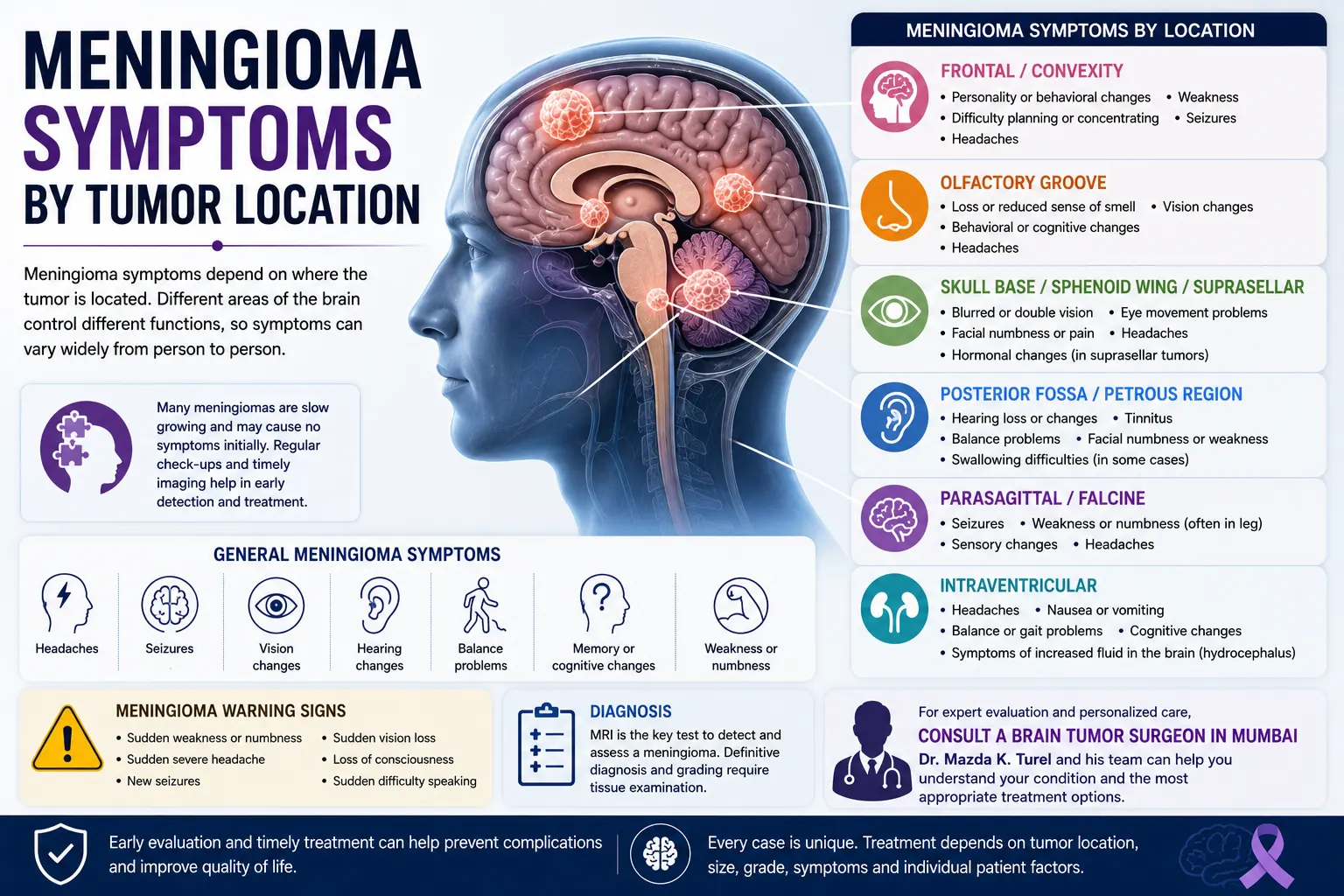
Two people with meningiomas can experience very different symptoms. One may notice changes in vision, while another develops seizures, weakness, hearing problems, or a reduced sense of smell. Understanding meningioma symptoms by location helps explain why this happens.
Meningiomas arise from the meninges, the protective tissue surrounding the brain and spinal cord. Many grow slowly and may produce no symptoms for a long time. Problems generally develop when the tumor becomes large enough to press on the brain, cranial nerves, blood vessels, or other nearby structures.
Location is therefore an important part of understanding symptoms, but it is not the only factor. Tumor size, growth, surrounding swelling, and individual anatomy also influence what a patient experiences.
Why Do Meningioma Symptoms Change With Tumor Location?
Meningioma symptoms vary by location because different areas of the brain and skull base control different functions. A tumor near the optic nerves may affect vision, while one near hearing or facial nerves may cause hearing or facial symptoms. Tumors pressing on brain regions involved in movement, behaviour, or language may produce a different pattern altogether.
Meningiomas generally grow from tissue covering the brain rather than from the brain cells themselves. As they enlarge, they can push against neighbouring brain tissue or cranial nerves.
This also explains why symptoms are sometimes subtle at first. Slowly growing tumors may allow surrounding structures to adapt for a period before the effects become noticeable. Some meningiomas are discovered incidentally during an MRI or CT scan performed for an unrelated reason.
Meningioma Symptoms by Location: A Practical Comparison
Meningioma Location | Possible Symptoms |
Frontal/convexity | Personality or behavioural changes, difficulty planning, weakness, seizures, headaches |
Olfactory groove | Reduced or lost sense of smell, possible vision changes, cognitive or behavioural changes |
Sphenoid wing/skull base | Blurred or double vision, eye-related symptoms, headache, cranial nerve problems |
Suprasellar | Vision changes and, in some cases, effects involving nearby pituitary structures |
Parasagittal/falx | Seizures, weakness or numbness depending on the nearby brain region |
Posterior fossa/petrous region | Hearing changes, balance problems, facial symptoms, sometimes swallowing or coordination difficulties |
Intraventricular | Headache, nausea, balance or cognitive symptoms if cerebrospinal fluid flow becomes obstructed |
These are patterns rather than rules. The same location may produce different symptoms in different patients.
Frontal Meningioma Symptoms
A meningioma near the frontal part of the brain may affect functions such as behaviour, decision-making, movement, organisation, speech, and aspects of smell.
Possible frontal meningioma symptoms may include:
- Changes in personality or behaviour
- Reduced motivation
- Difficulty planning or organising tasks
- Poor concentration
- Weakness affecting part of the body
- Speech difficulties, depending on the side and exact location
- Seizures
- Headaches
These symptoms may develop gradually. A family member may sometimes notice behavioural or cognitive changes before the patient recognises them.
However, personality changes, memory problems, or reduced concentration have many possible causes. They should not be considered evidence of a meningioma without neurological assessment and appropriate imaging.
Convexity Meningiomas
A convexity meningioma grows along the surface of the brain beneath the skull.
These tumors can sometimes grow considerably before causing symptoms. When they begin pressing on the underlying brain, possible signs include seizures, weakness, numbness, headache, or other neurological problems depending on the exact region involved.
Olfactory Groove Meningioma Symptoms
Olfactory groove meningiomas develop near the nerves involved in smell at the front of the skull base.
One particularly relevant symptom is:
- Reduced or lost sense of smell
As the tumor enlarges, it may also affect nearby frontal brain structures or visual pathways. This means some patients can develop visual changes or changes involving cognition and behaviour. Johns Hopkins specifically notes that olfactory groove meningiomas can cause loss of smell and may produce visual problems when they become large.
A reduced sense of smell is common in many conditions, including sinus disease and viral illness, so it should not automatically be attributed to a tumor.
Skull Base Meningioma Symptoms
The skull base contains many tightly packed cranial nerves and important blood vessels. For this reason, even a relatively localised tumor can sometimes affect vision, hearing, facial sensation, eye movement, swallowing, or balance.
Possible skull base meningioma symptoms include:
- Blurred vision
- Double vision
- Reduced vision
- Hearing changes
- Ringing in the ear
- Facial numbness or pain
- Balance problems
- Difficulty swallowing in selected locations
- Headache
Skull base symptoms depend heavily on which nerves and structures are being compressed.
Sphenoid Wing Meningioma
A sphenoid wing meningioma forms along the skull base behind the eyes.
Because this region lies close to visual nerves and major blood vessels, symptoms may include visual problems, headache, or eye-related neurological changes. Treatment planning can also be more complex when the tumor surrounds important nerves or arteries.
Suprasellar Meningioma
A suprasellar meningioma grows near the optic nerves and the pituitary region.
Visual symptoms can therefore be particularly relevant, such as:
- Reduced visual clarity
- Loss of part of the visual field
- Progressive vision loss
Tumors in this region may also affect structures related to pituitary function depending on their size and exact position.
Progressive unexplained visual loss requires proper eye and neurological evaluation rather than waiting for other symptoms to appear.
Parasagittal and Falcine Meningioma Symptoms
Parasagittal and falcine meningiomas develop near the membrane separating the two cerebral hemispheres and close to major venous structures.
Symptoms depend on which section of the nearby brain is compressed.
Possible signs include:
- Seizures
- Weakness
- Numbness
- Difficulty with movement
- Headaches
If a tumor lies close to the motor areas controlling the legs, weakness may be more noticeable in a leg. Tumors affecting other nearby cortical regions may produce different symptoms.
The relationship with major venous channels can also influence surgical planning, which is one reason imaging review is important rather than relying only on the tumor’s measured size.
Posterior Fossa and Petrous Meningioma Symptoms
Posterior fossa and petrous meningiomas arise toward the back and lower part of the skull, close to the brainstem, cerebellum, and several cranial nerves.
Possible symptoms may include:
- Hearing loss or hearing changes
- Ringing in the ears
- Facial numbness
- Facial pain
- Balance problems
- Unsteadiness
- Coordination difficulties
- Double vision in some cases
Johns Hopkins notes that posterior fossa and petrous meningiomas can press on cranial nerves and produce facial or hearing symptoms. A petrous meningioma may also compress the trigeminal nerve, potentially producing facial pain similar to trigeminal neuralgia.
Because the skull base is anatomically crowded, symptoms may sometimes involve more than one cranial nerve.
Can an Intraventricular Meningioma Cause Different Symptoms?
Yes.
An intraventricular meningioma forms within the ventricular system, the fluid-containing spaces inside the brain.
If it interferes with the flow of cerebrospinal fluid, it can contribute to hydrocephalus, which means excess fluid builds up within the brain’s ventricular system.
Possible symptoms can include:
- Headaches
- Nausea or vomiting
- Balance difficulties
- Slower thinking or memory problems
- Increasing drowsiness in more significant cases
These symptoms can also occur with many other neurological disorders and require medical assessment to determine the cause.
What Are General Meningioma Warning Signs?
Location-specific symptoms are useful, but some meningioma warning signs occur across several tumor locations.
Commonly reported symptoms include:
- New or progressively worsening headaches
- Seizures
- Blurred or changing vision
- Weakness
- Numbness
- Hearing changes
- Balance problems
- Memory changes
- Confusion
- Loss of smell
Meningiomas may develop slowly, and some produce no symptoms until they become larger.
None of these symptoms is specific enough to diagnose a meningioma. Migraine, stroke, eye disorders, ear disorders, seizures from other causes, and many other neurological conditions can produce similar symptoms.
How Are Meningiomas Diagnosed?
MRI is commonly used to evaluate a suspected meningioma because it shows the tumor and its relationship with surrounding brain structures in detail.
The assessment may include:
- Neurological examination
- MRI of the brain, often with contrast when appropriate
- CT scanning in selected situations
- Vision or hearing tests depending on tumor location
- Comparison with previous scans
A definite tumor grade is established through examination of tumor tissue by a neuropathologist when surgery and tissue sampling are performed. Meningiomas are classified into grades based on their pathological features.
The scan itself remains essential for understanding where the tumor is, whether it is producing swelling, and how closely it lies to nerves, blood vessels, or functional brain areas.
Does Every Meningioma Need Treatment?
No.
Some small meningiomas are found incidentally, cause no symptoms, and show little or no growth. In selected patients, doctors may recommend active surveillance with periodic MRI scans rather than immediate treatment.
Treatment becomes more likely when a tumor:
- Is growing
- Produces neurological symptoms
- Compresses important structures
- Threatens vision or other neurological functions
- Has imaging characteristics that require further management
Depending on the individual case, treatment may involve surgery, stereotactic radiosurgery, or fractionated radiation therapy. The choice depends on factors such as tumor size, location, grade, symptoms, age, general health, and whether safe removal is possible.
When Should You Seek Urgent Medical Attention?
Seek urgent medical care for sudden or severe neurological symptoms such as:
- A first seizure
- Sudden weakness or numbness
- Sudden difficulty speaking
- Sudden significant vision loss
- Loss of consciousness
- Rapidly worsening confusion
- A severe sudden headache
- Rapid deterioration in balance or neurological function
These symptoms should not automatically be assumed to come from a meningioma. Stroke, bleeding, seizures, and other acute neurological conditions can cause similar problems.
When Should You Consult a Neurosurgeon?
A neurosurgical review is relevant when MRI or CT identifies a meningioma, particularly when it is growing, producing symptoms, or located near important nerves, vessels, or functional brain areas.
A neurosurgeon may review:
- Tumor location
- Tumor size and growth
- Neurological symptoms
- Brain swelling
- Relationship to cranial nerves
- Relationship to major blood vessels
- Whether observation is appropriate
- Whether surgery or radiation should be considered
Patients with a diagnosed meningioma may seek assessment from a brain tumor surgeon in Mumbai to understand how the tumor’s location affects treatment planning.
Dr. Mazda K. Turel can review the patient’s symptoms, neurological examination, and actual MRI images before discussing whether continued observation, surgery, radiation-based treatment, or another approach may be appropriate.
Conclusion
Understanding meningioma symptoms by location helps explain why the condition can look so different from one patient to another. A frontal meningioma may affect behaviour or movement, an olfactory groove tumor may interfere with smell, and a skull base or posterior fossa meningioma may affect vision, hearing, facial sensation, or balance.
Symptoms alone cannot tell where a tumor is located or confirm that a meningioma is present. MRI, neurological examination, symptom progression, and the relationship between the lesion and nearby structures are all needed to understand the diagnosis.
Some meningiomas can be safely monitored, while others require surgery or radiation-based treatment. If imaging identifies a meningioma, specialist review can help determine whether the safest next step is observation or active treatment based on the individual tumor and patient.
Frequently Asked Questions
What are the most common meningioma symptoms by location?
Meningioma symptoms by location vary according to which structures are compressed. Frontal tumors may affect behaviour, concentration, movement, or speech; skull base tumors may affect vision, hearing, or cranial nerves; olfactory groove tumors may affect smell; and posterior fossa tumors can cause hearing, facial, balance, or coordination symptoms.
Can a frontal meningioma change personality?
It can. The frontal lobes are involved in personality, decision-making, behaviour, planning, and movement. A meningioma pressing on this region may therefore contribute to behavioural or personality changes. However, such changes have many possible neurological, psychiatric, and medical causes, so brain imaging and clinical evaluation are necessary before attributing them to a tumor.
What are the first signs of a skull base meningioma?
There is no single first symptom. Depending on location, a skull base meningioma may initially cause blurred or double vision, hearing changes, facial numbness or pain, altered smell, balance problems, or headache. Symptoms often develop gradually because many meningiomas are slow-growing.
Can a meningioma cause seizures?
Yes. Seizures are a recognised symptom of meningioma and may occur when the tumor or associated changes irritate nearby brain tissue. A first seizure should receive medical assessment because many conditions other than meningioma can cause seizures. The type of seizure may also vary depending on the area of the brain involved.
Can a meningioma cause vision loss?
Yes, particularly when it develops close to the optic nerves, optic pathways, sphenoid wing, or suprasellar region. Vision may become blurred or progressively reduced, depending on which structure is compressed. Persistent or progressive unexplained vision changes deserve specialist assessment because several eye and neurological conditions can produce similar symptoms.
Are meningiomas always symptomatic?
No. Some meningiomas cause no symptoms and are found accidentally during brain imaging for another reason. Small or slow-growing tumors may be monitored with repeat scans if they are not growing or threatening important structures. Symptoms become more likely when the tumor enlarges or begins compressing the brain, cranial nerves, or other structures.
Does the location of a meningioma affect whether surgery is possible?
Yes. Location is a major consideration in surgical planning. Surface tumors may be more accessible, while skull base tumors can lie close to important cranial nerves, arteries, or venous structures. The goal is not simply to remove as much tumor as possible, but to balance tumor control with preservation of neurological function.