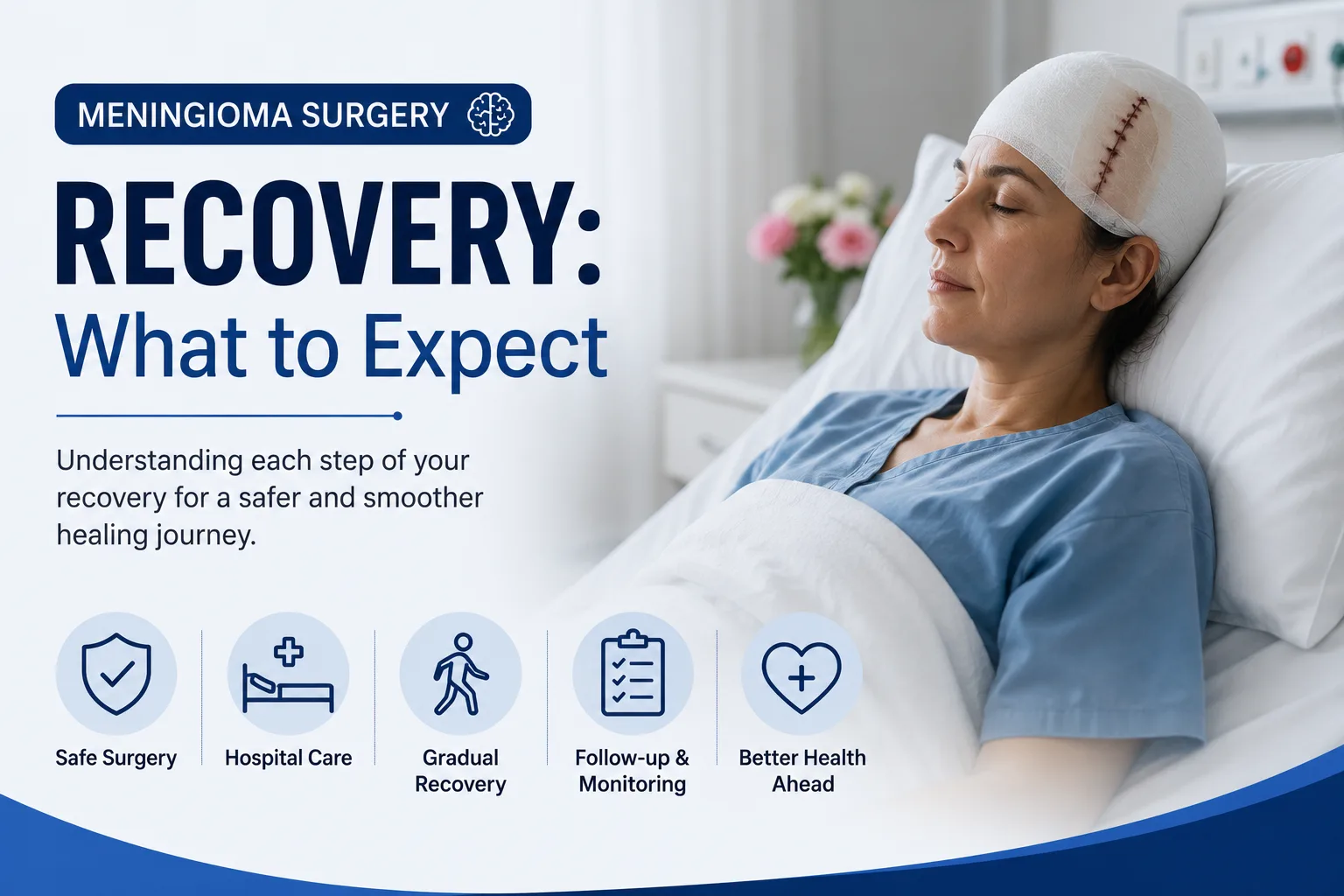
Recovering from brain surgery is rarely the same for two people. Meningioma surgery recovery depends on the tumor’s size and location, the type of operation performed, neurological symptoms before surgery, the extent of tumor removal, and the patient’s general health.
During the first few days, the medical team mainly watches for neurological changes, bleeding, swelling, seizures, infection, and problems related to the operation. Once home, fatigue, mild headaches, scalp discomfort, and reduced stamina can continue for some time. Returning to work, driving, exercise, and other normal activities should be gradual and based on advice from the treating neurosurgeon.
Recovery also includes more than healing the incision. Pathology results, postoperative scans, rehabilitation when needed, and long-term MRI follow-up all form part of care after meningioma removal.
How Long Does Meningioma Surgery Recovery Take?
There is no fixed meningioma operation recovery time. Many patients remain in hospital for a few days after brain tumor surgery and then continue recovering at home for several weeks. Returning fully to previous activities may take longer depending on the operation, neurological symptoms, tumor location, complications, and need for rehabilitation.
A person who had a relatively straightforward operation for an accessible tumor may recover differently from someone whose meningioma involved the skull base, cranial nerves, major blood vessels, or areas responsible for movement and speech.
Recovery may also take longer if a patient experienced seizures, weakness, vision changes, balance difficulties, or cognitive problems before surgery.
Rather than focusing on a single number of weeks, it is more useful to look at progress in stages.
What Happens During the Meningioma Surgery Hospital Stay?
The meningioma surgery hospital stay is mainly a period of close observation and early recovery.
Immediately after surgery, patients are generally monitored in a specialised recovery area or neurological intensive care setting. The team checks vital signs and repeatedly assesses brain function.
These checks may include:
- Alertness and orientation
- Arm and leg strength
- Speech
- Vision
- Sensation
- Balance and coordination
- Headache or nausea
- Surgical wound
- Seizure activity
Some patients have an MRI or CT scan after surgery to assess the operative area and look for concerns such as significant bleeding or swelling.
Getting out of bed and beginning short walks is often encouraged relatively early when medically safe. Mayo Clinic notes that mobilisation may begin on the day of surgery or the following day.
Hospital stay varies. General brain tumor surgery guidance describes stays ranging from a few days to around a week depending on the operation and recovery, while individual centres may have shorter typical stays for uncomplicated cases.
What Might You Feel After Meningioma Removal?
Patients often expect to feel immediately “back to normal” once the tumor has been removed. In reality, the brain and body need time to recover from surgery.
After meningioma removal, some patients may temporarily experience:
- Fatigue
- Headache
- Tenderness around the incision
- Scalp numbness or unusual sensations
- Mild swelling around the surgical area
- Reduced stamina
- Changes in sleep
- Difficulty concentrating for long periods
- Temporary balance difficulties
- General weakness after being in hospital
The exact symptoms depend partly on where the tumor was located and how extensive the operation was.
Some neurological symptoms that existed before surgery may improve gradually rather than immediately. Others may persist, particularly when a nerve or part of the brain had already been affected by prolonged compression.
Recovery should therefore be assessed against the patient’s individual preoperative condition.
Practical Steps During Recovery After Meningioma Surgery
Once you return home, the aim is steady recovery rather than pushing yourself back into a normal schedule immediately.
Build Activity Gradually
Walking is often encouraged because it helps maintain mobility and prevents prolonged inactivity.
Start with manageable activity based on the instructions given at discharge. Increase duration gradually rather than suddenly returning to strenuous exercise.
After brain tumor surgery, patients are commonly advised to avoid vigorous exercise and heavy lifting during early recovery until cleared by their surgical team.
Give Fatigue Time to Improve
Fatigue following brain surgery can be more noticeable than patients expect.
You may feel reasonably well in the morning but become tired after a short period of activity. Resting when needed is sensible, but prolonged bed rest throughout the day is usually not the goal unless specifically advised.
Try to balance gentle movement with adequate sleep and rest.
Follow Your Medication Plan Carefully
Some patients are discharged with medicines for:
- Pain
- Seizure control
- Brain swelling
- Stomach protection
- Other individual medical needs
Do not stop steroids or anti-seizure medicines suddenly unless your medical team tells you to do so.
Medication plans differ between patients, including how long medicines need to continue.
Take Care of the Surgical Wound
Your surgical team should tell you:
- When dressings can be removed
- When the incision can get wet
- When you can wash your hair
- Whether stitches or staples need removal
- What wound changes should be reported
General surgical guidance recommends following the specific wound-care instructions given at discharge and watching for signs of infection.
Avoid applying creams, oils, hair products, or other substances directly to a healing incision unless your surgeon has approved them.
When Can You Return to Work?
There is no standard return-to-work date after meningioma surgery.
A desk-based role may be easier to resume than work involving:
- Heavy lifting
- Driving
- Machinery
- Working at heights
- Long shifts
- Significant physical exertion
Some people also notice that concentration and mental stamina recover more slowly than physical mobility.
A phased return may therefore be more realistic than immediately returning to full working hours.
Mayo Clinic notes that several weeks of recovery may be necessary before typical daily activities can be resumed after brain tumor surgery.
Your neurosurgeon should advise based on the operation, current symptoms, medications, and type of work.
When Can You Drive After Meningioma Surgery?
Driving should only restart after medical clearance and when any applicable legal requirements have been met.
The timing may be affected by:
- Seizures before or after surgery
- Anti-seizure medicines
- Vision changes
- Weakness
- Coordination problems
- Reaction time
- Concentration
- The type of surgery performed
Feeling physically comfortable does not automatically mean that driving is safe.
Ask the treating team specifically rather than assuming that driving can resume once the wound has healed.
Will You Need Rehabilitation After Surgery?
Some patients do. Others recover independently.
Rehabilitation may be useful if the tumor or operation affected movement, balance, communication, swallowing, or daily function.
Depending on the problem, this may involve:
- Physical therapy for strength, walking, and balance
- Occupational therapy for everyday activities and independence
- Speech and language therapy for speech, communication, or swallowing
- Cognitive rehabilitation when memory, attention, or planning have been affected
Rehabilitation is recognised as part of recovery for some patients after brain tumor surgery.
Needing rehabilitation does not necessarily indicate that something has gone wrong. It may simply be part of helping the brain and body regain function after treatment.
Why Are the Pathology Results Important After Meningioma Removal?
Surgery provides tissue that can be examined by a neuropathologist.
This confirms the diagnosis and determines the tumor grade. Meningiomas are classified according to their pathological characteristics, and grade is one factor that influences follow-up and additional treatment decisions.
Doctors also consider:
- How much tumor was safely removed
- Tumor location
- Postoperative MRI findings
- Tumor grade
- Individual molecular or pathological features where relevant
- The patient’s age and general health
Some patients need no immediate additional treatment after surgery. Others may require radiation or closer surveillance, particularly when residual tumor remains or the pathology shows a higher-grade meningioma.
Why Are Follow-Up MRI Scans Needed?
Surgery does not mean that imaging follow-up ends.
MRI allows the medical team to assess the operative area and monitor for residual or recurrent tumor over time.
The timing of scans depends on:
- Tumor grade
- Extent of removal
- Postoperative findings
- Location
- Previous growth behaviour
- Additional treatment
A patient who had complete removal of a lower-grade tumor may have a different surveillance schedule from someone with residual or higher-grade disease.
Keep copies of previous imaging whenever possible. Comparing scans over time helps doctors understand whether anything has changed.
Warning Signs During Meningioma Surgery Recovery
Some discomfort and fatigue can occur after surgery, but new or rapidly worsening neurological symptoms deserve prompt attention.
Contact your surgical team urgently or seek emergency medical care if you develop:
- New weakness or numbness
- A new seizure
- Loss of consciousness
- Increasing confusion or unusual drowsiness
- New difficulty speaking
- Significant new vision problems
- Repeated vomiting
- A severe or rapidly worsening headache
- Increasing difficulty walking
- Fluid, pus, significant swelling, or increasing redness around the wound
- Fever together with concerning wound or neurological symptoms
After brain tumor surgery, medical teams specifically monitor for complications such as bleeding, infection, swelling, and seizures.
Your own discharge instructions should always take priority because risks vary according to the operation.
When Should You Consult a Neurosurgeon?
A neurosurgeon remains involved throughout recovery after meningioma surgery, not simply during the operation itself.
Follow-up visits allow the surgeon to review:
- Wound healing
- Neurological recovery
- Postoperative MRI or CT findings
- Pathology results
- Medication needs
- Seizure management
- Activity restrictions
- Rehabilitation needs
- Long-term MRI surveillance
- Whether additional treatment is required
Patients considering surgery or seeking follow-up assessment can consult a brain tumor surgeon in Mumbai to review the meningioma’s location, surgical plan, postoperative imaging, and recovery expectations.
Dr. Mazda K. Turel can assess these factors in the context of the individual patient’s neurological function and overall condition rather than applying a fixed recovery timeline to every case.
Conclusion
Meningioma surgery recovery is a gradual process rather than a fixed number of days or weeks. Hospital monitoring covers the earliest stage, but healing continues at home as energy, mobility, concentration, and confidence return.
Patients should follow individual instructions for medicines, wound care, exercise, work, and driving. Pathology results and postoperative imaging also matter because recovery is only one part of the treatment process; doctors must still decide how the tumor should be monitored and whether any further treatment is appropriate.
Most importantly, recovery should show a general direction of improvement. New seizures, weakness, speech or vision changes, increasing confusion, severe worsening headaches, or concerning wound changes deserve prompt medical attention rather than waiting for the next routine appointment.
Frequently Asked Questions
How long is meningioma surgery recovery?
There is no single recovery period. Many patients spend several days in hospital and then continue recovering at home for several weeks. More complex surgery, neurological problems, tumor location, age, and rehabilitation needs may extend recovery. Normal activity should be resumed gradually based on the treating neurosurgeon’s advice rather than according to a fixed timetable.
How long is the hospital stay after meningioma surgery?
The meningioma surgery hospital stay commonly lasts a few days, although some patients require longer observation. Length of stay depends on the type of operation, neurological condition, mobility, postoperative imaging, pain control, complications, and how well the patient is recovering. General brain tumor surgery guidance describes stays from a few days to approximately a week in some cases.
Is fatigue normal after meningioma removal?
Fatigue is common after major surgery, including brain surgery. Anaesthesia, healing, disrupted sleep, medications, reduced activity, and the brain’s recovery can all contribute. Energy usually improves gradually rather than overnight. Severe or worsening fatigue accompanied by confusion, unusual drowsiness, weakness, fever, or other neurological symptoms should be discussed with the medical team.
Will headaches continue after meningioma surgery?
Headaches or incision-related discomfort may occur during early recovery. Their intensity and duration vary. Pain should generally be manageable with the treatment plan provided by the surgical team. A severe headache that suddenly appears or progressively worsens—particularly with vomiting, weakness, confusion, seizures, or unusual drowsiness—requires prompt medical assessment.
Can a meningioma return after complete removal?
Recurrence can occur, although individual risk depends on factors such as tumor grade, location, biological characteristics, and extent of removal. For this reason, follow-up imaging may still be recommended after surgery even when the surgeon believes the visible tumor was completely removed. Higher-grade or residual meningiomas may require closer monitoring or further treatment.
Will I need radiation after meningioma surgery?
Not every patient needs radiation. The decision depends on the pathology, tumor grade, residual tumor, location, recurrence risk, and individual circumstances. Radiation may be considered in selected cases involving residual, recurrent, unresectable, or higher-grade disease. The recommendation is made after reviewing the surgical findings, pathology, and postoperative imaging.
When can I exercise normally again after meningioma surgery?
Light movement and walking may begin relatively early when medically safe, but strenuous activity and heavy lifting are usually restricted during early recovery. The appropriate time to return to the gym, running, swimming, or heavier exercise depends on wound healing, neurological recovery, seizures, medications, and the type of operation. Obtain clearance from your surgical team first.