Hearing that a brain tumor may have returned can feel very different from receiving the first diagnosis. Patients often want to know whether another operation is possible, whether radiation can be given again, and what other treatments remain available. Recurrent brain tumor treatment is not based on one fixed pathway. The right approach depends on the original tumor type, where the recurrence is located, how much previous treatment was given, current neurological symptoms, molecular findings, age, and overall health.
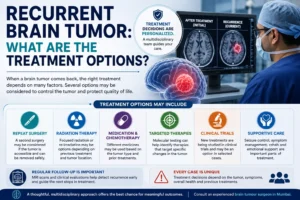
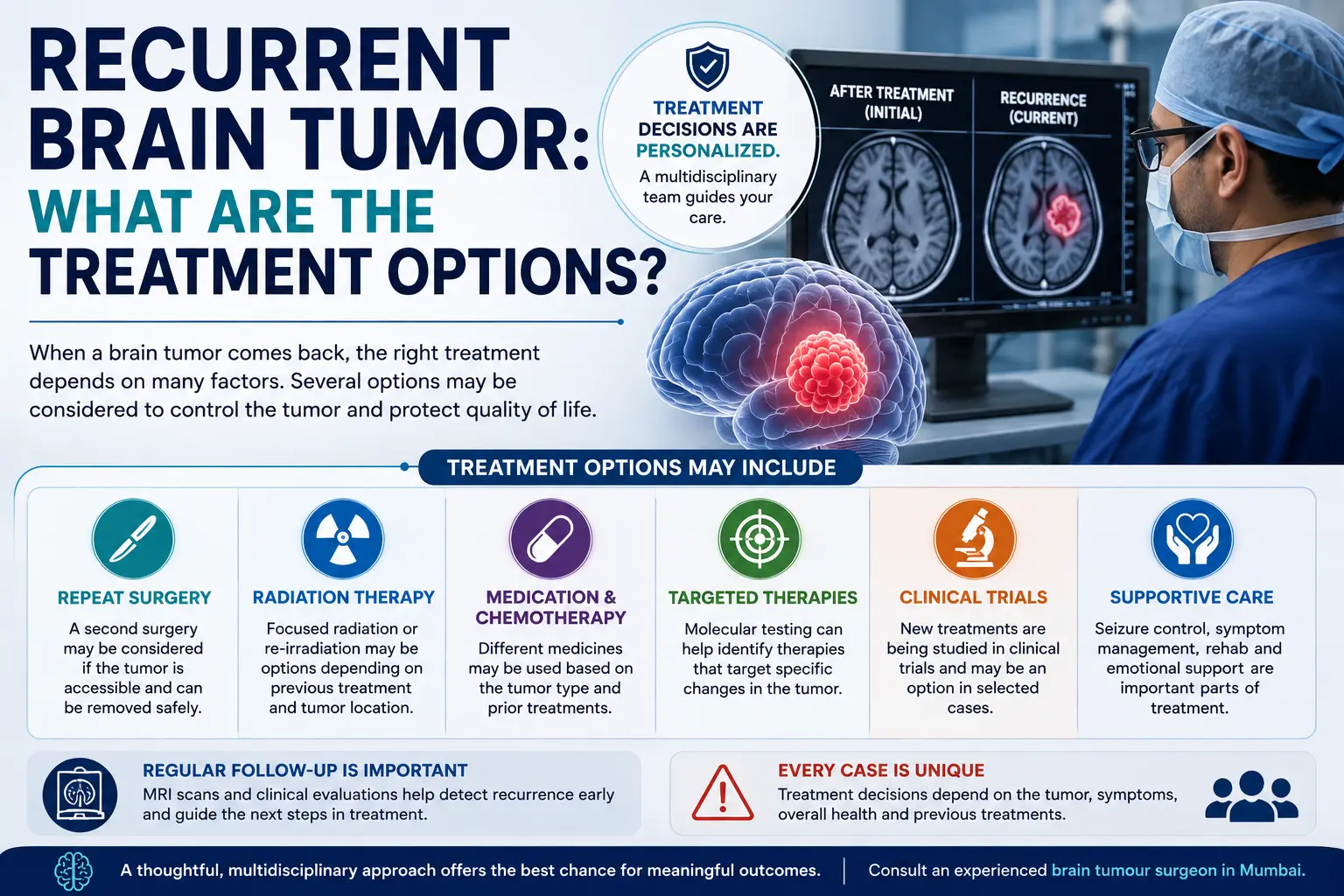
A recurrent tumor may appear in the same area as the original tumor or elsewhere in the central nervous system. Treatment options can include repeat surgery, radiation, drug treatment, targeted therapy, clinical trials, and supportive care.
The first step, though, is making sure that a new scan really represents recurrence.
Does a New MRI Abnormality Always Mean the Brain Tumor Has Returned?
No. A new or enlarging abnormality after brain tumor treatment does not always represent active tumor recurrence. Radiation-related tissue injury and other treatment effects can sometimes resemble tumor growth on conventional MRI. Doctors may therefore use previous scans, advanced imaging, clinical findings, and occasionally biopsy or surgery to clarify the diagnosis.
This distinction matters because treatment for active tumor is very different from treatment for radiation-related damage.
Radiation necrosis, for example, can sometimes look similar to recurrent tumor and may produce overlapping symptoms. Advanced MRI techniques and, in selected situations, PET or other imaging may provide additional information.
Doctors may compare:
- The current MRI with previous scans
- How quickly the abnormal area has changed
- Contrast enhancement patterns
- Surrounding swelling
- Neurological symptoms
- Previous radiation fields
- Previous surgery and pathology
- Molecular features of the original tumor
If uncertainty remains and the answer would change treatment, obtaining tissue may sometimes be considered.
How Is Recurrent Brain Tumor Treatment Chosen?
There is no single treatment that suits every recurrence.
The NCI notes that treatment of recurrent central nervous system tumors depends on the patient’s condition, expected treatment side effects, tumor location, and whether the tumor can be surgically removed. Options may include surgery, radiation therapy, chemotherapy, targeted therapy, or clinical trials.
The medical team will usually consider:
- Original tumor diagnosis and grade
- Molecular or genetic findings
- Time since the original treatment
- Tumor size and location
- Whether there is one area of recurrence or several
- Previous radiation dose
- Previous chemotherapy or targeted treatment
- Current neurological function
- General health
- Whether treatment is likely to preserve or improve quality of life
The same MRI finding can therefore lead to different recommendations in two different patients.
When Is a Second Brain Tumor Surgery Considered?
A second brain tumor surgery may be considered when the recurrent tumor can be reached safely and removing it is expected to provide a meaningful benefit.
Possible reasons include:
- Relieving pressure on the brain
- Improving or stabilising neurological symptoms
- Reducing tumor volume
- Obtaining new tissue for diagnosis
- Checking whether tumor biology has changed
- Creating space before another treatment
- Clarifying recurrence when imaging remains uncertain
Repeat resection is an option for selected recurrent CNS tumors, although many patients may not be suitable because the tumor is technically difficult to remove or the patient’s health has changed.
Why Might Repeat Surgery Not Be Recommended?
Another operation is not automatically helpful simply because the tumor can technically be reached.
Surgery may be less appropriate when:
- The recurrence is deep within critical brain structures
- The tumor is widespread or infiltrative
- Surgery would create a high risk of permanent neurological disability
- Several areas of recurrence are present
- The patient’s health makes another major operation difficult to tolerate
- Another treatment is more likely to provide benefit with less risk
General brain tumor surgery may involve complete or partial removal depending on what can be achieved without unacceptable damage to healthy brain tissue.
The aim is not merely to operate again. It is to decide whether repeat surgery is likely to change the patient’s treatment course in a useful way.
Can Radiation Be Given Again?
Sometimes.
Previous radiation does not automatically rule out further radiation, but re-irradiation requires careful planning because normal brain tissue has already received radiation exposure.
Possible techniques may include:
- Stereotactic radiosurgery
- Fractionated stereotactic radiotherapy
- Other highly focused radiation approaches
The suitability of repeat radiation depends on the location and size of the recurrence, the previous dose, the time since earlier radiation, and the amount of healthy brain that would be exposed again.
NCI guidance notes that repeat radiation for recurrent CNS tumors must be considered cautiously because of potential neurological effects and radiation necrosis.
Stereotactic techniques can sometimes focus treatment on a smaller target while limiting exposure to surrounding tissue.
What Drug Treatments May Be Used When a Brain Tumor Comes Back?
When a brain tumor comes back, drug treatment depends heavily on the exact diagnosis.
Possible approaches include:
- Chemotherapy that was not previously used
- Reuse of selected medicines in particular circumstances
- Targeted therapy when the tumor has an actionable molecular change
- Antiangiogenic treatment for selected tumor types
- Other systemic medicines
- Clinical trial treatments
NCI lists chemotherapy, antiangiogenesis therapy, radiation and surgery among options used for recurrent CNS tumors.
Molecular testing can become particularly useful at recurrence because certain tumors have genetic or biological features that make targeted treatment worth considering. Mayo Clinic notes that targeted therapy is available for selected brain tumors when testing identifies appropriate tumor characteristics.
Treatment should therefore be based on the exact pathology rather than the general phrase “recurrent brain tumor.”
How Is Recurrent Glioma Treatment Different?
Recurrent glioma treatment requires particularly careful planning because diffuse gliomas can infiltrate surrounding brain and may have already been treated with surgery, radiation and chemotherapy.
Depending on the tumor and patient, options may include:
- Repeat surgery
- Additional drug therapy
- Re-irradiation
- Targeted treatment in selected molecular subtypes
- Clinical trials
- Supportive neurological care
For recurrent malignant gliomas, NCI includes re-resection, chemotherapy, radiation and antiangiogenic approaches among possible management strategies.
A recurrence does not automatically mean that the same treatment used the first time should simply be repeated. Previous response, molecular findings, treatment toxicity and the location of the new tumor all influence the next decision.
Where Do Clinical Trials Fit?
Clinical trials may be particularly relevant after recurrence because standard treatment choices can become more limited after previous surgery, radiation or chemotherapy.
Trials may investigate:
- New targeted medicines
- Immunotherapy
- New drug combinations
- Novel radiation strategies
- Treatment devices
- Advanced imaging approaches
NCI specifically lists clinical trial participation among options for recurrent CNS tumors.
A clinical trial is not automatically the correct choice for every patient. Eligibility depends on the exact tumor type, molecular profile, previous therapies, current health, and study requirements.
Supportive Care Is Part of Treatment, Not an Afterthought
Treatment of recurrence should also address symptoms and daily function.
Supportive care may include:
- Medicines for seizures
- Treatment for brain swelling
- Pain or headache management
- Physiotherapy
- Occupational therapy
- Speech and language therapy
- Cognitive rehabilitation
- Psychological support
- Palliative care when appropriate
Follow-up after brain tumor treatment may involve neurological examinations, MRI and rehabilitation services to detect recurrence and manage the effects of the tumor or previous treatment.
Palliative care does not necessarily mean that active treatment has stopped. It can be used alongside surgery, radiation or drug treatment to improve symptom control and quality of life.
What Is Recovery Like After Repeat Brain Tumor Surgery?
Recovery from a second operation varies according to the tumor’s location, previous surgery, current neurological symptoms, age and general health.
After surgery, the team may monitor:
- Strength
- Speech
- Vision
- Alertness
- Balance
- Seizures
- Surgical wound
- Postoperative imaging
Brain tumor surgery may be followed by additional radiation or chemotherapy depending on the diagnosis and surgical findings.
Some patients return home and recover gradually over several weeks. Others require rehabilitation or a longer period of assistance.
Recovery expectations should therefore be discussed before surgery rather than assuming they will be identical to the first operation.
Which Symptoms Need Urgent Medical Attention?
A person with a previous brain tumor should contact the treating team when neurological symptoms are new or clearly worsening.
Seek urgent medical assessment for:
- A new seizure
- Sudden weakness or numbness
- New difficulty speaking
- Sudden major vision changes
- Loss of consciousness
- Rapidly worsening confusion
- Repeated vomiting with neurological deterioration
- A severe or rapidly worsening headache
These symptoms can occur with tumor progression, but they may also be caused by seizures, stroke, bleeding, treatment complications or other neurological emergencies.
When Should You Consult a Neurosurgeon?
Neurosurgical review is particularly useful when imaging shows a localised recurrence that may be removable, when pressure on the brain is producing symptoms, or when new tissue could help guide treatment.
A consultation may address:
- Is this definitely tumor recurrence?
- Can the recurrent lesion be removed safely?
- Would surgery improve symptoms or treatment options?
- Is biopsy more appropriate than resection?
- Which neurological functions are near the tumor?
- How does previous surgery affect the new operation?
- Will radiation or drug treatment still be required afterwards?
- What are the realistic recovery expectations?
Patients considering repeat surgery can seek evaluation from a brain tumor surgeon in Mumbai to review the current and previous MRI scans together.
Dr. Mazda K. Turel can assess imaging, neurological function, previous treatment and pathology before discussing whether repeat surgery or another treatment strategy may be appropriate.
Conclusion
Recurrent brain tumor treatment is highly individual because recurrence can mean something very different depending on the original diagnosis, tumor location, previous therapy and current neurological function.
A new MRI abnormality also needs careful interpretation because treatment-related changes can sometimes resemble active tumor. Once recurrence is established, options may include repeat surgery, radiation or re-irradiation, chemotherapy, targeted therapy, clinical trials and supportive care.
The aim is not simply to repeat everything that was done after the first diagnosis. The medical team needs to ask what treatment is likely to provide useful tumor control while preserving neurological function and quality of life.
For patients with a surgically accessible recurrence, reviewing both the new and previous scans with a neurosurgeon can help clarify whether another operation has a meaningful role.
Frequently Asked Questions
Does brain tumor recurrence always mean the cancer is more aggressive?
No. Brain tumor recurrence means that the tumor has returned after treatment, but the meaning of recurrence varies greatly between tumor types. Some slow-growing tumors can recur after a long period, while aggressive tumors may return sooner. Repeat imaging and, in selected cases, new tissue testing may be needed to understand how the tumor is behaving.
Can a recurrent brain tumor be operated on again?
Yes, selected recurrent tumors can be treated with repeat surgery. The decision depends on tumor location, size, neurological symptoms, previous operations and the patient’s health. Surgery is more useful when meaningful tumor removal or tissue diagnosis can be achieved without an unacceptable neurological risk.
How do doctors know whether MRI changes are recurrence or radiation damage?
The two can sometimes look similar. Doctors compare serial MRIs, clinical symptoms and previous treatment details. Advanced MRI, PET or other tests may provide additional information, but uncertainty can remain. In selected cases, biopsy or surgical removal may be needed to obtain tissue and establish the diagnosis.
Can radiation be used if I already had radiotherapy?
Sometimes, but it requires careful assessment. Re-irradiation depends on the previous radiation dose, location of recurrence, time since treatment and tolerance of surrounding brain tissue. Focused techniques such as stereotactic radiation may be considered in selected cases, but repeat radiation carries risks including radiation necrosis.
Is recurrent brain tumor treatment always more aggressive?
No. Treatment intensity should reflect the diagnosis, symptoms, previous therapies and individual goals. Some recurrences require surgery or combined treatment, while others may be monitored, treated with focused radiation or medication, or managed primarily through symptom-directed care. More treatment is not automatically better treatment.
Can targeted therapy be used for a recurrent brain tumor?
Potentially. Some tumors contain molecular changes that can be targeted with specific medicines. Tumor tissue may therefore undergo molecular testing to determine whether an appropriate targeted therapy exists. Targeted treatment is not available or effective for every brain tumor type.
What questions should I ask before a second brain tumor surgery?
Ask what the operation is expected to achieve, how much tumor may be removable, which neurological functions are at risk, whether new tissue testing could change treatment, what alternatives exist, what recovery may involve, and which treatments are likely to follow surgery. These questions help clarify whether another operation offers a meaningful benefit in your individual situation.