
Twelve years of pain, twelve thousand kilometres, and a diagnosis that had been visible the whole time
She arrived in Mumbai in a wheelchair, just two days before Christmas. She had travelled more than 12,000 kilometres from Feilding, a small town in New Zealand that I had to find on a map.
At 43, she was a mother of six. For eighteen months, she had been unable to walk even to her own letterbox.
By New Year’s Day, she was walking through the front door of her home. Her son was so surprised to see her on her feet that, as she tells it, he asked her to sit back down.
I am writing about Karolyn’s case not because the surgery was unusual. It wasn’t. I am writing about the twelve years that came before it.
Twelve years is a long time to be told to lose weight
Karolyn Carroll’s journey with chronic pain began in 2012, when she fell while pregnant and subsequently developed persistent pain in her hip. At the time, she was advised to lose weight, with the expectation that reducing her weight would ease her symptoms. She followed that advice and lost the weight, but the pain remained.
For the next nine years, she continued to live with the problem before eventually undergoing surgery to address a microfracture in her hip. The procedure provided meaningful relief, but only for about eighteen months. Her symptoms returned after she sustained a tear to the hip capsule.
As the hip became increasingly compromised, her lower back began to bear more of the mechanical load. This kind of compensation can occur when one part of the musculoskeletal system is unable to function normally, placing additional stress on other structures.
The situation took a further turn when Karolyn was lifting a heavy sack of animal feed and suddenly felt her back give way.
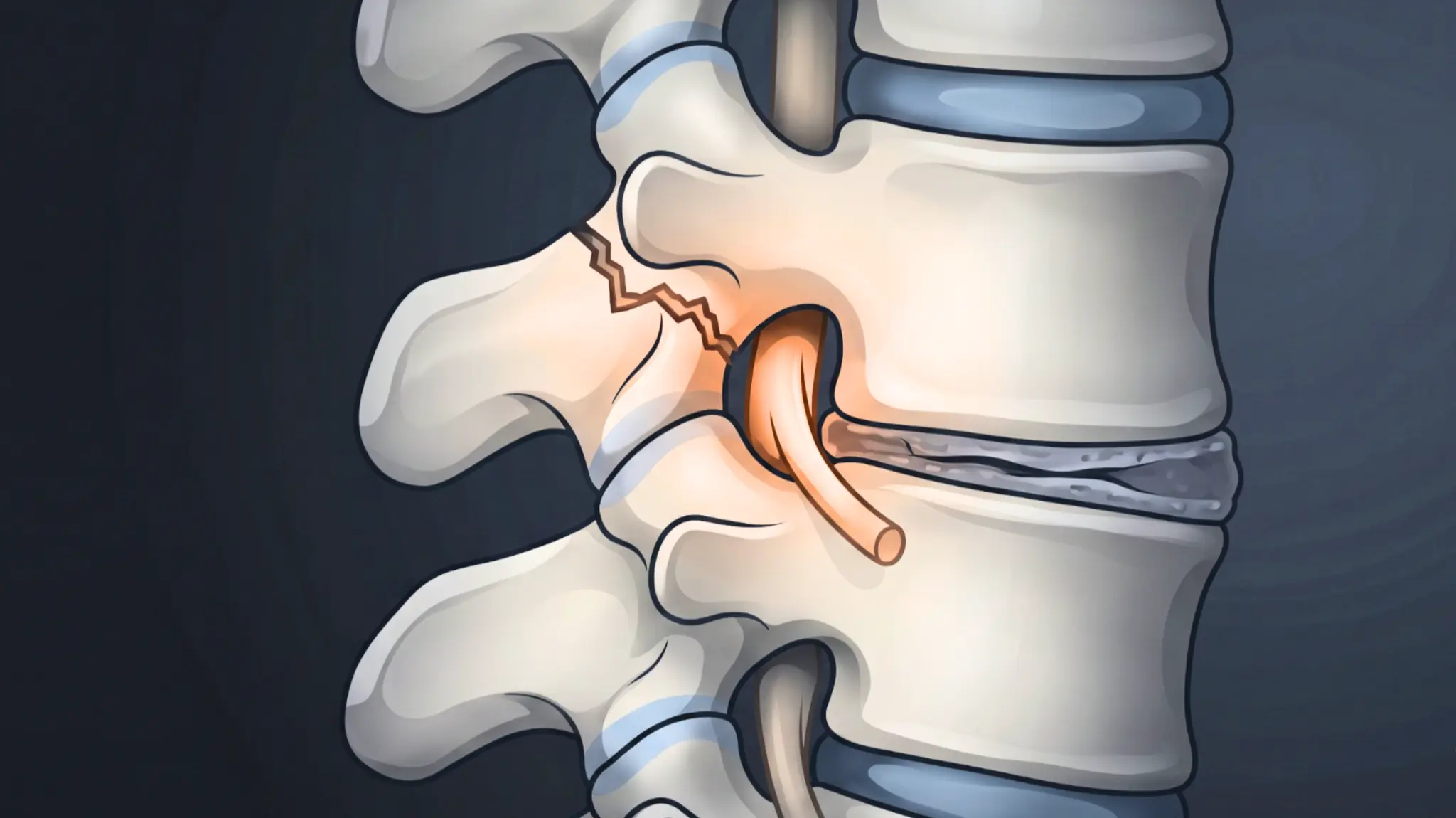
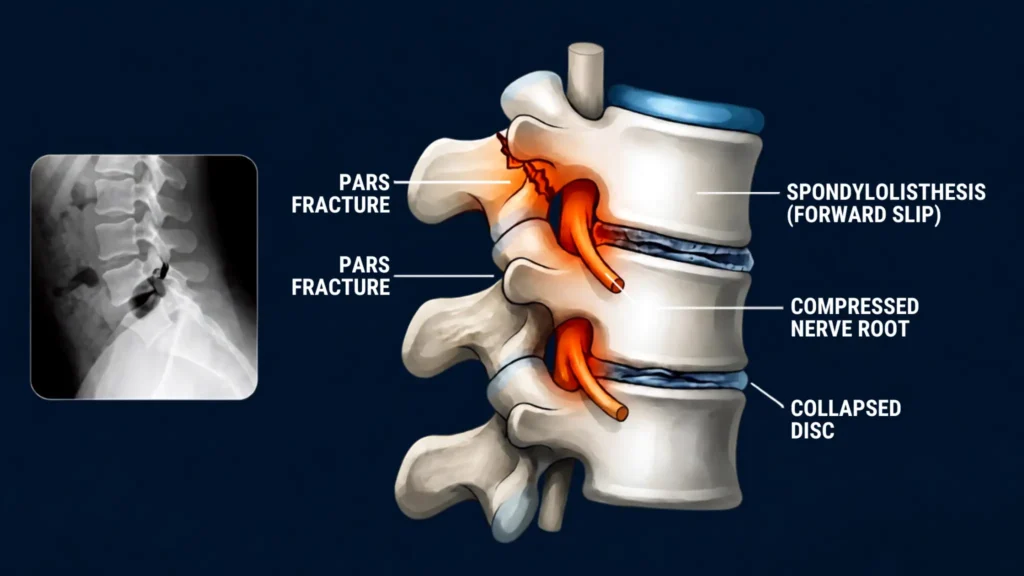
When I reviewed her imaging, it was clear that this was no longer an isolated hip problem. The disc in her lower back had almost completely collapsed, and she had pars fractures that had compromised spinal stability. One vertebra had consequently slipped forward over the one beneath it, causing spondylolisthesis and narrowing the space around the spinal nerves.
These findings gave a clear structural explanation for her symptoms. The scans showed spinal instability, severe disc collapse, vertebral slippage and nerve compression, all consistent with what she was experiencing.
By then, she was taking up to 40 tablets a day, including high-dose morphine, and needed a wheelchair whenever she left home.
What she had been offered, and what troubled me about it
In New Zealand, her claim for surgical cover had been declined by the Accident Compensation Corporation.
She was subsequently quoted around NZ$85,000 privately for a spinal fusion using an anterior approach, which involves reaching the front of the spine through the abdomen. She was also told that the operation might not take her pain away.
I have no interest in criticising a colleague I have never met, working in a healthcare system in which I do not practise, and treating a patient I had not yet examined. There may have been very sound reasons for that assessment.
But there was something I felt was important to explain to Karolyn. Her pain had a structural explanation.
She had a severely collapsed disc, pars fractures, a slipped vertebra and nerve compression. The findings on her imaging correlated with her symptoms and clinical examination.
That is very different from chronic back pain where the source of pain is unclear or where imaging findings do not correspond with the patient’s symptoms.
So I told her that, in my assessment, surgery had a reasonable chance of making a substantial difference. I also explained that no responsible surgeon can guarantee a pain-free outcome.
Two weeks later, with her travel and admission arranged by the medical travel company, IndiCure Health Tours, that had first put her reports in front of me, she was in Mumbai.
What we did
The first step was not surgery. It was a re-assessment.
Even when a patient travels from another country, they need a thorough evaluation on arrival. I reviewed Karolyn’s history, examined her myself, repeated the necessary imaging and assessed whether she was fit for anaesthesia and surgery.
I would never take a patient to the theatre simply because their scans look convincing on a screen thousands of kilometres away. That assessment can sometimes change the treatment plan. In Karolyn’s case, it confirmed that surgery was the right course.
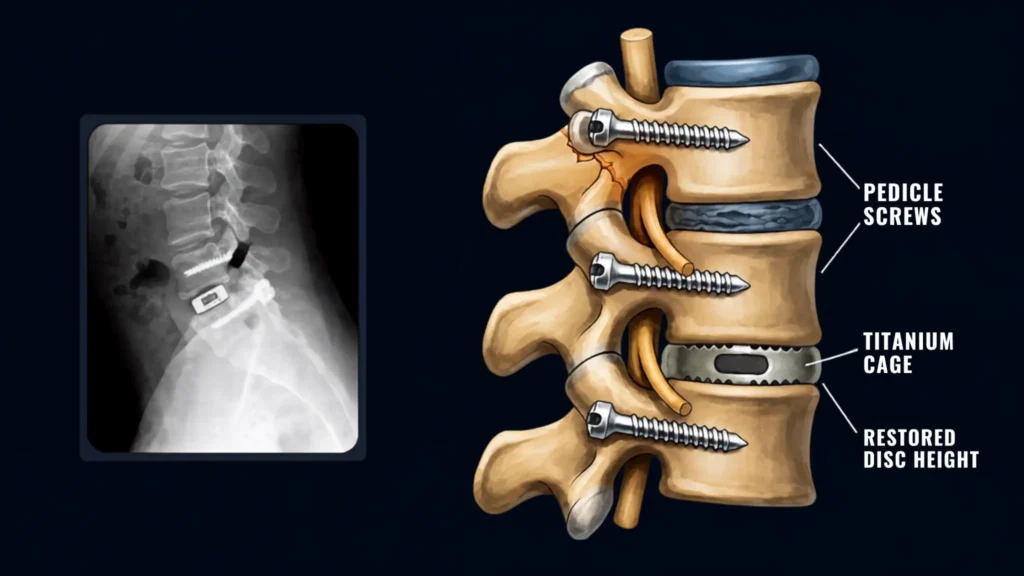
She underwent a minimally invasive lumbar interbody fusion with decompression, performed using robotic navigation.
In practical terms, the procedure involved stabilising the unstable segment with four pedicle screws placed through small incisions rather than a long midline wound.
A titanium interbody cage was inserted into the collapsed disc space, together with the patient’s own bone graft. The aim was to restore disc height, improve alignment and create the conditions for the vertebrae to fuse.
The slipped vertebra was reduced towards a more appropriate alignment, and the compressed nerves were decompressed.
Two aspects of the technique are worth explaining because patients ask me about them constantly.
Why navigation
When the pars is fractured, and a vertebra has slipped, the anatomy is no longer quite what you expect from a textbook. The landmarks surgeons use to judge the trajectory of a pedicle screw can be altered.
Navigation allows me to plan the screw trajectories using the patient’s own CT imaging and then verify their position during the procedure.
The robot is not independently performing the operation. It is a tool that helps me execute a carefully planned procedure with greater precision. In spine surgery, where a few millimetres can matter, that distinction is important.
Why minimally invasive
The muscles alongside your spine are not simply tissue that needs to be moved out of the way. They are part of the system that helps you stand, move and support your spine.
Traditional open surgery requires a much larger exposure and greater disruption of these tissues. With minimally invasive techniques, we work through smaller corridors and aim to preserve as much of the surrounding muscle and soft tissue as possible.
For appropriately selected patients, this can mean less blood loss, less postoperative muscle disruption and earlier mobilisation. The smaller scar is useful, but it is not the main reason I choose a minimally invasive approach.
The next morning
We stood her up on the first day after surgery.
Karolyn has described feeling confused rather than delighted. After so long in pain, she did not know what to make of its sudden absence.
Within 48 hours, she was walking the corridor and climbing the hospital stairs. She had not done either for eighteen months.
By day six, she was fit to fly home.
But early mobility does not mean the spine had healed. Spinal fusion takes months to become solid bone. In the meantime, the implants provide stability while the fusion develops.
Her early recovery showed that the nerve compression had been relieved and that she could move without the severe pain that had restricted her.
These are two different things, and patients can understandably confuse them.
Where she is now, and what I take from it
Karolyn still has to look after her back. A spinal fusion does not make someone invulnerable, and rehabilitation remains an important part of recovery.
She now attends a supervised gym programme through Sport Manawatū’s Green Prescription scheme. She line dances twice a week. She has retrained and started a small business.
The technology was not the most important part of her story. Minimally invasive fusion has been used for years.
The important part was understanding why she was in pain and whether the proposed treatment addressed that cause.
If you are living with persistent back or leg pain, there are three things I think are worth remembering.
- Get the diagnosis, not just the prescription. If pain has continued for years, it is reasonable to ask what is causing it and whether your symptoms have a clear clinical and imaging correlation.
- Not all back pain needs surgery. Surgery is not the answer simply because an MRI shows an abnormality. Many spinal conditions can and should be managed without an operation. The decision depends on the diagnosis, symptoms, examination, imaging and response to appropriate conservative treatment.
- A second opinion is not disloyalty. If you have been offered a major operation that you do not understand, or you have been told that nothing can be done despite persistent symptoms and significant imaging findings, another specialist opinion may help you understand your options.
Distance is no longer the obstacle it once was. Patients from around the world can have their imaging and reports reviewed before travelling, followed by an in-person assessment if surgery is considered.
Karolyn’s experience is one example of that.
Her story was subsequently reported in New Zealand by Stuff and New Zealand Woman’s Weekly. She has told me that she continues to share it because she has already spoken with other people living with chronic pain about her experience.
I think that is the right instinct. Sometimes a patient’s story gives another patient the courage to ask one more question.
And sometimes, that question is where the journey begins.
Frequently Asked Questions
What is spondylolisthesis?
Spondylolisthesis occurs when one vertebra slips forward relative to the vertebra beneath it. It can result from several causes, including degeneration of the spine or a defect or fracture involving the pars interarticularis.
Depending on its severity and the structures affected, it can cause lower back pain, buttock or leg pain, numbness, tingling or weakness.
Does spondylolisthesis always require surgery?
No. Many cases of spondylolisthesis can be managed with non-surgical treatment such as physiotherapy, strengthening exercises, activity modification and appropriate pain management.
Surgery may be considered when symptoms remain disabling despite appropriate conservative treatment, or when there is significant instability, progressive neurological impairment or nerve compression that requires surgical treatment.
The decision should be individualised based on the patient’s symptoms, examination and imaging.
What is a pars fracture?
The pars interarticularis is a small section of bone at the back of a vertebra that connects parts of the vertebral arch.
A pars fracture, often referred to as a spondylolysis, is commonly a stress-related fracture or defect in this region. It is particularly associated with repetitive spinal extension and rotation, including in some adolescent athletes.
When the pars is compromised, it can contribute to instability and, in some cases, allow the vertebra to slip forward over the one below it.
How long does recovery from minimally invasive lumbar fusion take?
Recovery varies from patient to patient and depends on the procedure, the number of levels treated, overall health and the reason for surgery.
Many appropriately selected patients are able to stand and walk within a day or two after surgery. Hospital stay may be several days, depending on recovery and individual circumstances.
Light activities are often introduced progressively over the following weeks, while the fusion itself can take several months to become solid bone. Your surgeon and rehabilitation team will determine when it is appropriate to increase activity and return to heavier loading.
Can I have spine surgery if I live overseas?
Yes. For international patients, medical records, MRI or CT scans and reports can often be reviewed remotely to provide an initial opinion about whether an in-person assessment may be appropriate.
However, a remote review is not a substitute for a clinical examination. If you travel for treatment, the diagnosis and suitability for surgery should be independently reassessed before an operation is performed.
Fitness to fly home is also assessed individually after surgery.
My practice is based at Wockhardt Hospitals, Mumbai Central. International patients can also work with a medical travel provider to coordinate practical arrangements such as visas, airport transfers and accommodation.
Karolyn’s medical travel arrangements were coordinated by IndiCure Health Tours, who also assisted with obtaining her treatment estimate before she travelled.
Published with the patient’s consent. Her account was reported by Annemarie Quill for Stuff (14 July 2025) and Kasia De Vydt-Jillings for New Zealand Woman’s Weekly (28 August 2025). Photography © Are Media / Bernadette Peters, not reproduced here.
This article describes one patient’s course and is written for general education. It is not medical advice and does not establish a doctor-patient relationship. Outcomes differ between patients. Please seek an individual consultation before making any treatment decision.
2 thoughts on “The Surgical Distance”
Every day I wake up with a heart full of gratitude, amazed by how dramatically my life seemed to change after my encounter with the Great DR UYI. In this I was given six-digit numbers that supposedly led to a $980 million to my lottery win an outcome I could hardly have imagined. As a father of four I know the true value of family. It has been several years since I lost my beloved wife to cancer yet I still feel her absence every day. There are moments when I wish I could share this extraordinary experience with her because she would have been the first person I called. Her memory continues to give me strength and reminds me never to take life’s blessings for granted. What touched me most in this was the sense of hope and faith it inspired. i listened carefully to the guidance DR UYI gave to me and i followed eveything DR UYI told me with sincerity and determination. The experience became a powerful and i won $980 million with the help of DR UYI you can contact him via email drzukalottospelltemple@gmail.com ON WhatsApp on +17174154115
I am out here to speed this good news to the entire world on how I got help from Dr UYI a great lottery spell caster that will help you cast a lottery spell and give you the rightful numbers to win the lottery, I didn’t believe lottery spell at first but as life got harder i decided to give a try, I spend so much money on tickets just to make sure I win. until the day I met Dr UYI online, which so many people have talked good about, that he is very great when it comes to casting lottery spell, he told me the necessary things to do and behold it was like a magic, i won $220 Million Dollars Mega Million with the numbers Dr UYI gave to me. his a really trustful person worthy and reliable, i am sharing this to you who have been finding it so hard to win the lottery, Thanks you Dr UYI who helped me Contact him via email: drzukalottospelltemple@gmail.com OR WhatsApp on +17174154115