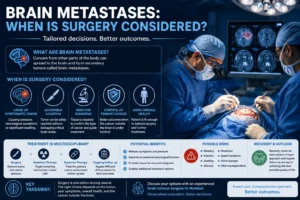
Finding that cancer has spread to the brain can lead to an immediate question: does the brain tumor need to be removed? Brain metastases surgery is an important treatment for selected patients, but not every brain metastasis requires an operation.
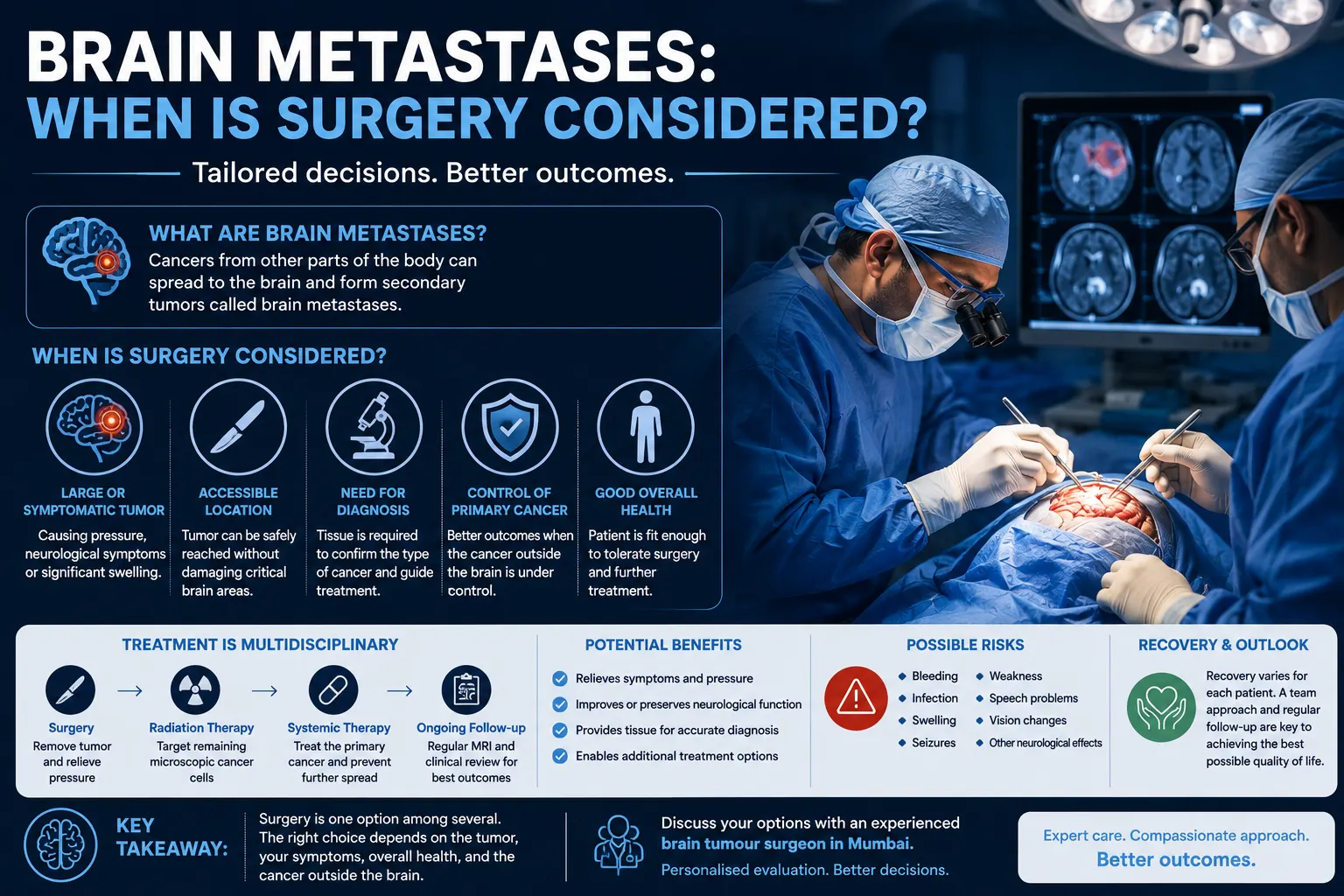
Surgery is more likely to be considered when there is a large or symptomatic tumor causing pressure on the brain, when tissue is needed to confirm the diagnosis, or when removing a dominant lesion could relieve neurological symptoms. Patients with several small metastases may instead be treated with focused radiation or other therapies depending on the cancer type and overall situation. Current multidisciplinary guidelines emphasise that decisions should take into account tumor size, mass effect, number of brain lesions, systemic cancer control, neurological symptoms and general health.
What Are Brain Metastases?
Brain metastases are tumors that develop when cancer cells from another part of the body spread to the brain. They are therefore different from primary brain tumors, which begin within the brain itself.
For example, cancer originating in the lung, breast, kidney or another organ can spread through the bloodstream and form one or more tumors in the brain.
This distinction matters because brain metastasis treatment is based not only on what is happening inside the brain but also on:
- The original cancer type
- Whether the primary cancer is controlled
- Disease elsewhere in the body
- Number and size of brain metastases
- Available systemic treatments
- Neurological symptoms
- Overall health and functional status
Treatment is therefore usually planned by a multidisciplinary team rather than by neurosurgery alone.
When Is Brain Metastases Surgery Considered?
Brain metastases surgery is most often considered for a large or symptomatic lesion causing significant pressure on the brain, for an accessible tumor where removing it may relieve neurological symptoms, or when tissue is needed to establish the diagnosis. Patients with multiple metastases or poorly controlled cancer elsewhere may be less likely to benefit from surgery.
The main situations are discussed below.
A Large Metastasis Is Causing Mass Effect
Mass effect means that a tumor and its surrounding swelling are pushing on nearby brain structures.
This may lead to symptoms such as:
- Weakness
- Difficulty speaking
- Increasing headaches
- Confusion
- Balance problems
- Vision changes
- Reduced alertness
Current ASCO-SNO-ASTRO guidance states that patients with large brain metastases causing mass effect are among those most likely to benefit from surgical consideration. ASTRO also recommends multidisciplinary neurosurgical discussion for tumors producing mass effect.
Surgery can provide immediate physical decompression in a way that radiation cannot.
One Tumor Is Producing Significant Neurological Symptoms
Sometimes a patient has several metastases, but one larger lesion is responsible for most of the neurological problem.
For example, a tumor near the motor cortex might cause progressive weakness, while smaller metastases elsewhere cause no symptoms.
In this situation, surgery may be considered for the dominant symptomatic lesion, while smaller tumors may be managed separately with stereotactic radiosurgery or another treatment. Patients with multiple metastases are not automatically excluded from surgery when a surgically accessible lesion is producing symptoms and the remaining disease can be managed.
Doctors Need Tissue to Confirm the Diagnosis
Not every abnormal brain lesion in someone with cancer is automatically assumed to be a metastasis.
A metastatic brain tumor surgery or biopsy may sometimes be recommended when:
- There is no known primary cancer
- The MRI appearance is uncertain
- The brain lesion behaves differently from the known cancer
- Tissue information could change treatment
The joint ASCO-SNO-ASTRO guideline specifically notes that surgery may help patients with suspected brain metastases but no established primary cancer diagnosis by providing tissue for diagnosis as well as tumor removal.
The tissue is examined by a pathologist and may also undergo molecular testing where relevant.
Does Every Single Brain Metastasis Need Surgery?
No.
A single metastasis can sometimes be treated with stereotactic radiosurgery, particularly if it is relatively small, does not produce major mass effect and can be treated safely with focused radiation.
ASTRO recommends stereotactic radiosurgery for many patients with a limited number of brain metastases and reasonable functional status. For larger tumors or tumors causing mass effect, surgical assessment becomes more important.
The choice therefore depends on:
Factor | Surgery May Be More Relevant | Non-Surgical Local Therapy May Be More Relevant |
Tumor size | Larger lesion | Smaller lesion |
Mass effect | Significant | Little or none |
Symptoms | Progressive neurological symptoms | Minimal or no symptoms |
Need for tissue | Diagnosis uncertain | Diagnosis already established |
Surgical accessibility | Safely accessible | High surgical risk |
Systemic disease | Reasonably controllable | Extensive uncontrolled disease may alter goals |
This is a general framework rather than a fixed treatment rule.
How Does the Number of Brain Metastases Affect Surgery?
Historically, surgery was most often discussed for a single brain metastasis. Treatment has become more individualised as stereotactic radiation and systemic cancer therapies have improved.
A patient with several metastases may still be considered for secondary brain tumor surgery when one lesion is:
- Much larger than the others
- Producing significant brain pressure
- Causing disabling neurological symptoms
- Accessible for safe removal
The remaining lesions may then be treated with stereotactic radiation or other therapies.
However, current guidelines note that patients with multiple brain metastases or uncontrolled systemic cancer are generally less likely to benefit from surgery unless the remaining disease can also be managed effectively.
Why Does Cancer Outside the Brain Matter?
Brain surgery treats the lesion inside the brain. It does not treat cancer elsewhere in the body.
Doctors therefore consider the wider cancer picture before recommending an operation.
Questions may include:
- Is the original cancer responding to treatment?
- Is there widespread progression elsewhere?
- Are effective targeted or immune therapies available?
- Is the patient physically fit enough for surgery and further oncology treatment?
- Would surgery meaningfully improve neurological function or quality of life?
The NCI notes that the status of cancer outside the brain can influence whether surgical treatment provides meaningful benefit.
This is one reason brain metastases neurosurgery should be planned alongside medical oncology and radiation oncology.
What Happens During Surgery for a Brain Metastasis?
Most surgically accessible metastases are removed through a craniotomy.
During a craniotomy:
- The patient receives anaesthesia.
- The surgeon makes an incision in the scalp.
- A section of skull is temporarily removed.
- Image-guided navigation may help locate the tumor.
- The metastasis is removed as safely as possible.
- Tissue is sent for pathological testing.
- The skull bone is replaced and secured.
MRI or CT imaging is used before surgery for planning. Depending on tumor location, techniques that monitor neurological function may also be used.
The aim is not simply to remove the tumor—it is to remove it without causing avoidable injury to functioning brain.
What Are the Possible Risks of Brain Metastases Surgery?
Every intracranial operation carries risk, and the exact risks depend heavily on the location of the metastasis.
Possible complications include:
- Bleeding
- Infection
- Brain swelling
- Seizures
- Cerebrospinal fluid leakage
- Weakness
- Speech problems
- Vision changes
- Balance or coordination problems
- Memory or concentration changes
Brain tumor surgery risks vary according to tumor size, location, the surrounding brain structures and the patient’s overall health.
A metastasis close to speech areas creates a different risk profile from one near the visual pathways or motor cortex.
The neurosurgeon should therefore explain risks using the patient’s actual MRI rather than only giving a general complication list.
What Happens After Metastatic Brain Tumor Surgery?
Removing a metastasis is usually only one part of the treatment plan.
Postoperative MRI
Brain imaging is commonly performed after surgery to assess:
- The surgical cavity
- Remaining tumor
- Swelling
- Bleeding or other complications
MRI findings help guide subsequent treatment.
Radiation to the Surgical Cavity
Radiation therapy is commonly recommended after resection to improve control in the brain.
For patients with limited brain metastases, current ASTRO guidance generally favors stereotactic radiation to the surgical cavity over whole-brain radiation in appropriate cases because it can preserve cognitive function and quality of life while treating the area at risk for recurrence.
The exact timing and technique are determined by the radiation oncology team.
Continued Cancer Treatment
Brain metastasis treatment also has to address the primary cancer and disease elsewhere in the body.
Depending on the cancer, treatment after surgery may involve:
- Targeted therapy
- Immunotherapy
- Chemotherapy
- Hormonal therapy
- Other cancer-specific systemic treatment
The availability of treatments that work inside the central nervous system increasingly influences whether local treatment can sometimes be deferred for selected asymptomatic patients. Such decisions require multidisciplinary review.
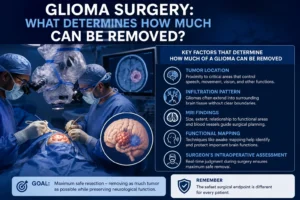
Why Would a Surgeon Deliberately Leave Some Glioma Behind?
Leaving visible tumor can sound concerning, but there are situations where it represents the safer surgical decision.
A surgeon may stop resection if further removal would risk:
- Permanent weakness
- Loss of speech
- Difficulty understanding language
- Significant visual loss
- Major sensory problems
- Damage to important deep brain pathways
- Injury to critical blood vessels
NCI describes preservation of neurological function as an important constraint on how much CNS tumor can be surgically removed.
In these situations, treatment may continue with radiation, chemotherapy, further observation, or another strategy based on the pathology.
The objective is not simply the largest possible resection. It is the largest safe resection for that individual brain and tumor.
What Is Recovery Like After Brain Metastasis Surgery?
Recovery depends on the operation, neurological condition before surgery, tumor location, age, general health and whether complications occur.
After surgery, patients are monitored for:
- Strength
- Speech
- Alertness
- Vision
- Seizures
- Balance
- Wound healing
Hospital stays after brain tumor surgery commonly range from several days to around a week, although individual recovery varies. Returning to normal activities may take several weeks, and some patients need physical, occupational or speech rehabilitation.
A patient who had substantial weakness before surgery may have a different recovery course from someone whose main symptom was headache from mass effect.
Which Symptoms After Surgery Need Urgent Medical Attention?
Follow the surgical team’s discharge instructions carefully.
Prompt medical assessment may be needed for:
- New or worsening weakness
- A seizure
- New difficulty speaking
- Loss of consciousness
- Rapidly increasing confusion
- New major vision problems
- Repeated vomiting
- A severe or progressively worsening headache
- Significant redness, swelling or discharge from the surgical wound
New neurological symptoms after brain surgery should not simply be observed at home without medical advice.
When Should You Consult a Neurosurgeon?
A neurosurgical review is particularly relevant when MRI identifies a large or symptomatic brain metastasis, when significant mass effect is present, or when tissue diagnosis may be needed.
A consultation may address:
- Whether surgery is likely to help
- Whether the lesion can be safely removed
- Whether biopsy alone may be enough
- Which neurological functions are close to the tumor
- Whether other metastases are present
- Whether stereotactic radiation is an alternative
- The condition of the cancer elsewhere in the body
- What radiation or systemic treatment is likely after surgery
Patients considering brain metastases surgery may seek evaluation from a brain tumor surgeon in Mumbai to review the actual MRI and discuss whether neurosurgical treatment has a meaningful role.
Dr. Mazda K. Turel can review neurological symptoms, imaging and the wider treatment context before discussing surgical options. Management should usually be coordinated with the patient’s medical and radiation oncology teams.
Conclusion
Brain metastases surgery has an important role, but only for carefully selected patients. Surgery becomes particularly relevant when a large or accessible metastasis is causing significant pressure or neurological symptoms, or when doctors need tissue to establish the diagnosis.
The number of metastases, condition of the cancer elsewhere in the body, available systemic treatments, age, general health and neurological function all influence whether an operation is appropriate.
Surgery is also rarely the complete treatment plan. Postoperative radiation is commonly used to control disease around the surgical cavity, while medical oncology treatment addresses the cancer as a whole.
The most useful decision comes from multidisciplinary review of the MRI, symptoms, cancer diagnosis and treatment goals rather than from tumor size alone.
Frequently Asked Questions
When is brain metastases surgery usually recommended?
Brain metastases surgery is most commonly considered for a large, accessible lesion producing significant mass effect or neurological symptoms. It may also be useful when tissue is needed to establish the diagnosis. Patients with several metastases or extensive uncontrolled cancer elsewhere may be less likely to benefit unless the remaining disease can also be managed.
Is surgery possible if there are multiple brain metastases?
Yes, in selected patients. Surgery may be considered for one dominant lesion that is large, symptomatic or causing brain compression, while smaller metastases can sometimes be treated with focused radiation. The decision depends on overall tumor burden, systemic cancer control, symptoms and whether surgery is likely to provide meaningful neurological benefit.
Is stereotactic radiosurgery better than surgery for brain metastases?
Neither is universally better. Stereotactic radiosurgery is often suitable for smaller lesions that do not require decompression or tissue diagnosis. Surgery may be preferable for larger tumors, significant mass effect, severe symptoms or diagnostic uncertainty. Tumor size, location, number of metastases and overall health help determine the most appropriate option.
Does surgery cure metastatic brain cancer?
Surgery removes a particular brain metastasis but does not eliminate cancer cells elsewhere in the body or guarantee that additional brain metastases will not develop. Treatment commonly continues with radiation and cancer-specific systemic therapy. Ongoing MRI surveillance is therefore part of care even after successful tumor removal.
Why is radiation needed after brain metastasis surgery?
Microscopic tumor cells may remain around the surgical cavity even when the visible metastasis has been removed. Postoperative radiation improves control at the treated brain site. In appropriate patients with limited metastases, focused stereotactic radiation to the cavity is commonly recommended after surgery.
How long is recovery after metastatic brain tumor surgery?
Recovery varies according to tumor location, neurological symptoms, type of surgery, age and overall health. Hospital recovery often takes several days, followed by several weeks of gradual recovery at home. Some patients require physical, occupational or speech rehabilitation depending on neurological function after surgery.
Can brain metastasis surgery improve neurological symptoms?
It may improve symptoms when those problems are caused by pressure from a surgically removable tumor. For example, removing a large lesion can relieve mass effect. However, improvement cannot be guaranteed, particularly if surrounding brain tissue has already sustained permanent damage or the symptom has another cause.