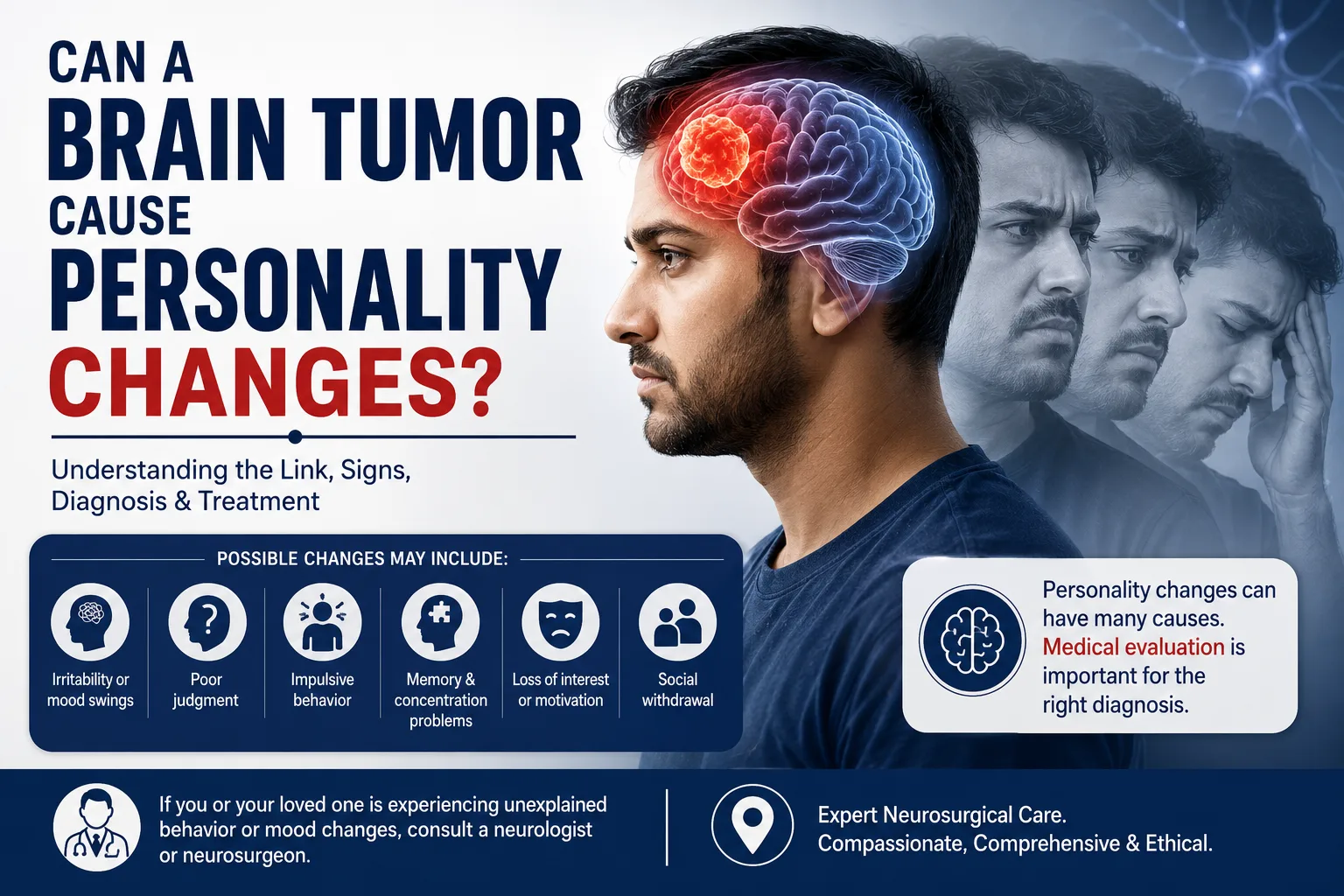
Can a Brain Tumor Cause Personality Changes?
A family member becoming unusually withdrawn, impulsive, irritable, forgetful, or emotionally different can be difficult to understand. In some cases, brain tumor personality changes can occur because a tumor affects areas involved in behaviour, judgment, emotions, memory, or decision-making. However, personality changes alone do not mean that someone has a brain tumor.
The significance of these changes depends on how they started, whether they are progressing, what other neurological symptoms are present, and what a medical examination shows. Tumor location also matters. Changes affecting the frontal lobe, for example, may influence behaviour and judgment differently from tumors affecting areas primarily involved in vision or movement.
This article explains what these changes may look like, why they happen, how doctors investigate them, and when neurological or neurosurgical assessment may be appropriate.
Can a Brain Tumor Really Change Someone's Personality?
Yes, a brain tumor can sometimes cause changes in personality, mood, behaviour, concentration, or emotional control. These symptoms may develop if the tumor or associated swelling affects brain regions involved in these functions. The exact presentation varies according to the tumor’s location, size, growth rate, and effect on nearby brain tissue.
Recognised symptoms of brain tumors can include personality or behavioural changes along with headaches, seizures, weakness, problems with speech or vision, memory changes, and difficulty with balance.
Sometimes the person experiencing the change may not recognise it themselves. A partner, relative, friend, or colleague may be the first to notice that “something seems different.”
This does not automatically point to a tumor. Similar changes can occur due to depression, anxiety, medication effects, sleep problems, dementia, stroke, hormonal or metabolic disorders, infections, substance use, and several other neurological or psychiatric conditions.
What Do Brain Tumor Personality Changes Look Like?
There is no single personality pattern associated with a brain tumor. The changes depend on which networks of the brain are affected.
Possible changes may include:
- Unusual irritability or anger
- Reduced motivation or interest in usual activities
- Becoming unusually quiet or withdrawn
- Impulsive or socially inappropriate behaviour
- Poorer judgment or decision-making
- Difficulty planning or organising everyday activities
- Emotional instability
- Reduced awareness of how behaviour affects others
- Problems concentrating
- New memory difficulties
- Confusion
- Changes in sleep or activity level
Some people may seem less emotionally responsive than before. Others may become more restless, uninhibited, anxious, or easily frustrated.
These brain tumor behavior changes should be considered alongside the rest of the clinical picture. A gradual personality change with no other symptoms requires a different evaluation from a sudden behavioural change accompanied by weakness, confusion, seizures, or speech difficulty.
Why Can a Frontal Lobe Tumor Affect Personality?
The frontal lobes are involved in several higher-level functions, including judgment, planning, decision-making, emotional regulation, personality, movement, and aspects of speech. A tumor affecting this region may therefore alter behaviour even before obvious physical symptoms develop.
A frontal lobe tumor personality change may appear as:
- Loss of initiative
- Reduced motivation
- Poor judgment
- Difficulty controlling impulses
- Changes in social behaviour
- Difficulty organising tasks
- Emotional changes
- Problems concentrating
- Reduced self-awareness
For example, a person who was previously organised and careful might begin making unusual decisions or struggle to complete familiar tasks. Someone who was socially reserved may behave in ways that seem unexpectedly uninhibited.
These examples are not diagnostic signs. Doctors need to assess whether the behavioural change represents a neurological problem and, if so, what is causing it.
Do Only Frontal Lobe Tumors Cause Behaviour Changes?
No.
Although the frontal lobes have a particularly strong relationship with personality and executive function, tumors elsewhere in the brain may also affect behaviour, mood, memory, communication, or awareness.
Symptoms vary because different areas perform different functions. Tumor-related symptoms can also develop because of swelling around a lesion, pressure on nearby tissue, seizures, or disruption of communication between different parts of the brain. Tumor location, size, and growth rate all influence the clinical presentation.
Can a Brain Tumor Cause Mood Changes?
Yes, brain tumor mood changes may occur in some patients. A person may appear more irritable, emotionally flat, anxious, tearful, restless, or less interested in activities than usual.
Mood changes can also happen for reasons unrelated to a tumor. Depression, anxiety, chronic stress, medications, sleep deprivation, hormonal conditions, neurological disorders, and major life events may produce similar symptoms.
This overlap is why doctors avoid interpreting mood or personality change in isolation.
Concern increases when a new behavioural or mood change progresses and is accompanied by symptoms such as:
- A first seizure
- Persistent or worsening headaches
- Weakness or numbness
- Speech difficulty
- Vision changes
- Problems with balance
- Repeated nausea or vomiting
- Increasing confusion
- Unusual drowsiness
- Memory or concentration problems
Brain tumors are only one possible explanation for this group of symptoms.
Personality Change Has Many Possible Neurological Causes
A noticeable personality change sometimes prompts doctors to consider whether there is an underlying neurological problem.
Possible personality change neurological causes can include conditions affecting brain structure or function, such as stroke, seizures, neurodegenerative disease, brain injury, infections of the nervous system, and brain tumors. Certain metabolic illnesses and medications can also affect cognition and behaviour.
Psychiatric and psychological causes must also be considered.
The timing often provides useful information. Doctors may ask whether the change appeared suddenly or gradually, whether it is getting worse, and whether it coincided with headache, seizure, weakness, memory problems, illness, medication changes, or other symptoms.
A medical assessment is therefore more useful than trying to identify a cause based on behaviour alone.
How Do Doctors Investigate Personality Changes?
Evaluation usually starts with a careful history. Because the patient may not notice all behavioural changes, information from a close family member can sometimes be helpful.
The doctor may ask about:
- When the changes began
- Whether they appeared suddenly or gradually
- Whether symptoms are worsening
- Memory and concentration
- Sleep and daily functioning
- Headaches
- Seizures or episodes of altered awareness
- Weakness or numbness
- Speech and vision
- Balance and coordination
- Current medicines
- Previous neurological or psychiatric conditions
A neurological examination may then assess strength, sensation, reflexes, eye movements, speech, coordination, memory, attention, and other brain functions.
When Is an MRI Needed?
If the history or examination raises concern for a structural brain problem, imaging may be recommended.
An MRI, or magnetic resonance imaging scan, creates detailed images of the brain and surrounding structures. Contrast material may sometimes be used to help doctors characterise an abnormal area.
A CT scan can also provide brain imaging and may be particularly useful when urgent assessment is required or MRI is not immediately suitable.
If a scan identifies a tumor or another lesion, further evaluation depends on its appearance, location, size, symptoms, and suspected diagnosis. In some situations, tissue obtained through biopsy or surgery is needed to determine exactly what type of tumor is present.
When Should Personality or Behaviour Changes Be Checked by a Doctor?
Treatment is directed primarily at the cause of the neurological symptoms rather than personality change as a separate diagnosis.
Depending on the tumor and individual circumstances, management may involve:
- Observation with follow-up imaging
- Medicines to control specific symptoms
- Treatment for swelling around the tumor when clinically appropriate
- Medicines for seizures when indicated
- Surgery
- Radiation therapy
- Chemotherapy or other systemic treatment
- Cognitive, psychological, occupational, speech, or physical rehabilitation
Not every brain tumor needs surgery.
The treatment plan depends on factors including the type of tumor, its size and location, whether it is growing, its relationship to important brain structures, the symptoms it is producing, the patient’s age and overall health, and findings on imaging.
Even when surgery is considered, the goal and extent of surgery have to be planned around neurological safety and the characteristics of that particular tumor.
If a Brain Tumor Is Found, How Are Personality Changes Treated?
Medical evaluation is sensible when a personality change is new, unexplained, persistent, noticeably worsening, or affecting the person’s ability to function normally.
More urgent assessment is appropriate if behavioural changes occur together with:
- A new seizure
- Sudden weakness or numbness, particularly on one side
- Sudden difficulty speaking or understanding speech
- Sudden significant vision problems
- Loss of consciousness
- Severe new confusion
- A sudden, extremely severe headache
- Rapidly worsening neurological symptoms
Some of these symptoms can occur with conditions such as stroke or seizures and require prompt medical assessment. They should not be assumed to be caused by a brain tumor.
When Should You Consult a Neurosurgeon?
A neurosurgeon is generally involved when imaging identifies a brain tumor or another structural abnormality that may require specialist assessment.
The consultation may involve reviewing:
- MRI or CT images
- Neurological examination findings
- Symptoms and how they have changed
- Tumor location and size
- Possible diagnosis
- Whether further imaging or biopsy is necessary
- Whether surgery has a useful role
- Risks of treatment and observation
- Other treatment options
Patients with a suspected or diagnosed brain lesion may benefit from evaluation by a brain tumor surgeon in Mumbai to understand what the scan shows and whether surgical or non-surgical management is appropriate.
Dr. Mazda K. Turel can review the patient’s symptoms, neurological findings, and imaging before discussing the available options. A neurosurgical consultation does not automatically mean that surgery is required.
Conclusion
Brain tumor personality changes are possible, particularly when a tumor affects regions involved in judgment, behaviour, emotion, memory, or decision-making. Yet a change in personality is not enough to diagnose a brain tumor. Psychiatric conditions, medications, sleep problems, stroke, seizures, neurodegenerative diseases, and several other medical problems can produce similar changes.
What matters is the overall pattern. A new or progressively worsening behavioural change deserves medical attention when it cannot be explained, especially if headaches, seizures, weakness, speech or vision problems, confusion, or other neurological symptoms are also present.
A clinical examination and, when appropriate, brain imaging can help identify the underlying reason. If a scan shows a brain tumor, neurosurgical review can clarify the diagnosis and whether observation, surgery, or another treatment approach is suitable.
Frequently Asked Questions
Are personality changes an early sign of a brain tumor?
They can be an early symptom in some people, particularly when a tumor affects brain regions involved in behaviour, judgment, emotions, or cognition. However, personality change is not specific to brain tumors and has many other possible causes. A new or progressive change becomes more concerning if it occurs with seizures, headaches, weakness, speech problems, vision changes, or other neurological symptoms.
What personality changes are associated with a frontal lobe brain tumor?
A frontal lobe tumor may sometimes be associated with reduced motivation, impaired judgment, impulsive behaviour, difficulty planning, poor concentration, emotional changes, or behaviour that seems unusual for the person. The pattern varies considerably. The frontal lobe contributes to personality, decision-making, movement, and other functions, so symptoms depend on the exact area affected.
Can brain tumor personality changes happen without headaches?
Yes. A brain tumor does not have to cause a headache, and symptoms depend heavily on its location and effect on the surrounding brain. Some people may initially develop seizures, cognitive problems, behavioural changes, weakness, speech difficulties, or vision changes. The absence of headache therefore cannot by itself confirm or exclude a brain tumor.
Are sudden mood swings a sign of a brain tumor?
Mood swings alone are much more commonly associated with causes other than a brain tumor. However, new and unexplained brain tumor mood changes are possible when areas involved in emotional regulation are affected. If mood changes are progressive or occur with neurological symptoms such as seizures, weakness, confusion, or speech difficulties, medical evaluation is appropriate.
Can an MRI detect the cause of personality changes?
MRI can identify many structural causes within the brain, including tumors, strokes, inflammation, and other abnormalities. It does not identify every possible cause of behavioural change. Doctors decide whether imaging is appropriate after considering the patient’s history and neurological examination. Psychiatric, metabolic, medication-related, and other causes may require different investigations.
Do personality changes improve after brain tumor treatment?
Improvement is possible in some patients, but it cannot be predicted from the symptom alone. Recovery depends on the tumor’s type and location, how long the brain has been affected, surrounding swelling, treatment received, and other individual factors. Some patients may also require cognitive, psychological, occupational, speech, or physical rehabilitation after treatment.
Can a headache alone confirm or rule out a brain tumor?
No. Personality change does not determine whether surgery is necessary. Surgery is considered after reviewing the diagnosis, imaging findings, tumor location, size, growth, symptoms, overall health, and potential risks and benefits. Some tumors can be monitored, while others may require surgery or treatment through oncology or radiation specialists.