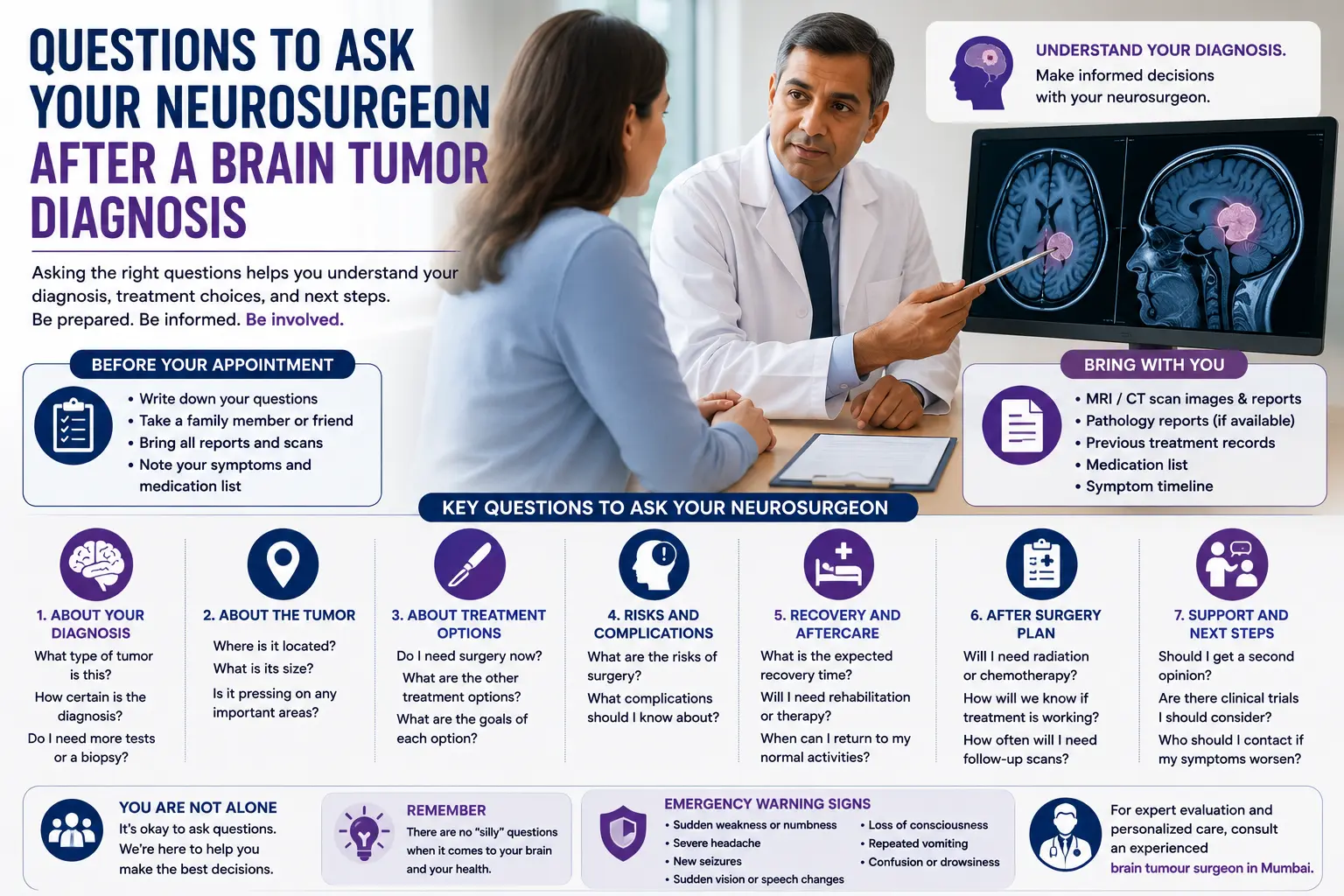
A brain tumor diagnosis often comes with more information than anyone can comfortably process in one appointment. MRI findings, tumor location, surgery, biopsy, pathology, radiation, and recovery may all be discussed at once. Preparing questions to ask after brain tumor diagnosis can make the consultation easier to follow and help you understand which decisions actually need to be made now.
You do not need to ask every possible question. Start with the issues that affect your diagnosis, neurological function, and treatment plan. The National Cancer Institute recommends preparing questions in advance and bringing a family member or trusted person when helpful, particularly because appointments can involve a large amount of new information.
The aim is not to leave the consultation knowing every medical detail. It is to leave knowing what the scan shows, what still needs confirmation, what your options are, and what happens next.
Questions to Ask After Brain Tumor Diagnosis: Start With These
The most useful questions after a brain tumor diagnosis are: What exactly is the tumor? Where is it located? Is the diagnosis confirmed or only suspected from MRI? Do I need more tests or tissue diagnosis? Is surgery necessary? What are the alternatives, risks, treatment goals, and next steps?
If consultation time is limited, prioritise these:
- What does my MRI actually show?
- What type of brain tumor do you suspect?
- Is the diagnosis confirmed, or do I need a biopsy?
- Does this tumor need treatment now?
- Is surgery an option for me?
- What neurological functions are close to the tumor?
- What are the risks of treating it versus monitoring it?
- What treatment is likely to follow surgery?
- Should I get a second opinion?
- What symptoms should make me seek urgent medical care?
Mayo Clinic similarly recommends prioritising the most important questions because consultation time can be limited.
What Reports and Records Should You Take to the Consultation?
A neurosurgeon usually gains more information from seeing the actual brain scans than from reading the radiology report alone.
If available, bring or arrange access to:
- MRI scans and radiology reports
- Previous MRI or CT scans for comparison
- Pathology report if a biopsy or surgery has already been performed
- Pathology slides or tissue information when seeking a formal second opinion
- Previous surgery records
- Radiation treatment summary
- Chemotherapy or other cancer treatment records
- Current medication list, including steroids and anti-seizure medicines
- Relevant blood-test results
- A short timeline of symptoms and when they started
- Details of any seizures, weakness, speech problems, visual changes, or memory changes
For specialist brain-tumor consultations, NCI programs specifically request relevant MRI/CT images and reports, pathology material when available, recent clinical notes, and prior surgery or treatment summaries.
If you are seeking a pathology second opinion, another centre may need the original slides or tissue block rather than only the written report.
Ask: “What Exactly Is My Diagnosis?”
Do not be afraid to ask your neurosurgeon to explain the diagnosis in plain English.
Useful questions include:
- What type of tumor do you think this is?
- Is it definitely a tumor, or are there other possibilities?
- Is it likely benign or malignant?
- What grade is suspected?
- How certain can we be from MRI?
- Do I need tissue to confirm the diagnosis?
- If tissue is available, has it been reviewed by a neuropathologist?
- Will molecular or genetic testing be performed on the tumor?
Modern brain-tumor diagnosis may use microscopic examination together with molecular testing to classify a tumor more precisely and guide treatment. NCI recommends asking about the exact type, grade, accuracy of the diagnosis, and whether molecular or genetic testing has been performed.
This matters because two tumors that appear similar on MRI may require very different treatment.
Ask the Neurosurgeon to Show You the MRI
A radiology report may contain words such as “enhancing lesion,” “edema,” “mass effect,” or “midline shift.” Ask what those findings mean in your own scan.
Consider asking:
- Where exactly is the tumor?
- How large is it?
- Is there swelling around it?
- Is it pushing on the brain?
- Is it close to an important artery or vein?
- Is it near the speech, movement, vision, or memory areas?
- Is there hydrocephalus or blockage of brain fluid?
- Has it changed compared with previous imaging?
- Does the MRI suggest that it can be removed safely?
Tumor type, size, grade, location, general health, and patient preferences all influence brain-tumor treatment decisions.
Understanding location is particularly useful because the safest treatment for a small tumor beside the optic nerves or brainstem may be very different from treatment for a similarly sized surface tumor.
Questions for a Brain Tumor Surgeon About Surgery
Not every brain tumor requires surgery.
If surgery is being discussed, good questions for a brain tumor surgeon include:
- Why are you recommending surgery?
- What is the main goal of the operation?
- Is the goal complete removal, partial removal, decompression, or biopsy?
- How much tumor do you realistically expect to remove?
- Why might some tumor need to be left behind?
- What important brain structures are nearby?
- Will you use neuronavigation, functional mapping, awake surgery, or another technique?
- Could biopsy alone be a reasonable alternative?
- What happens if I choose not to have surgery now?
The answer may be different depending on whether the tumor is a meningioma, glioma, pituitary tumor, vestibular schwannoma, metastasis, or another lesion.
For some tumors, observation may be reasonable. For others, surgery provides tissue diagnosis, relieves pressure, or forms an important part of treatment. Mayo Clinic lists surgery, radiation, radiosurgery, chemotherapy, targeted therapy, and observation among options used according to tumor characteristics and individual circumstances.
Ask About Risks in Terms of Your Daily Function
A generic list of surgical complications is less useful than understanding which risks apply to your tumor’s location.
Ask:
- Could surgery affect my speech?
- Could it affect my arm or leg strength?
- Is vision at risk?
- Could hearing or facial movement be affected?
- What is the risk of seizures?
- Could memory or concentration change?
- What complications are temporary, and which could be permanent?
- What rehabilitation might I need afterwards?
If a tumor lies close to language or motor areas, the risk discussion should address those specific functions.
Also ask what the surgeon considers an acceptable balance between removing more tumor and protecting neurological function.
For many brain tumors, “maximum safe removal” is more medically meaningful than trying to remove tumor at any cost.
Ask What Will Happen Immediately After Surgery
Surgery may be the entire treatment for some tumors, but for others it is only the first stage.
Ask:
- Will I need radiation after surgery?
- Will I need chemotherapy or another drug?
- Does that decision depend on the pathology?
- Which molecular test results could change my treatment?
- If some tumor remains, what happens next?
- How will we know whether treatment is working?
- How often will I need MRI scans?
- Are clinical trials relevant to my diagnosis?
NCI recommends asking about treatment choices, their benefits and risks, how treatment response will be measured, possible clinical trials, side effects, and the follow-up imaging schedule.
If the tumor has not yet been biopsied, your doctor may not be able to answer every postoperative treatment question before pathology is available.
That uncertainty is normal.
Ask About the Neurosurgeon's Experience With Your Tumor
Brain tumors are not one disease. Some are relatively common, while others require highly specialised techniques.
Questions worth asking include:
- How often do you treat brain tumors?
- Do you regularly operate on my tumor type?
- Do you operate on tumors in this particular location?
- Is this operation performed by a multidisciplinary team?
- Will another specialist be involved?
- Does my case need discussion in a brain-tumor multidisciplinary meeting?
NCI specifically suggests asking a neurosurgeon how much experience they have with brain or spine tumors and with the patient’s particular diagnosis.
The purpose is not to search for an impressive number. It is to understand whether the surgeon and treatment centre routinely manage the problem you have.
Should You Get a Second Opinion?
A second opinion is reasonable when the diagnosis or treatment decision is significant, particularly before complex brain surgery.
Consider one if:
- The diagnosis is uncertain
- The tumor is rare
- Major surgery has been recommended
- Different treatment approaches may be possible
- The tumor is close to critical brain structures
- You want another pathology review
- You are uncomfortable making the decision with the information you currently have
NCI notes that second opinions are common and may confirm the first plan, suggest another approach, or provide additional information. The second specialist generally reviews the relevant medical records, scans, and pathology material.
NCI’s brain-tumor experts also encourage second opinions when the diagnosis is first made or when a tumor recurs and additional treatment choices are being considered.
Getting another opinion does not automatically mean that the first recommendation is wrong.
Practical Questions Patients Often Forget
The medically complex questions may dominate the appointment, but day-to-day issues matter too.
Before leaving, consider asking:
- Who should I contact if symptoms worsen?
- Is there a number to call outside normal clinic hours?
- Which symptoms require emergency care?
- Are there medicines I should avoid?
- Can I continue working?
- Is flying or travel safe?
- Are there restrictions because I have had a seizure?
- Should someone stay with me at home?
- When is my next appointment?
- Do I need another MRI before that visit?
Write down the answers or ask permission for a family member to take notes.
A short written treatment summary can also be useful when several specialists are involved.
When Should You Consult a Neurosurgeon?
A neurosurgical consultation is relevant after imaging identifies a brain tumor or lesion that might require biopsy, surgery, monitoring, or specialist interpretation.
The consultation should ideally answer three broad questions:
- What is the lesion most likely to be?
- Does it need surgical treatment?
- What are the consequences of treating it now versus taking another approach?
Patients seeking specialist assessment may consult a brain tumor surgeon in Mumbai to review the actual imaging, neurological examination, and available reports.
Dr. Mazda K. Turel can assess these findings before discussing whether observation, additional testing, biopsy, surgery, or another treatment pathway may be appropriate.
A consultation does not automatically commit a patient to surgery.
Conclusion
Preparing questions to ask after brain tumor diagnosis can turn a difficult consultation into a more focused discussion. You do not need to understand every technical detail. Start by establishing what the tumor is likely to be, where it is located, whether tissue diagnosis is needed, what treatment choices exist, and which neurological functions could be affected.
Take your MRI images, reports, pathology information, treatment records, medication list, and a short symptom history when possible.
If surgery is recommended, ask about the goal of the procedure rather than only whether the tumor can be removed. Understanding risks, alternatives, recovery, pathology testing, postoperative treatment, and follow-up can help you make a more informed decision.
And when the diagnosis or treatment choice remains uncertain, seeking a second specialist opinion is a reasonable part of planning brain-tumor care.
Frequently Asked Questions
What are the most important questions to ask after brain tumor diagnosis?
The most useful questions to ask after brain tumor diagnosis are: What type of tumor is suspected? Where is it located? Is the diagnosis confirmed? Do I need biopsy or surgery? What are my treatment choices? Which brain functions are at risk? What happens if I wait? What treatment may follow surgery? NCI encourages patients to prepare diagnosis and treatment questions before appointments.
Should I bring the actual MRI or only the written report?
Bring or provide access to the actual MRI images whenever possible, together with the report. Neurosurgical decisions can depend on the tumor’s precise relationship with brain structures, nerves, and blood vessels. Specialist NCI brain-tumor consultations request both scans and their corresponding radiology reports.
What should I ask if brain tumor surgery is recommended?
Ask why surgery is recommended, its goal, how much tumor may be removable, which neurological functions are nearby, the main risks, whether biopsy or observation is an alternative, expected hospital stay and recovery, and what treatment may be required afterwards. The answer should be specific to your scan rather than only a general explanation of brain surgery.
What are good brain tumor second opinion questions?
Useful brain tumor second opinion questions include: Do you agree with the diagnosis? Has the pathology been reviewed? Do you agree that surgery is necessary? Would you use the same surgical approach? Are there reasonable alternatives? Would additional molecular testing change treatment? NCI notes that second opinions can confirm or change a diagnosis or treatment recommendation.
Should someone come with me to my neurosurgery consultation?
It can help. A trusted family member or friend can listen, take notes, remember details, and help you ask questions that are easy to forget during a stressful appointment. NCI specifically recommends considering bringing a loved one and a prepared list of questions to brain-tumor appointments.
Do I need to ask about molecular testing?
If tissue diagnosis is available or planned, it is reasonable to ask whether molecular, genetic, or other specialised testing is relevant to your particular tumor. Modern brain-tumor classification can rely on molecular findings in addition to microscopic appearance, and these results may influence diagnosis and treatment decisions.
How do I know if I need a second opinion before surgery?
A second opinion can be especially useful for a rare diagnosis, uncertain pathology, tumor near critical brain structures, or major operation with several reasonable treatment approaches. It is also reasonable simply because you want greater confidence before deciding. NCI describes second opinions as common and notes that they can provide more information or alternative options.